Red Fish Healing Centre drives up policing costs in Coquitlam: RCMP report

Coquitlam’s facility for addiction and mental illness is a valuable community partner. However, Red Fish Healing Centre is also responsible for a spike in policing costs, according to Coquitlam RCMP.
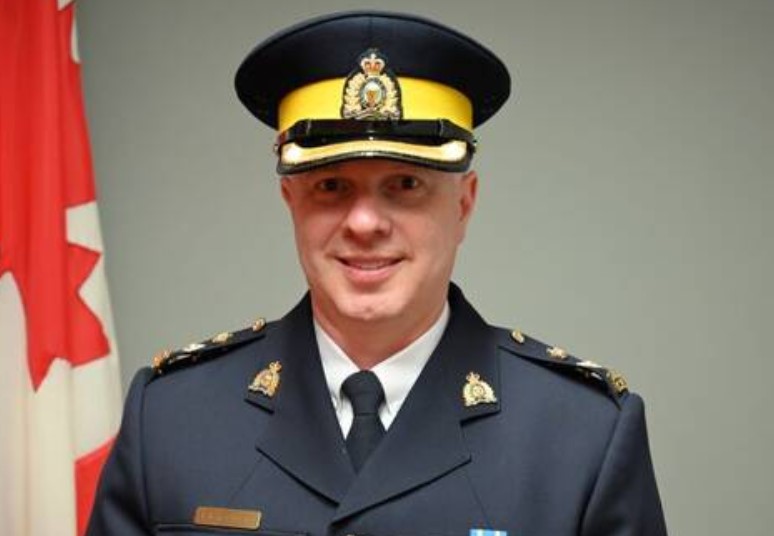
Police opened 301 files at Red Fish between January and September. The majority of those files – 69 percent – are missing persons cases, according to Coquitlam RCMP Supt. Keith Bramhill, who discussed the issue with Coquitlam council on Monday.
“I am very thankful that we have a 105-bed facility . . . that wants to help the most vulnerable people in our community. In many ways I wish we had more, just not all in the same city because it has had a real impact on police labour and resources,” Bramhill said.
Local news that matters to you
No one covers the Tri-Cities like we do. But we need your help to keep our community journalism sustainable.
A representative from the Ministry of Mental Health and Addictions – who declined to be identified – emphasized that patients at Red Fish aren’t there become of criminal behaviour.
The centre reaches out to police to track down patients who don’t return on time after leaving Red Fish on a physician ordered pass. Those efforts are important for the safety of patients, many of whom are being treated for both mental health and addiction issues.
The vast majority of Red Fish patients experienced improved mental health between admission and discharge, according to the ministry representative.
Missing persons files have cost Coquitlam RCMP about $500,000 in labour for 2023, according to the RCMP’s crime report. The detachment has a $30.6-million contract with the city.
Throwing more labour at the issue likely won’t solve the problem, Bramhill said.
“We’re really not getting to the root problem of why those vulnerable people are going missing,” he said.
Missing persons cases can take between 24 and 40 hours – time spent doing several tasks including visiting family and friends as well as collecting DNA, Bramhill said.
“Many of the people are vulnerable people that we find and then bring back and go missing again,” Bramhill said.
The issue is a concern, noted Coun. Craig Hodge.
Red Fish works well, “but it’s driving up our policing costs,” Hodge said.
The centre is working with the province to make some security/logistical changes, Bramhill told council, adding he’s “relatively optimistic” those changes will help.
Bramhill emphasized that staff at Red Fish care and are doing their best.
More mental health calls
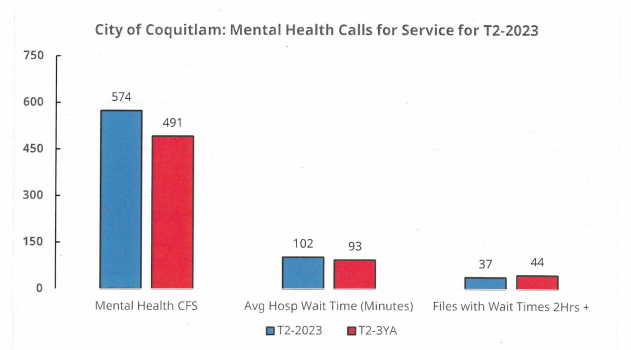
The RCMP fielded 574 mental health calls in the last trimester, 83 calls more than the three-year average.
The situation is exacerbated by lack of space and staff at hospitals.
Police officers, on average, spend one hour and 42 minutes waiting to get a patient admitted to hospital. That wait-time represents an increase from the three-year average of 93 minutes.
The hospital system is generally over-burdened and unable to get the waiting police officer back to work in a timely manner, Bramhill told council.
“Being in the hospital, you kind of get lost in the system.”
However, the situation could be improved as Coquitlam RCMP prepares for the “soft launch” of a mobile mental health team this fall.
Consisting of one police officer and a psychiatric nurse who can provide on-site mental health assessments, the Mobile Integrated Crisis Response team should help vulnerable people in the community, Bramhill told council.
“I think it’s going to help triage and minimize some of the labour efforts and actually give us back some of those hours for the police hours,” he said.
Two psychiatric nurses have been hired and are in the process of being security-cleared before getting on the road. The nurses will work for Fraser Health but will have “some accountability” to police, Bramhill said.
Coquitlam is set to receive $250,000 from the province in annual funding for the program, which is slated to roll out in nine B.C. communities.
“It’s not the perfect solution but it is a good sight better than what we’ve been dealing with,” Mayor Richard Stewart said Monday.
Author