Port Moody adopts new amenity charge bylaw as council wrestles with impact on housing projects, amenities

Port Moody council has unanimously approved a new amenity cost charges (ACC) bylaw that will fundamentally change how the city collects money from new developments to pay for community facilities.
The new provincial system comes at a difficult time for an already struggling development market.
Mayor Meghan Lahti acknowledged council nevertheless had little choice but to move forward with approval, or else potentially lose out on crucial revenues for amenities.
Local news that matters to you
No one covers the Tri-Cities like we do. But we need your help to keep our community journalism sustainable.
“If we are not approving development, and if we are not moving forward with the density that is being talked about in transit oriented areas, then that places more of a burden on the taxpayer,” Lahti said. “We have to bring in the bylaw.”
Council gave all three readings to the bylaw on July 14, replacing the city’s long-standing community amenity contribution (CAC) system with the provincially mandated ACC framework. The legislation also updates the city’s development cost charges (DCC) reduction bylaw to extend eligible exemptions to the new charges.
The new bylaw is designed to help fund growth-related amenities over the next 25 years, including community centres, aquatic facilities, libraries, parks, childcare facilities and public spaces.
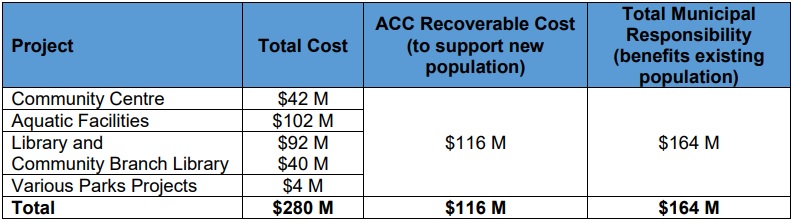
Staff identified roughly $280 million in eligible capital projects, but only $116 million can legally be recovered through ACCs, leaving the remaining $164 million to be funded through taxes, grants, borrowing or other sources.
The discussion highlighted the difficult balancing act facing municipalities across B.C., which are adapting to sweeping provincial housing reforms that standardized development financing while eliminating many of the negotiated contributions cities previously relied upon.
Already challenging market

The new ACC rates are higher than the current CAC rate in every land use category.
Coun. Kyla Knowles questioned whether increasing development charges during a weak market could further discourage projects.
She pointed to the city’s own financial feasibility analysis, which found none of the sample development scenarios achieved the roughly 15 percent profit margin lenders typically expect before financing projects.
“So what we’re proposing here is to make it a little bit worse for anything to be able to be brought forward, or for anyone to get financing,” Knowles said. “It’s just kind of mind blowing.”
The staff report similarly found that while all four development scenarios analyzed were already below typical profitability targets under current market conditions, the proposed ACC rates would reduce profit margins by only another 0.2-1 percent.
Coun. Diana Dilworth said focusing solely on ACCs overlooked the dozens of other fees developers face from all levels of government.
She also argued the new system provides greater certainty than the former negotiated CAC process.
“Nobody is making a 15 percent profit these days,” Dilworth said, adding she has seen recent development pro formas where builders were simply breaking even to finish projects already underway. “They just want to finish it and get out of town and get it done and over with.”
Existing projects protected
One of the biggest questions before council involved how the city would treat major multi-phase developments that have already signed master development agreements and committed to paying CACs over many years.
Council sought clarification on whether those projects would suddenly face higher ACC bills.
Staff said they deliberately designed a credit system to avoid changing “the rules of the game” for developments that already have legally binding agreements in place.
Projects with signed master development agreements, phased construction and existing CAC commitments will receive a 100 percent credit against the new ACCs, effectively allowing them to continue under the existing agreements.
However, if those projects later seek additional density through a rezoning amendment, the extra density would become subject to the new ACC rates rather than the previous CAC system.
Essentially, existing commitments will be honoured, but any future density increases would trigger the new charges.
Staff said that approach is consistent with other Lower Mainland municipalities, provincial guidance and legal advice.
Why the bylaw matters
Staff warned the consequences of delaying the bylaw would extend beyond administrative compliance. They told council the province has largely eliminated the former CAC system while significantly restricting density bonus contributions in transit-oriented areas, leaving ACCs as one of the city’s primary tools for recovering growth-related infrastructure costs.
Without an ACC bylaw, Port Moody would potentially lose revenue needed to build future amenities, staff said.
The provincial legislation also replaces the former negotiated CAC approach with a standardized system similar to DCCs allowing municipalities to collect fixed fees for eligible infrastructure such as recreation facilities, libraries, childcare facilities and public squares.
Taxpayer burden remains
Coun. Haven Lurbiecki said much of the discussion had focused on developer profitability, but she believed the larger issue was ensuring existing taxpayers are not left paying for growth.
She questioned why only $116 million of the city’s $280-million capital program could be recovered through ACCs.
Staff explained provincial rules only allow municipalities to charge for the portion of facilities needed to accommodate future population growth.
Using a community centre as an example, staff said replacing an existing building cannot be charged to a new development because it serves current residents. Only the additional floor area needed to accommodate future growth qualifies for ACC funding, with each project undergoing its own benefit allocation analysis.
Lurbiecki noted taxpayers will still ultimately be responsible for $164 million in growth-related facilities that cannot legally be recovered through ACCs.
“I think ACCs can be a really good thing,” she said, while adding council will eventually need to review all of its growth policies together to ensure the city is not “leaving anything on the table.”
Coun. Callan Morrison said the discussion illustrated why accommodating growth remains financially important.
If no new housing is built, he said, existing taxpayers would shoulder the full cost of major community facilities such as pools, recreation centres and libraries.
Growth allows those costs to be shared with new residents over time through development charges while also helping fund affordable housing and other amenities, Morrison said, although he acknowledged future growth projections may need to be revisited if market conditions remain weak.
“We’re going to be having a discussion about the trajectory of development and growth and the market that is going on right now, and where we see ourselves going in the very, very near future, and that some of this might get adjusted,” he said. “There’s a balancing act that has to happen.”
Staff also confirmed developments already in the approval process will receive a 12-month in-stream protection period before the new charges apply, consistent with the province’s longstanding DCC framework.
Author