Port Coquitlam waterfront owners win Pitt River access rights in long-running legal battle between family
A long-running family dispute has ended after a B.C. Supreme Court judge found that the owners of a Port Coquitlam waterfront home have access rights to the Pitt River foreshore.
In a decision released on Dec. 16, Justice Christopher Giaschi ruled the property on Argue Street: “has always been and continues to be a riparian property,” despite decades of shoreline alterations connected to the operations of Harken Towing Co. Ltd.
He also found the towing company unlawfully interfered with those rights by blocking access to the riverfront.
Local news that matters to you
No one covers the Tri-Cities like we do. But we need your help to keep our community journalism sustainable.
“I am of the view that the building of the retaining wall and the infilling . . . did not alter the riparian nature of the property and did not extinguish the riparian rights,” Giaschi said. “The erection of the barricade and the posting of the no trespassing signs have prevented the plaintiffs from accessing both the foreshore . . . and the water.”
The case pitted Jennifer and Shane Mackenzie, the married homeowners, against Harken Towing Co. Ltd., related company Harken Lands Ltd., Tidal Towing Ltd., and Shane’s great-uncle Gordon Mackenzie.
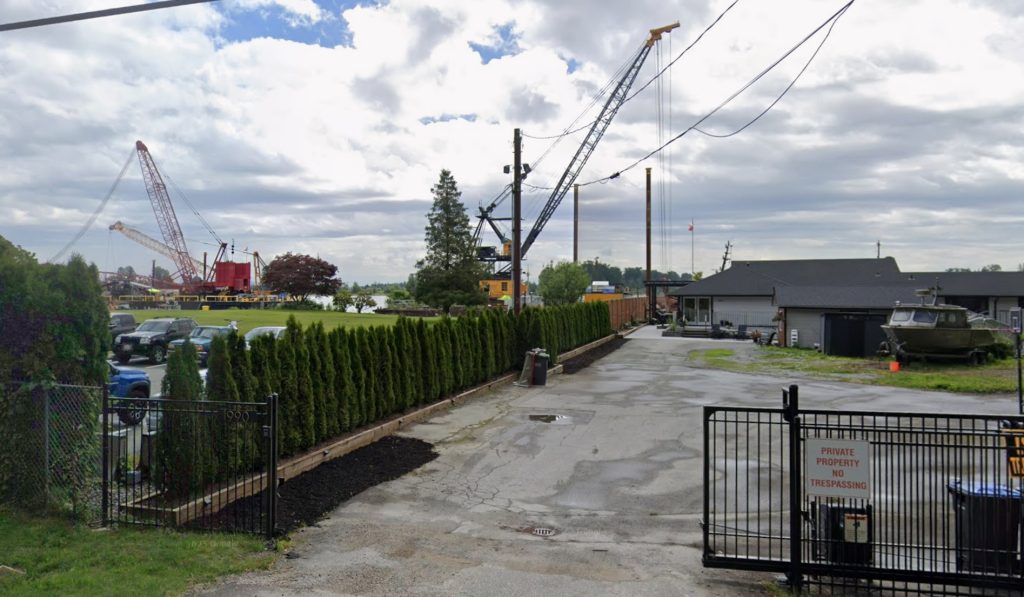
The court heard that the Mackenzie family has owned the property since 1949. Harken Towing – a company founded by Shane’s great-grandfather – has operated for decades from a leased foreshore strip and water lot directly in front of the residence, including what the court described as a marina-like operation with docks and a floating office.
The relationship between the property homeowners and the towing company was “without complaint or incident,” until the couple purchased the property in 2016.
Within weeks of taking title, the plaintiffs warned that Harken’s operations interfered with their riparian rights and proposed a lease and annual payment for riparian consent – demands that Harken refused.
The dispute escalated in the years that followed, including trespass-related issues that were later resolved when the company removed structures encroaching on the homeowners’ land. The riparian access issue, however, has remained unresolved.
The barricade
Tensions rose further when Harken erected a thigh-high barricade along the boundary between the homeowners’ property and the foreshore lease area, ran buried electrical cables under it, and posted No Trespassing signs.
The couple testified the barrier effectively cut them off from the foreshore and the river, forcing them to climb over the barricade to access areas they had previously used as an extension of their yard.
Gordon acknowledged the barricade deterred access, but said it was installed for safety reasons.
Justice Giaschi rejected that explanation, finding as fact that Harken installed the barricade and signs to prevent the homeowners from having access.
Riparian rights survive
A central question was whether the property still qualified as riparian – meaning it adjoins a body of water – given that Harken had constructed retaining walls and, through dredging and backfilling over decades, created what is now a strip of dry land between the homeowners’ lot and the water.
Harken argued the infilled foreshore effectively “sundered” the home from the river, extinguishing riparian rights.
The judge disagreed, ruling that human-made infilling and shoreline engineering cannot be used to erase riparian status or rights that attach to the upland parcel. He also pointed to Harken’s own lease with the Vancouver Fraser Port Authority (VFPA) – which administers the federal foreshore — noting it contains clauses explicitly prohibiting interference with third-party riparian rights..
Giaschi said those provisions would be unnecessary if the home were not riparian.
The court declared that the homeowners’ riparian rights include the right to access the foreshore, to use ramps to reach the water lot, and to use docks but only as a way to access the water. The judge, however, said those rights do not include rights to moor vessels long-term at those docks.
Barricade to remain
Although Giaschi found the barricade and signage unlawfully interfered with riparian rights, the court refused to order the barricade removed.
The reason: the foreshore is owned by the Crown and administered by VFPA, and neither was a party to the case. The judge found VFPA has a “reversionary interest” under the lease and contractual control over alterations to structures on the leased premises.
It would therefore be inappropriate to order its removal without VFPA before the court.
The decision leaves the plaintiffs free to launch a further proceeding that includes VFPA, though Giaschi suggested that shouldn’t be necessary given his interference finding.
Other claims dismissed
Claims against Tidal Towing Ltd.. and against Gordon Mackenzie personally, were dismissed due to a lack of evidence tying them directly to the interference, and Harken’s counterclaim seeking declarations over its access to the marina was dismissed as moot.
The parties were granted leave to return to court to address the issue of costs.
Author