Vehicle traffic rises by double digits on Port Coquitlam’s major roadways
North-south increases a result of Burke Mountain development, Mayor Brad West says
Port Coquitlam is experiencing a sizable increase in vehicle traffic.
Many segments on the city’s north-south routes — Broadway Street, Coast Meridian Road, and the Fremont Connector — have seen double digit increases in vehicle traffic since 2016, according to figures from a 2022 vehicle count that was presented to council on Dec. 12.
Traffic on the Fremont Connector, specifically between Seaborne Avenue and Nicola Avenue, has risen by 56 per cent since the last count in 2018.
Local news that matters to you
No one covers the Tri-Cities like we do. But we need your help to keep our community journalism sustainable.
Similarly, the number of cars using Broadway from Industrial Avenue to the Mary Hill Bypass jumped by 55 per cent from 2018 to 2022. And on Coast Meridian an average of 17,868 vehicles were clocked between Victoria Ave. and Greenmount Ave. per day — an increase of 34 per cent since 2016.
The increase in volume can largely be attributed to development on Burke Mountain, a Coquitlam neighbourhood that will eventually house more than 50,000 people, said Mayor Brad West at the Dec. 12 committee of council meeting.
“There is no doubt that the development of Burke Mountain continues to have a very significant impact on the community,” West stated.
He added that the rise in traffic also shows the importance of fully developing the Fremont Connector, a project that has been on the city’s radar for years.
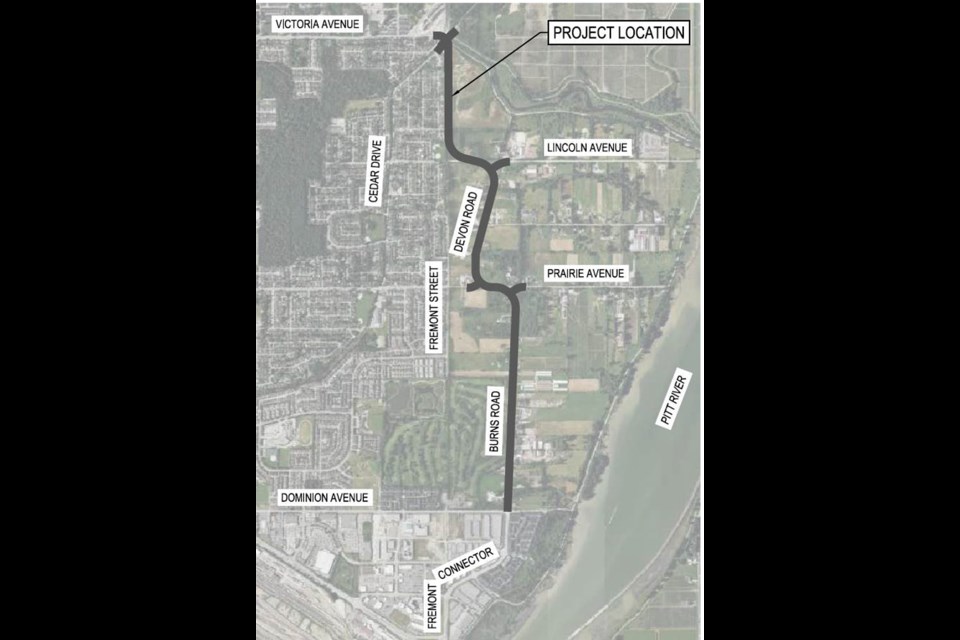
In 2021, Coquitlam and Port Coquitlam reached an agreement to build a new 4.7 km arterial road that will provide residents with another north-south option to get from Burke Mountain to the Mary Hill Bypass.
The connector, which will provide two lanes of traffic, is expected to start at the east end of Victoria Dr.
From there, the route will follow the existing Fremont St. to Lincoln Ave. It is then slated to snake through a series of roads — Devon Rd., Prairie Ave., and Burns Rd. — before connecting with the Mary Hill Bypass.
“I know our city is working diligently with the City of Coquitlam to make that a reality,” West stated.
Traffic data was not collected in 2023 due to a lack of available contractors.
Putting the pedal to the metal
David Walker, a civil engineering project manager with the city, said the 2022 traffic count revealed a few spots where motorists were excessively speeding.
Specifically, along Broadway St., the posted speed limit is 50 km/h. But the 85th percentile — the speed at which 85 percent of drivers will go in favourable conditions — was measured at 81 km/h between Kingsway Ave. and Langan Ave. and 80 km/h from Industrial Ave. to Mary Hill Bypass.
It’s an issue that has gotten worse since digital speed boards were installed between Industrial Ave. and Mary Hill Bypass in 2020, the report to council stated.

The findings might lead to more police stops in the region.
Additional RCMP enforcement may be coming to Broadway St., Walker said, and the Fremont Connector and Shaughnessy St., where drivers were also often monitored at speeds above the limit.
“Areas requiring speed enforcement will be communicated to the community policing department and RCMP,” Walker stated.
Bike lane watch
Infrastructure improvements were also presented to council last month.
Protected cycling lanes on Broadway St., Shaughnessy St., and the Fremont Connector have been identified as potential projects in Port Coquitlam’s draft master transportation plan, which has not been vetted or ratified by council, Walker stated.
Coun. Dean Washington opposed plans to add bike lanes on any of the major vehicle routes, saying there are alternate ways — such as the Traboulay Trail — for cyclists to get around the city.
“For the life of me, I just can’t see putting a bike lane down Shaughnessy St.,” he stated.

Coun. Nancy McCurrach, who called herself an avid cyclist, said there is a need for more bike connections throughout the city and will wait on the project designs before making a final decision.
There is a growing need to foster more road cycling routes in the city, added Coun. Darrell Penner. While he hasn’t seen a lot of bike traffic along the Fremont Connector, he has noticed a high volume of cyclists travelling along the gravel section of the PoCo Trail beside the Pitt River.
“I’ll call them the Speedo guys, they’ll be six or eight of them just ripping down the trail like it’s a road, blasting by people,” Penner stated.
“We gotta try to steer people that have road bikes to stick on the roads and not on the trails themselves.”
As the project continues, concrete cycling data will be collected to show how many people are using bikes on major roads in the city, Walker said.
The master transportation plan is expected to be finalized in the first quarter of 2024.
Author