Trees cleared from Oxford Heights lot; city ‘has no choice’
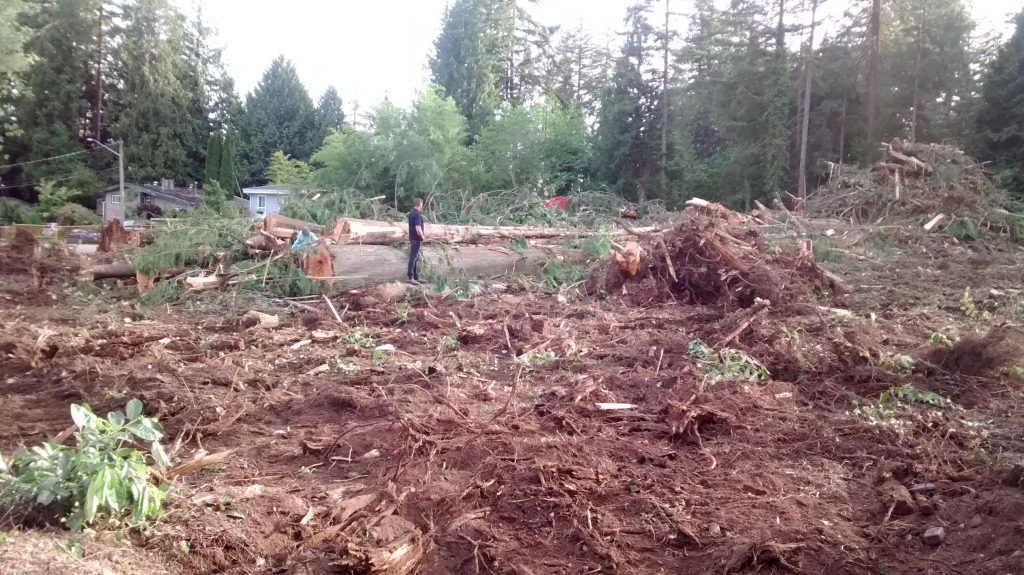
Port Coquitlam is owed 168 replacement trees after a developer cleared a lot on Windermere Avenue in May.
The developer applied to subdivide the property into seven lots, stated Port Coquitlam’s director of development services Bruce Irvine.
“Under the new provincial regulation, the city has no choice but to approve this development as it fits in the parameters in the legislation,” Irvine added.
Local news that matters to you
No one covers the Tri-Cities like we do. But we need your help to keep our community journalism sustainable.
Port Coquitlam required more than $111,800 in securities to, “make sure tree replacement occurs,” Irvine stated.
Provincial legislation around small-scale housing generally allows for between three and six units to be built single-family lots, depending on proximity to transit.
There can be a balance between saving trees and hitting housing targets, according to a response from the Ministry of Housing and Municipal Affairs.
The province’s manual on small-scale, multi-unit housing recommends reducing or eliminating parking requirements, allowing for more impermeable surfaces and greater tree retention, according to the ministry.
Tree protection bylaws are consistent with provincial housing legislation as long as the bylaw isn’t used to reduce density permitted density, according to the ministry.
Port Moody previously lobbied for the province to integrate tree canopy protection into housing legislation, with Coun. Amy Lubik emphasizing the importance of tree retention.
“It’s not just nice to have, we know that the neighborhoods during the heat dome that had greenery and tree canopy were the ones that were less likely to lose people,” Lubik said.
There is nothing in the provincial legislation that stops municipalities from selecting reasonable development permit areas to protect environmentally sensitive areas, according to a 2024 letter from Port Moody MLA Rick Glumac.
“Provincial density allowances that are intended to unlock more housing opportunities do not supersede or override city bylaws,” Glumac wrote.
Given the size of the parcel at 1863 Windermere Ave., each of the seven new lots could have a primary home and a secondary unit, Irvine stated
The developer requested the tree-cutting permit in 2024. Following the completion of multiple arborist reports over two nesting seasons, the city granted the tree-cutting permit earlier this month, Irvine explained.
The city did not provide the arborist reports to the Dispatch.
The subdivision is under review. The city’s review of the subdivision is focused on size constraints and servicing requirements, which could result in the developer paying more for upgrades.
Port Coquitlam’s tree replacement bylaw generally requires a one-to-one replacement for trees with a diameter less than of 60 centimetres. For trees with a diameter larger than 60 centimetres, the replacement ratio rises to two-to-one.
Port Moody’s recently amended tree replacement bylaw requires a maximum replacement ratio of four-to-one, depending on the canopy size the trees reach at maturity.
Coquitlam’s tree replacement bylaw is based on lot size as well as how many trees remain on a property after removal. In a case where there are zero trees remaining on an approximately 12,000-square-foot lot, the owner might be required to plant eight replacement trees.
If the owner was left with at least three trees on an 8,600-square-foot lot, they may not be required to replant any replacement trees.
Author