Centennial Secondary grads call on Coquitlam to join Sue Big Oil campaign
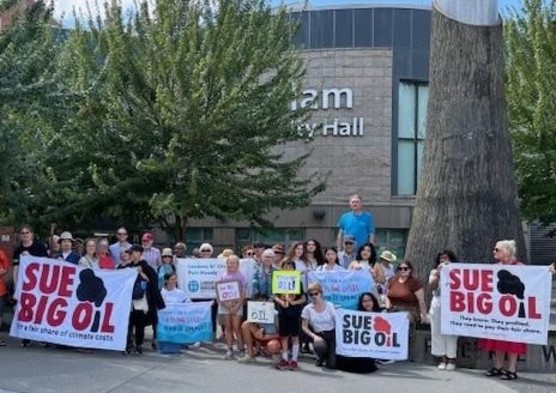
Think globally. Act legally.
That was the message Monday as a pair of recent Centennial Secondary grads called for Coquitlam to join the growing, but not yet led, class action lawsuit against major oil and gas companies.
“During yet another summer with record-breaking temperatures, instead of being outside with my friends enjoying the lakes and the parks of B.C. I am indoors, standing in front of you, explaining why I think that I am deserving of a good future,” Natalia Narvaez Jurado told city council on Monday.
Local news that matters to you
No one covers the Tri-Cities like we do. But we need your help to keep our community journalism sustainable.
As world leaders fail to implement meaningful policy on climate, cities like Coquitlam will end up paying for that failure, Jurado advised.
“We need you to take climate action now,” she said. “We are asking you to begin a discussion and a vote toward joining the Sue Big Oil lawsuit.”
Municipalities including Nelson, Pemberton, Burnaby, Gibsons, View Royal, Squamish, Qualicum Beach and Slocan have signed on to the lawsuit, which could target companies like Chevron, Exxon Mobil, Saudi Aramco, British Petroleum and Shell, according to the non-profit West Coast Environmental Law.
“This lawsuit has the power to take the burden off of my generation’s shoulders,” Jurado said.
Fellow Centennial Secondary grad Elizabeth Romero Orellana lauded council for its record on environmental issues.
“But we also recognize that it is simply not enough.”
Amid wildfires, droughts, and mudslides, Orellana told council she’d rather worry about college midterms than the fact that each passing second is time that could’ve been used taking meaningful action on climate change.
Council should be: “the change that we need to preserve our beautiful city of Coquitlam,” she said.
Mayor Richard Stewart thanked the youths for attending the meeting while explaining that council can’t make legal decisions in an open meeting.
The city is crafting a climate action plan set to be released late 2025 or early 2026, noted
You can tell a city’s priorities by looking at its budget, Coun. Trish Mandewo told the youths.
“We do have a strategy,” Mandewo said.
City staff noted various environmental initiatives, including more EVs in the city’s fleet and a substantial drop in greenhouse gas emissions from the new Mundy Park Pool. The city did not provide a timeline for deciding whether or not to join the lawsuit.
For volunteer Mary Phelps, the response seemed underwhelming.
“The entire audience was very disappointed when there wasn’t one question from the council,” she said, emphasizing that the costs of climate change will touch everything from insurance to engineering.
Among the Sue Big Oil campaign members, there was some trepidation the students were being: “patted on the head for being good citizens and sent on their way,” Phelps said.
A member of the Laudato Si’ Circle environmental initiative out of St. Joseph’s Parish in Port Moody, Phelps was part of the movement to bring Sue Big Oil to Port Moody in 2024.
While campaign volunteers initially struggled to be heard in council chambers, Port Moody Mayor Meghan Lahti ultimately announced the city would join the lawsuit and: “recover our fair share of climate costs.”
Moving the case forward will require one city to take on the responsibility of serving as class action plaintiff and hiring the legal team.
While 11 local governments are backing the lawsuit, there is not yet a lead plaintiff, confirmed West Coast Environmental Law staff lawyer Andrew Gage.
“BC communities need to work together to ensure that a lead plaintiff is supported in the case, but the costs of the proposed class action are minor by comparison to the potential benefits,” Gage explained in an email to the Dispatch.
In the event another municipality takes that lead role, Port Moody pledged approximately $38,000 – $1 per resident – to help cover legal costs. The cash would be drawn from a litigation reserve fund and would not impact tax rates, Lahti stated.
Fiona Koza, a strategist with West Coast Environmental Law, noted the risk of failing to pursue litigation.
“Not suing major polluters for a fair share of climate costs means putting communities, like Coquitlam, at risk of skyrocketing climate change costs in the years to come, with few ways to recoup those costs,” Koza wrote in an email to the Dispatch.
In 2019, a group of 28 law professors from across Canada called on municipal, provincial and federal governments to take: “legal and other action to recover a share of local climate costs from global fossil fuel companies.”
The letter likened the “polluter pays principle” to lawsuits involving sellers and manufacturers of tobacco, opioids, and asbestos.
The case is difficult to predict as legal principles will need to be applied in a new context, the letter stated.
“A lawsuit against major fossil fuel corporations for climate-related costs will clearly be novel, in the sense that courts will need to answer difficult questions that they have not previously considered.”
However, the case is still worth pursuing, the letter stated.
“Such a case would be novel in the same way that the first court cases demanding recognition of Indigenous rights or gay marriage, or claiming compensation against tobacco or asbestos companies, were novel.”
Author