Pricey 12-storey seniors housing development near Kyle Centre advanced by Port Moody council
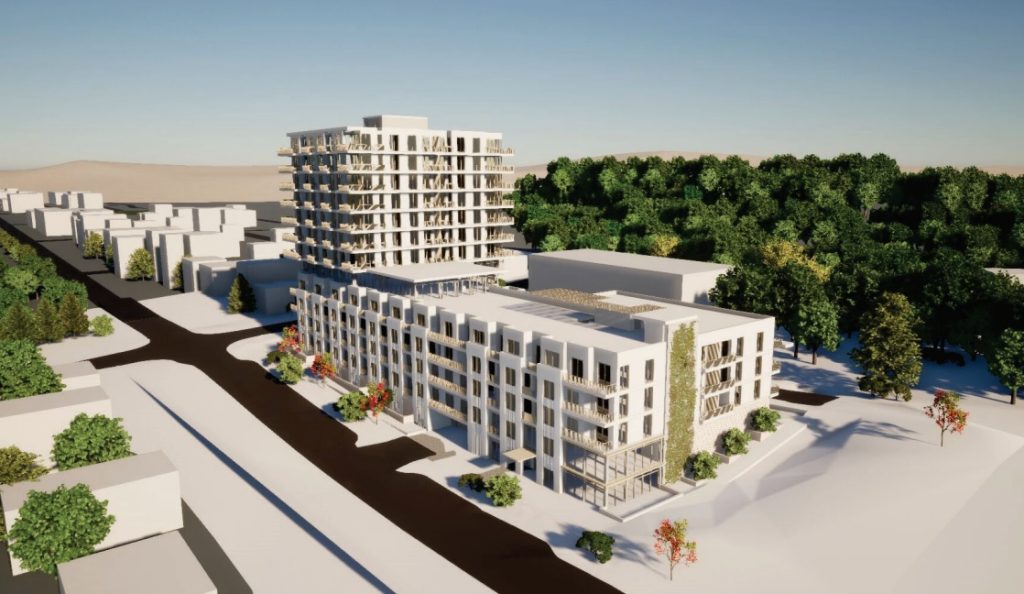
A plan to build an upscale seniors housing facility next to Kyle Centre has been given new life.
On Tuesday, July 23, Port Moody council voted 5-1 to advance Avenir Senior Living’s high-density project to second reading, despite earlier reservations.
Mayor Meghan Lahti said the location of the 41,000 sq. ft. site on the 2500 block of St. George St. is well suited for a seniors facility due to its proximity to local amenities like restaurants, doctors, drug stores and planned grocery stores.
Local news that matters to you
No one covers the Tri-Cities like we do. But we need your help to keep our community journalism sustainable.
“There is a need for seniors housing in Port Moody, and not just for supportive or low-income seniors housing,” Lahti said. “We can’t solve it all in one application.”
Numerous revisions have been made to the proposed Kyle Senior Living Centre since council unanimously rejected it in fall, 2023.
Council had previously voiced frustration over the developer’s lack of alterations to the application based on concerns raised by staff, development committees, council, and the general public.
The tower height has now been reduced from 14 to 12 storeys, strata seniors condominium units were replaced with market rental units, the building was reoriented to address shadows concerns, and a land dedication was offered to expand Kyle Park.
While some on council still voiced doubts about the project, they ultimately voted to advance the project to hear more from the public.
The facility would house 229 units, including: 48 memory care units, 133 full-service market rental units providing independent and assisted living, and 48 community care beds. Approximately 88 full and part-time staff would be employed.
Coun. Diana Dilworth said she appreciated the shift from condo strata apartments to market rentals.
Other councillors, however, raised concern over the pricey units, noting that Port Moody’s housing needs assessment specifically calls for seniors housing geared towards low and middle-income earners.
Coun. Amy Lubik said that she wanted more details about services and costs before she would support the proposal, adding she would like to see partnerships that could result in more public benefits.
“A frustration that I have is our society externalizes profits and socializes the supports,” Lubik said. “I think including a number of lower income and supportive units would change my mind.”
Coun. Haven Lurbiecki, who was the lone vote against moving the application forward, said zero affordable seniors housing facilities have been approved despite numerous opportunities over the years.
Dilworth countered that although the units are geared towards a wealthier clientele, it’s still addressing a housing gap in the community.
She said Port Moody will only be able to secure affordable housing through partnerships with senior levels of government, donating land, or waiving development levies.
“To say we’re not going to approve this because we need affordable housing for seniors is sort of throwing out the baby with the bathwater, because we need the whole spectrum,” Dilworth said.
Coun. Kyla Knowles noted the Vancouver City Council recently approved its first seniors housing strategy, and Port Moody should explore creating its own.
She said most people seeking seniors housing are homeowners looking to downsize and stay in their communities, but they lack housing options, including private pay facilities.
“All forms of senior housing must be added,” Knowles said. “We need it all, and we need it now.”
Avenir’s development will require rezoning and an amendment to the official community plan (OCP) to allow for the increased height and density, as the site is located in a single-family neighbourhood.
However, the site is captured under new provincial housing legislation (Bill 47) mandating density around transit oriented development (TOD), entitling Avenir to build up to eight storeys.
Avenir claimed the 12-storey tower was permitted because the majority of the development site would be covered with a four-storey podium, suggesting the average height is eight-storeys.
Staff supported this interpretation of the TOD legislation, but several councillors raised concerns that nothing outlined in Bill 47 detailed the ability to average building heights.
Lurbiecki took issue with staff adopting the “strange logic” of the developer.
“They do not have this entitlement to 12 (storeys). That is not in the legislation,” she said. “This height and massing does not belong in this area.”
Coun. Diana Dilworth suggested staff need to reach out to the province to confirm the legal interpretations.
Staff said they were trying to be flexible, but agreed approval of the proposed tower height was at council’s discretion.
Kate Zanon, general manager of community development, said an eight-storey building form would be blockier, have the same square footage, similar density, and would not allow for greenspace or the park dedication.
“The spirit of the legislation is to allow a certain entitlement within proximity to transit,” Zanon said. “It seemed a reasonable request based on past feedback around articulation of the building.”
Coun. Samantha Agtarap noted council cannot reject an eight-storey development, which if pursued, would result in more massing and a less interesting building.
Mayor Lahti agreed, and said she appreciated staff trying to be flexible with the application.
“The last thing we would want to see on that block is a large building from one end to the other,” Lahti said. “That will ruin everybody’s view.”
Several members of the public had raised concerns over the location of the tower, stating it would block the views of a significant number of property owners. Knowles introduced an amendment to have Avenir explore shifting the tower to western portion of the site, which passed unanimously.
Coun. Callan Morrison recused himself from the discussion due to a family connection to one of the applicants.
Author