Port Moody’s recreational facilities have ‘not kept pace with growth,’ say polled residents

A key theme drawn from a recent Port Moody survey is that the city’s recreational facilities “have not kept pace with growth,” according to staff.
A summary of public engagement related to the Recreation Facilities Feasibility Study (RFFS) was before council on Jan. 28, which polled residents on the state community’s current facilities, needs and options for future investments.
The RFFS is intended to help guide decision making and planning as the city develops its Parks and Recreation Master Plan, which is slated to begin in 2025.
Local news that matters to you
No one covers the Tri-Cities like we do. But we need your help to keep our community journalism sustainable.
Engagement methods included a resident survey, sounding boards, a mayor’s youth summit, user group surveys, community group discussions, and committee sessions.
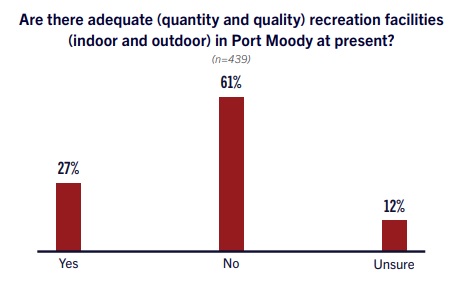
The resident survey, which had the highest response rate with 422 participants, found that while 65 percent said they were somewhat to very satisfied with the city’s recreational opportunities, 61 percent said there were not adequate facilities, according to the report.
A total of 73 percent listed one or more barriers from participating in recreational activities within the city. Topping that list was overcrowding (33 percent), better opportunities in other municipalities (27 percent), and poor/inadequate facilities (24 percent).
The public engagement also showed there was a high demand for some form of indoor aquatic centre, with swimming tanks (53 percent) and leisure pools (49 percent) being the most desired facilities.
Swimming lessons were also identified as the most desired type of programming for all age groups apart from seniors. However, many residents also recognized the cost impact from building an indoor pool, staff said.
A total of 27 percent of respondents said the majority of their household’s recreational activity takes place outside Port Moody, with most going to adjacent municipalities like Coquitlam, Burnaby, and Port Coquitlam.
Of those respondents who travel outside Port Moody, the top reasons were that suitable facilities or programs don’t exist locally, or that better facilities are elsewhere.
The recreational flight is more pronounced when it comes to user groups.
As part of the engagement, a questionnaire was provided to sports teams and programs that use Port Moody facilities: 53 percent said they regularly travel to facilities outside the city.
And while half of these groups said Port Moody’s current facilities meet their needs, 81 percent said they don’t believe they are adequate, with 37 percent reporting challenges in securing access and programming space.
However, many user groups found it challenging to isolate Port Moody’s recreational priorities given their programming spreads across the Tri-Cities.
Author