Port Moody council approves tallest towers in city history for Moody Centre transit hub
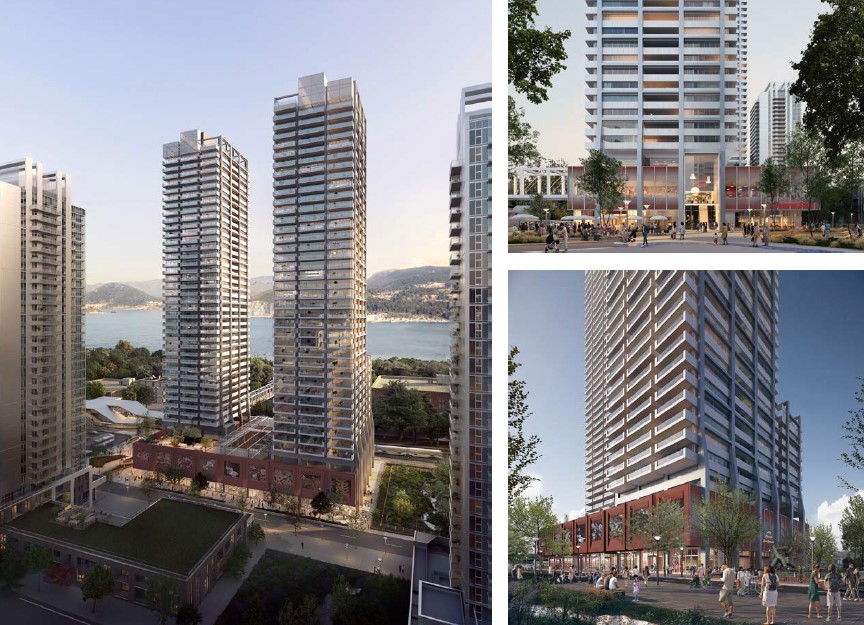
Port Moody council approved the tallest towers in its history on Tuesday night.
By a vote of 5-1 on Feb. 10, council adopted rezoning and official community plan amendments for PCI Developments’ twin 39-storey rental-tower project, clearing the way for another redevelopment project in the Moody Centre transit hub.
Mayor Meghan Lahti said council was determined to bring high-density developments to its SkyTrain stations, calling it a “strategic move” towards economic and community revitalization and sustainability.
Local news that matters to you
No one covers the Tri-Cities like we do. But we need your help to keep our community journalism sustainable.
“One of our main priorities was to create smart growth near transit, and this is another step in the right direction,” Lahti said. “I’m so happy that we are moving forward in that regard.”
The towers, located at 60 Williams St. and 3006–3022 Spring St., will have 865 purpose-built rental units, including 44 below-market, along with a large grocery store, commercial space, a public plaza, a daylit section of Slaughterhouse Creek, and a pedestrian overpass linking Moody Centre to Rocky Point Park.
The redevelopment also includes more than 400 parking stalls and a suite of amenities ranging from artist studios to rooftop green space.
According to city staff, the redevelopment will house an estimated 1,389 residents and include more than 56,000 sq. ft. of retail space, generating roughly 284 jobs between commercial and home-based employment.
The developer is also contributing about $25.1 million through community amenity contributions, density bonus payments and development cost charges – funding that supports infrastructure, parkland acquisition and housing initiatives – alongside the construction of major public amenities like the overpass and transit plaza.
Lone opposition
Like most high-density projects approved under the current council, the lone opposing vote came from Coun. Haven Lurbiecki.
She said the development is part of a broader highrise build-out framework that residents have never supported, calling it a “decision of council.”
“This development is part of a 14-tower plan for the area that has never been properly engaged on with the public,” Lurbiecki said. “A plan that will completely transform Port Moody into an unrecognizable place – and a plan that all engagement that we have so far tells us, clear as day, is not supported by residents.”
Lurbiecki claimed the project delivers more small rental units that fail to meet the needs of families, seniors and working residents, while also eliminating industrial land that could have supported employment.
She added that the towers exceed provincial housing legislation’s mandated density requirements, and offers just 5 percent of the units at below market rates, which she characterized as insufficient given the scale of the project.
Lurbiecki also criticized council for not having the new provincially authorized ACC bylaws in place, arguing the delay means “we’re leaving money on the table” for infrastructure and amenities.
Benefits praised
Supporters of the project pointed to the scale of public amenities being delivered alongside the housing.
Coun. Amy Lubik highlighted the daylighting of Slaughterhouse Creek – currently buried – as a major environmental and community benefit.
“Living in Suter Brook Village, walking over the creek, I’ve been thinking about how much I appreciate and enjoy that space,” Lubik said. “That’s a really important amenity for our community that adds so much to Moody Centre, which is so much concrete right now.”
She also praised the rooftop green spaces, public art, busking areas, and what she said were livable unit sizes.
Lubik also noted recent evidence suggesting increased rental supply is beginning to ease pressure on rents across Metro Vancouver.
One of the most enthusiastically received additions noted by councillors was the grocery store planned as part of the podium’s commercial space – a feature residents in the area have long requested.
Coun. Kyla Knowles called the grocery store “a long time coming,” saying it would allow residents to walk for essentials instead of driving across the city.
Knowles sharply pushed back on Lurbiecki’s criticisms, describing it as “disinformation” around transit oriented development (TOD) framework policy, ACCs, resident feedback, and affordable housing.
“I could spend an entire day writing a fact check post,” she said. “I reject all of that in hand.”
She also warned that Metro Vancouver’s coming development cost charge increases – expected to rise by more than 200 percent by 2027 – make it critical for municipalities to secure as many amenities as possible.
‘An exceptional amenity package’
Coun. Callan Morrison framed the project as one of the strongest amenity packages the city has negotiated.
Among the features he cited were a large public plaza, artist studio space, creek restoration, below-market rentals, adaptable housing, and the pedestrian overpass connecting Moody Centre residents directly to Murray Street.
“These are livable sized units being delivered,” Morrison said, noting average two-bedroom sizes around 753 sq. ft. and three-bedroom units approaching 1,000 sq. ft.
While acknowledging the towers’ height, Morrison emphasized the project is entirely rental and delivers some affordable units despite none being required under the current policy.
“I’m very excited to see the delivery of this project for our community,” he said.
Economic revitalization
Mayor Meghan Lahti said the industrial lands had long been targeted for redevelopment within the TOD area, and described the project as a catalyst for economic revitalization, new jobs, expanded green space and increased tax revenue.
“We envision these developments as places where community needs and desires are prioritized,” Lahti said, pointing to the public plaza, park space, affordable housing, cultural amenities and pedestrian infrastructure.
Coun. Diana Dilworth echoed that praise, contrasting the future transit plaza and pedestrian connections with the current landscape of parking lots and underused industrial buildings.
“I’m just really excited about what is coming to Moody Center,” she said.
Dilworth also countered Lurbiecki’s claims that Port Moody is lagging behind other municipalities in implementing new development financing tools, noting most major cities across Metro Vancouver are still actively working on ACC and DCC updates amid sweeping provincial housing reforms.
With the bylaws now adopted and an overarching development permit approved, the project can proceed to subdivision and detailed permitting, with construction still subject to further council approvals in the months ahead.
Author