Port Moody council orders fresh look at widening Barnet Highway rail overpass to ease traffic concerns
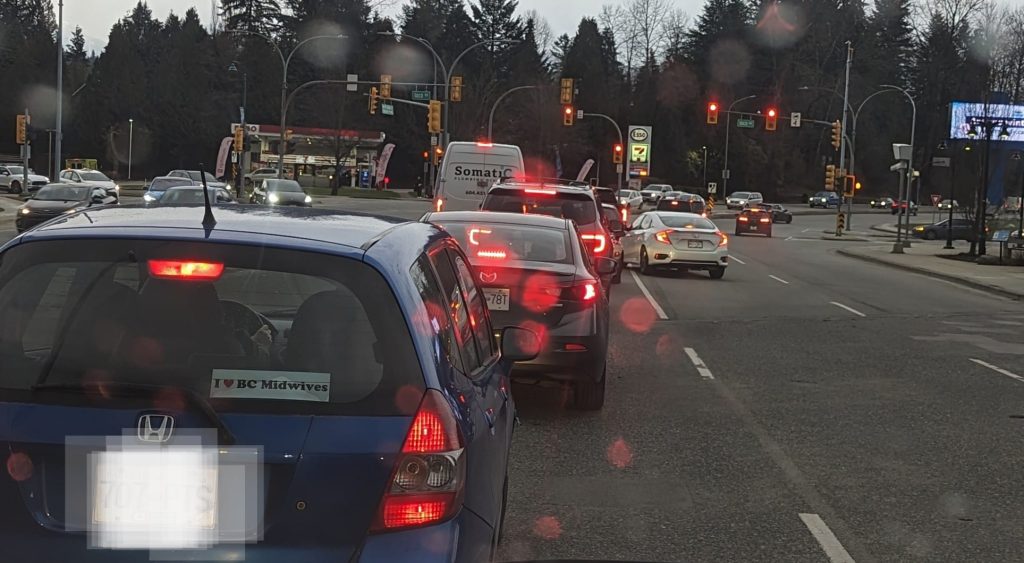
Aiming to ease rising traffic frustrations, Port Moody will revisit the idea of widening the eastbound Barnet Highway overpass over the Canadian Pacific Kansas City (CPKC) rail line – one of the city’s worst traffic choke points.
Coun. Callan Morrison introduced the motion, which passed unanimously on Nov. 12, directing staff to report back on previous engineering studies, update cost estimates, and outline how such work could be coordinated with upcoming seismic and deck rehabilitation projects on the structure.
“Traffic and congestion is listed as one of the top issues contributing to a decrease in quality of life for Port Moody residents, and traffic has consistently gotten worse” Morrison said. “We see every week, someone posting online about traffic congestion, and I feel it is important that this council takes a look at the ways in which we can help to investigate, mitigate and even improve upon our existing infrastructure.”
Local news that matters to you
No one covers the Tri-Cities like we do. But we need your help to keep our community journalism sustainable.
The overpass, which narrows to a pinch point at the Barnet Highway-Ioco Road intersection, has long been cited by residents as a major bottleneck that undermines traffic flow along St. Johns Street and Dewdney Trunk Road.
Morrison said the timing for a review is ideal because other major transportation projects in the area are already underway.
According to his memo to council, recent traffic increases are more likely tied to regional growth – particularly east of Port Moody – rather than local development, and the bottleneck created by the overpass “will continue to increase” as more through-traffic diverts through the city.
He emphasized the motion was not meant to solve road capacity issues, but rather to increase efficiency around “pinch points” and make improvements where financially feasible.
“I believe in latent demand, and I know that it would not matter how many lanes were built – they would eventually fill up,” Morrison said. “Even if we added other lanes to St Johns Street, as some people want, those lanes would still bottleneck to cross this overpass or go down Dewdney Trunk Road.”
Any renewed widening concept, he said, must also consider room for transit lanes and active transportation upgrades, particularly as the city advances the second phase of its St. Johns Street multi-use pathway project.
Upcoming seismic and deck rehabilitation work — already planned in the 2026 capital budget — makes the review timely, Morrison said. He added that revisiting past studies, including a 2009 widening report, and updating cost estimates now could allow staff to coordinate that work with already scheduled construction.
“As it stands, we do not have the road width across the rail overpass . . . to accommodate two strollers passing each other on the south side, let alone a multi-use path. So it makes sense to look at this,” he said.
Coun. Kyla Knowles stated much of council and staff’s time has been tied up reacting and adapting to provincial housing legislation passed in December 2023.
She said council had intentionally avoided adding more to staff workloads while the new Official Community Plan (OCP) was being re-done, but with the second reading now complete, other projects can be given attention.
“Our already busy staff had to drop their pencils to incorporate all these legislative changes into our policies, bylaws, agreements, OCP and so forth,” Knowles said. “It is time to focus on other issues, including implications to traffic in our growing region.”
Knowles proposed an amendment, which also passed unanimously, for staff to return not just with the updated overpass review, but also with a summary of broader congestion-easing options along St. Johns Street and Clark Road, including reviewing past traffic-flow studies and exploring the viability of rush-hour flow lanes.
Coun. Haven Lurbiecki sharply rejected any framing that the provincial housing bills are contributing to current traffic levels.
She said that Port Moody’s population growth, increasing from 33,500 in 2021 to 39,000 today, as well as regional growth were responsible.
“Not one major development application has been approved in Port Moody under the provincial housing legislation. That’s a fact,” Lurbiecki said. “It was development approvals under the last council, and any that are starting to come forward under this council. Every application approved so far that still has to be built is going to add to the traffic..”
She also pointed to council’s own decisions, including approvals at Coronation Park and within the Moody Centre transit-oriented development (TOD) area – projects with density that far exceed the province’s minimums – arguing these will add thousands more vehicles to the network.
While supporting the overall traffic review, Lurbiecki questioned its timing, describing it as “approve first, see if we can do anything about it after.”
She also introduced an amendment asking staff to provide projected traffic impacts once Port Moody reaches a population of 74,300, the upper-end figure in the draft OCP.
“The only way that council and the community can know exactly what we’re trying to solve is if we do some sort of broader study on what we’re expecting the traffic to be over text 15, 20, 25 years,” Lurbiecki said.
Pushback on long-term modelling
Other councillors said the amendment was impractical and unnecessarily narrow.
Coun. Samantha Agtarap said any long-range model must consider regional traffic patterns, given that “a good portion of existing traffic on St. Johns Street is through-traffic.”
“To just confine that study to Port Moody is not really going to tell us the whole story,” she said.
General manager of engineering and operations Jeff Moi noted the city already uses a cumulative development transportation model and integrates regional growth data from TransLink.
Creating a new forecast tailored to the OCP population target, he said, could be a “big exercise” requiring additional resources.
Knowles called Lurbiecki’s amendment “a solution looking for an additional problem,” adding that the OCP’s top-end population figure is still in question.
Coun. Diana Dilworth agreed the issue could be revisited later, but said council must first “get a common understanding” of past studies before deciding whether additional modelling is needed.
Morrison also opposed the amendment, saying the goal of his motion was to rely on existing studies and avoid unnecessary expenditures.
Lurbiecki’s amendment failed, with only herself in support.
Author