Completion of North Road Sewer Upgrade Project inches forward after U.S. rail company’s appeal dismissed
Following a Federal Court of Appeal ruling, a Metro Vancouver project connecting a Coquitlam sewer line to the Annacis Island Wastewater Plant can move forward.
The North Road Sewer Upgrade Project began in 2019, but the final phase of work has been delayed by a dispute with a U.S. rail company, which owns property where the line must cross.
On Jan. 17, 2025, the court dismissed the appeal from BNSF Railway Company, which argued the Canadian Transportation Agency’s (CTA) order authorizing construction had no jurisdiction over an agreement dating back to 1959.
Local news that matters to you
No one covers the Tri-Cities like we do. But we need your help to keep our community journalism sustainable.
“In my view, properly interpreted, the 1959 agreement does not apply to the district’s proposal for a new sewage pipe,” concluded Justice K. A. Siobhan Monaghan.
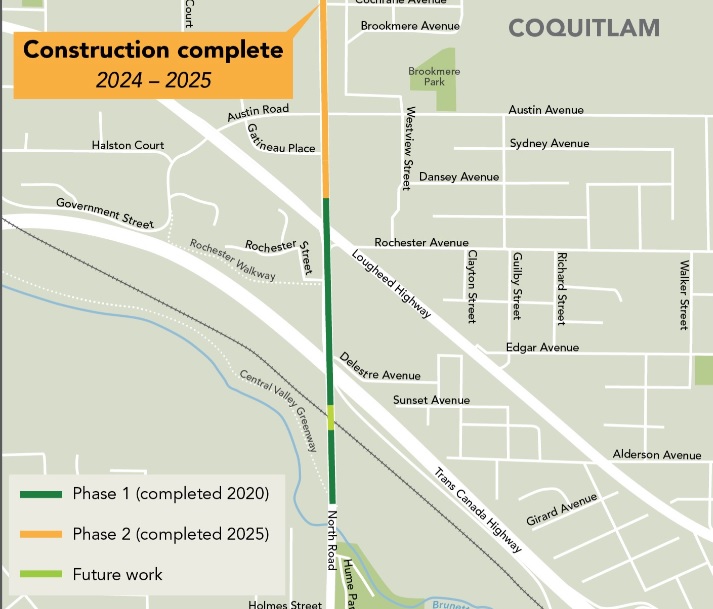
The North Road pipe runs for 2.5 kilometres through Coquitlam and Burnaby, and the construction project is set to replace the old 12-inch pipe, doubling its capacity to accommodate regional growth.
Work wrapped up on the Coquitlam side in 2025 and on the Burnaby side in 2020, save a small section where BNSF operates its railway under a vehicular bridge.
In 2021, the Greater Vancouver Sewerage and Drainage District (Metro Vancouver) applied to the CTA to replace the existing overhead sewage wastewater pipe on BNSF’s bridge.
The dispute between Metro Vancouver and BNSF arose after the parties came to an impasse over the portion of the sewage pipe on the bridge. When negotiations around utility crossings become deadlocked, the CTA has the ability to order construction.
BNSF argued that the CTA did not have the proper authority, stating that the 1959 agreement signed between Metro Vancouver and the company’s predecessor only granted permission to “attach, maintain and operate” the sewer pipe. The company asserted the current project would fall under “maintenance” in the decades-old agreement.
Metro Vancouver countered that the 1959 agreement did not apply, as the work is properly characterized as “reconstruction,” which the original contract did not consider.
CTA ultimately sided with Metro Vancouver in early 2023, which BNSF appealed, arguing the agency erred in its jurisdictional findings by not considering the original interpretation of the agreement.
While the court agreed with BNSF, it found applying the correct legal principles would not change the jurisdictional ruling, as the old agreement does not apply to current upgrades.
“In my view, the text of the licence-granting provision strongly suggests that the parties intended the 1959 agreement to apply only to the particular sanitary sewer pipe described in that provision: the 12-inch sewer pipe,” Siobhan Monaghan stated.
Costs for the appeal were granted to Metro Vancouver.
Construction on the final phase of the upgrade project is anticipated to begin in 2026 or 2027, according to Metro Vancouver’s website, though BNSF still has an opportunity to appeal the court’s decision in the Supreme Court of Canada.
Author