Port Moody to keep ear to streets with new noise-monitoring pilot
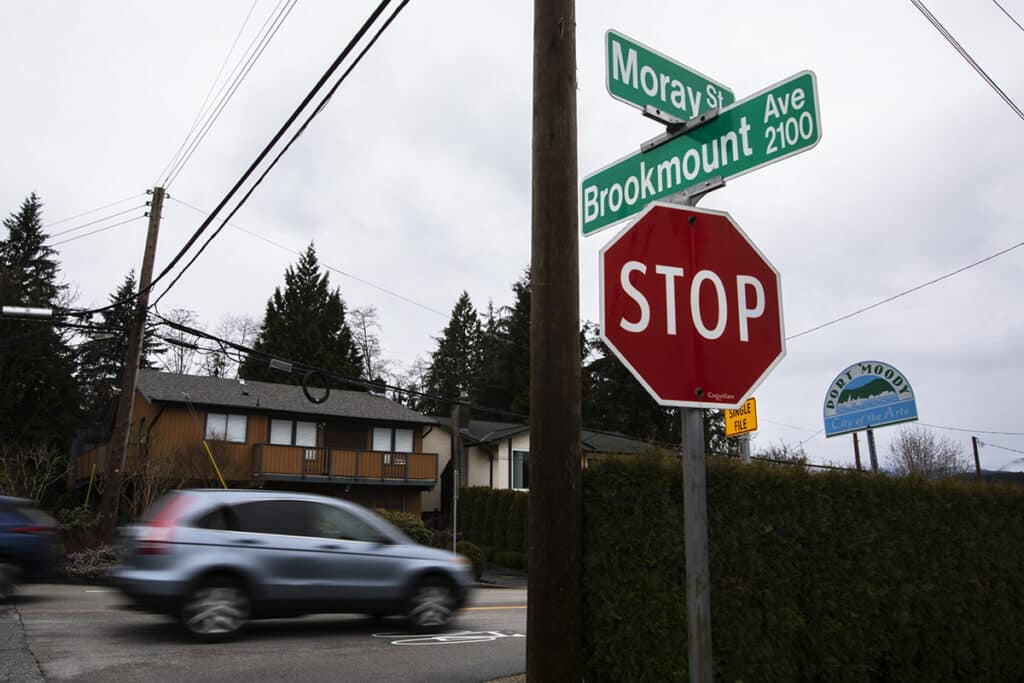
Port Moody will be watching the volume on noisy vehicles, with a new monitoring approach that’s more budget-friendly than its original plan.
On July 29, council unanimously approved staff’s recommendation to test a lower-cost, streetlight-mounted noise sensor. The new devices can detect and log when noise exceeds a certain decibel threshold. The project is meant to test the city’s soundscape ahead of stricter enforcement options in the future.
“We’ve all had our windows open and we’ve all heard those motorcycles and ripped mufflers disturbing the peace and quiet in our neighborhoods,” said Coun. Diana Dilworth. “What is being proposed by staff is a really good interim (project), so that we can actually confirm exactly where the highest levels of noise disturbance are occurring in the city.”
Local news that matters to you
No one covers the Tri-Cities like we do. But we need your help to keep our community journalism sustainable.
The decision follows a motion introduced by Couns. Dilworth and Samantha Agatarap in January, after hearing complaints from residents in Newport Village and Klahanie about disruptive motorcycle noise.
Port Moody sent a successful motion to UBCM in 2024, asking the province to investigate establishing a provincial pilot program, and change legislation to allow municipalities to use noise cameras for enforcement.
However, anticipating a slow response from the province, the councillors forged ahead with their own motion.
The city originally sought to trial high-definition noise cameras – devices capable of identifying vehicles responsible for excessive noise, much like speed or red-light cameras – but the cost proved prohibitive.
According to a staff report, one vendor offered a three-month pilot at approximately $10,000 plus additional servicing and staff time, pushing the total potential cost up to $12,000. Another vendor provided a free one-week trial but required costly installation and removal.
Dilworth said several providers initially indicated that they could provide noise cameras for a free pilot project.
“Staff went down that road – and there’s never a free lunch,” Dilworth said. “The end all and be all: it would cost a significant amount to do this.”
As an alternative, staff broached cheaper noise sensors, which will only cost $2,000 for installation and a one-year service plan.
The city’s new pilot will use noise sensors from a company Port Moody is already working with on a separate LED streetlight project.
Jeff Moi, general manager of engineering and operations, said that while the sensors will not capture vehicle photos or track their direction, they could still provide meaningful insight.
“I think it would provide much better information on the frequency and severity of noise and help us to understand if we want to go further,” Moi said.
Agatarap called the move “a great first step,” while emphasizing the need for continued lobbying to the province for enabling legislation.
“I’m hopeful that this can at least give us an idea of the noise or the soundscape in our communities . . . looking for paths towards enforcement, and also looking at ways to enable quieter cities,” she said.
Port Moody Police Chief Const. David Fleugel acknowledged the difficulties of enforcing existing noise laws under current rules.
“It is a challenge to be right there with the decibel reader, catching people as they drive by,” he said. “We’ve all heard it a million times, but we’re just not in position many times to be able to pull that person over. We’re just unable to prove it in court.”
Still, Fleugel expressed confidence in the city’s direction, adding that other municipalities are watching Port Moody’s progress closely.
Coun. Haven Lurbiecki said the project will help gather data to support future enforcement.
“We live in a city, and every city has noises, but excessive noise – purposefully loud noise—is what we’re trying to really get at here,” she said.
Coun. Callan Morrison supported the plan, adding would have even supported a more pricey option to better gather “hard concrete data.”
“Whether you live on Guilford Way, you live on Heritage Mountain Boulevard or Ioco Road – there are loud mufflers that are going to disturb you at some point,” he said. “To get the data is key, and to get it sooner than later is better.”
Moi confirmed staff are aiming to install the sensor in time to capture noise in August, when the city receives the most complaints. He added a preliminary report could be available next spring.
“We’re trying to get it in to capture a couple weeks in August, if we can, because we know summer is when we get the most calls,” Moi said.
A more advanced noise camera system could be considered later, pending legislative changes and community support.
Author