Budget tops $1-million for Port Moody’s Moray Street traffic calming project; some residents warn of congestion spillover
The cost of putting permanent traffic calming features on Moray Street has bumped up 42 percent from the original estimate.
Despite some opposition from residents, Port Moody council unanimously endorsed an updated design on May 20 and approved an additional $353,000 in funding due to rising construction costs, and new features, including a multi-use path on west side of the street.
Initially estimated at $720,000 in 2022, the project’s cost has increased to $1.25 million. Construction is expected to start later this year.
Local news that matters to you
No one covers the Tri-Cities like we do. But we need your help to keep our community journalism sustainable.
“Yes, it’s going to be more money that we had and originally anticipated, but I think that at the end of the day, this is going to be something that the community is going to appreciate,” said Mayor Meghan Lahti. “We’re talking about people having the ability to walk up and down that street feeling safe.”
Moray Street is a busy collector route connecting Port Moody to Coquitlam, carrying approximately 7,000 vehicles daily. Residents along the corridor have voiced safety concerns for years, particularly about speeding and inadequate pedestrian infrastructure.
In response, council authorized a traffic calming pilot in 2022, which included temporary curb extensions, reconfigured lane markings, and a pedestrian crosswalk with flashing lights at Pinda Drive.
According to speed monitoring conducted before and after the pilot’s implementation, the 85th percentile vehicle speeds dropped by approximately 5 to 6 kilometres per hour. Staff noted that traffic volumes were not significantly affected.
Based on those results, council voted in 2023 to move forward with permanent installations and allocated $75,000 for detailed design.
Coun. Callan Morrison said even a slight reduction in speed is a positive result, especially considering the area is captured under Inlet Centre’s transit oriented area, and can expect to see considerable growth in the future.
“As people start to develop in this area, there’s going to be more of a need for those multi-use paths and getting people down to St. Johns Street transit,” Morrison said. “The safer it can be made, the better.”
Design features
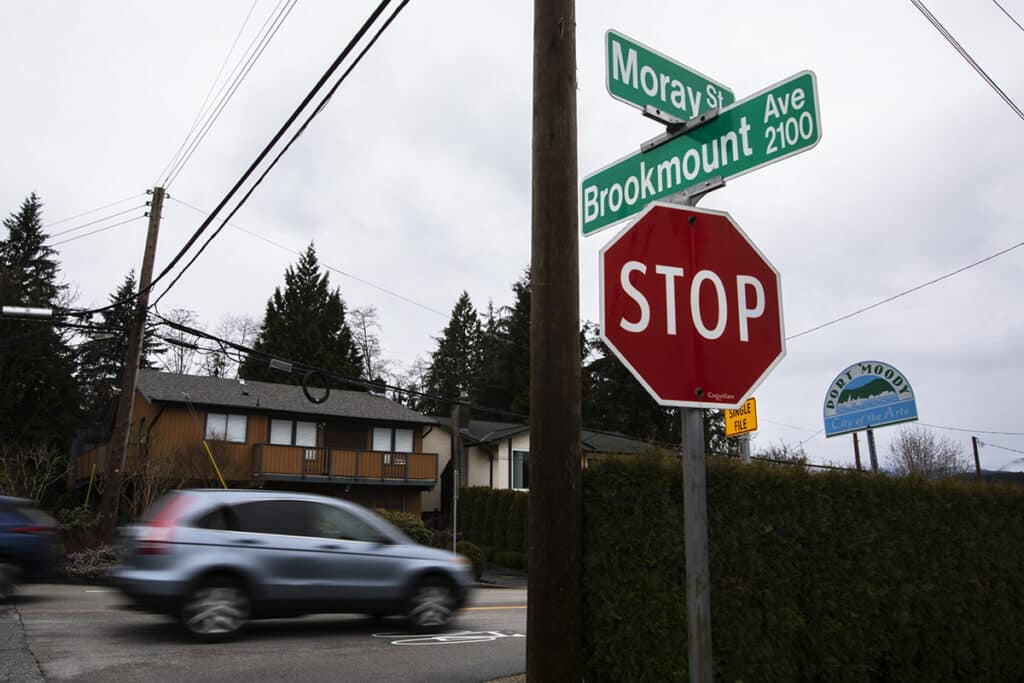
The final design now includes a continuous multi-use path along the west side of Moray Street from Flinn Court to Brookmount Avenue. A painted southbound bike lane will be added on the east side, taking advantage of space between the sidewalk and newly placed delineators. However, the originally proposed northbound bike lane has been removed from the plan, due to safety concerns over cyclist-pedestrian conflicts and the lack of space near curb bulges. Instead, cyclists heading northbound will be encouraged to use alternate routes along Brookmount and Clearview Drive.
The project will also add a new marked pedestrian crosswalk at Brookmount Avenue, improve existing street lighting, and extend the left-turn and through-lanes at the busy St. Johns Street intersection to improve northbound traffic flow and queuing capacity. Some changes have been made to preserve mature trees, resulting in the removal of parking on parts of the west side of the road, though parking has been reinstated on segments of the east side, where space permits.
While Coquitlam is considering extending its own multi-use path to the Port Moody border along Thermal Drive, it has not included any such project in its 10-year capital plan to date, according to staff.
Division
The proposed permanent traffic calming features, however, have stirred significant debate with local residents, and required significant revisions since the pilot project launched nearly three years ago.
Public engagement on the project included letters delivered to 135 homes and direct invitations sent to 20 Moray Street households to attend a virtual information session, held in March. Only four residents attended, but feedback continued afterward with phone calls, emails, and comments through the city’s website. By the end of April, the city had received 11 formal comments: one supportive, four constructive or neutral, and five expressing opposition.
Concerns raised by residents included the removal of parking spaces, potential safety issues, questions about the project’s effectiveness, and its overall cost. Staff met with several residents in late April and incorporated some of their suggestions into a revised design.
Opposition to the project kicked up again in April when council received a written petition signed by 26 local residents and an online petition with 182 signatures. Both opposed the traffic calming plan in its current form.
Public input on May 20 was again split between support and opposition to the project, though the supporters outnumbered opponents.
Several residents in opposition said the ICBC crash data being used to justify the project was incorrect, as it included St. Johns Street accidents. Only five crashes occurred along Moray Street between 2017 and 2021, they said.
They also raised concern over the price tag, and said the traffic calming features would cause congestion leading to spillover onto Brookmount Avenue and Clearview Drive, and residents of Pinda Street will get blocked in by vehicle backup on Moray. Another complaint was that the bike lanes and multi-use path won’t connect to Coquitlam’s network.
“This project makes no sense,” said Mark Cave. “Accidents should be the main driver of change and measure of safety.”
Other residents, however, said reduced speeds in the area make it safer for pedestrians to cross the street.
Walter Ceron said he’s watched traffic grow increasingly faster since moving onto Moray Street nearly four decades ago, stating the calming pilot has helped “tremendously.”
“People are going 50 to 60 kilometres thinking that they’re in the Indy,” Ceron said.
Despite the criticism, staff said that the current design reflects both technical best practices and community input, noting that continued community engagement will guide implementation.
Costs
The project’s current estimate includes more than $1 million in construction costs, plus contingency funding and design costs. Staff said the initial estimates were based on a more limited scope that did not include the $187,000 multi-use path, $46,000 in additional design work, or account for $138,000 in construction inflation.
The city has secured a $155,000 grant from TransLink, and is reallocating $100,000 from the city’s streetlight replacement fund. The remaining $353,000 will be drawn from the transportation reserve.
Coun. Kyla Knowles raised some concern over the spending for the multi-use path due to lack of connection to Coquitlam, but said the cost to Port Moody is not “outrageous.”
“This is an investment in safety,” she said. “It’s tough to put a price on safety.”
Council comments
Although several councillors acknowledged the traffic concerns of some residents, they said safety should take precedence.
Mayor Lahti said the city cannot approach traffic safety from the perspective of “counting accidents,” as the council is trying to create a more walkable city by encouraging other forms of transportation.
“(Traffic) is not a Port Moody problem. This is a regional problem. Everybody is feeling it,” she said. “We can’t build more roads, we’re not going to be widening our roads, so we really do need to be looking at ways to mitigate the impact of traffic.”
Coun. Samantha Agtarap agreed, stating the city needs to be focusing on providing safe infrastructure for pedestrians, cyclists and transit. Despite a lack of population growth between the 2016 and 2021 census, congestion did increase, she noted.
Coun. Haven Lurbiecki, conversely, railed against what she called a lack of overall traffic mitigation plan for the city, describing efforts to date as “plugging in the hole in the ship.”
She warned about the number of parking spots being approved by council, adding the density being approved by council was well beyond what is mandated under the provincial housing legislation.
“Traffic calming mechanisms like this are very important for safety at dangerous intersections, but it is not addressing this bigger root issue,” Lurbiecki said. “I think the (residents’ frustration) is a reflection of a much larger issue that we really need to tackle.”
Coun. Kyla Knowles introduced a motion at the end of the meeting, calling on the staff to report back with ideas on how to mitigate traffic impacts to neighbouring streets as a result of the Moray Street project. It passed unanimously.
Author