Port Moody’s new official community plan advances to second reading
Port Moody council has pushed its long-awaited official community plan (OCP) one step closer to adoption.
On Oct. 7, council voted 6–1 to give second reading to the draft Port Moody 2050 plan, which charts how the city will accommodate population growth, climate commitments, and new provincial housing mandates in the coming decades.
Mayor Meghan Lahti acknowledged the division among local residents around growth and development, but emphasized the OCP represents much more than land use.
Local news that matters to you
No one covers the Tri-Cities like we do. But we need your help to keep our community journalism sustainable.
“There is a lot in this plan that we can agree on. It’s not just about tower heights and density,” Lahti said. “While we strive for consensus. It’s not always achievable. Sometimes we might make tough choices that prioritize the greater good, even if they don’t align with everyone’s personal perspective.”
The OCP, last fully updated in 2014, serves as Port Moody’s overarching land-use and policy blueprint, guiding decisions on housing, parks, transportation, climate, and economic development.
The new draft lays out a 25-year horizon that would see the city’s population rise from about 38,900 in 2024 to roughly 74,300 by 2050, with about 32,000 dwellings and 13,000 jobs envisioned.
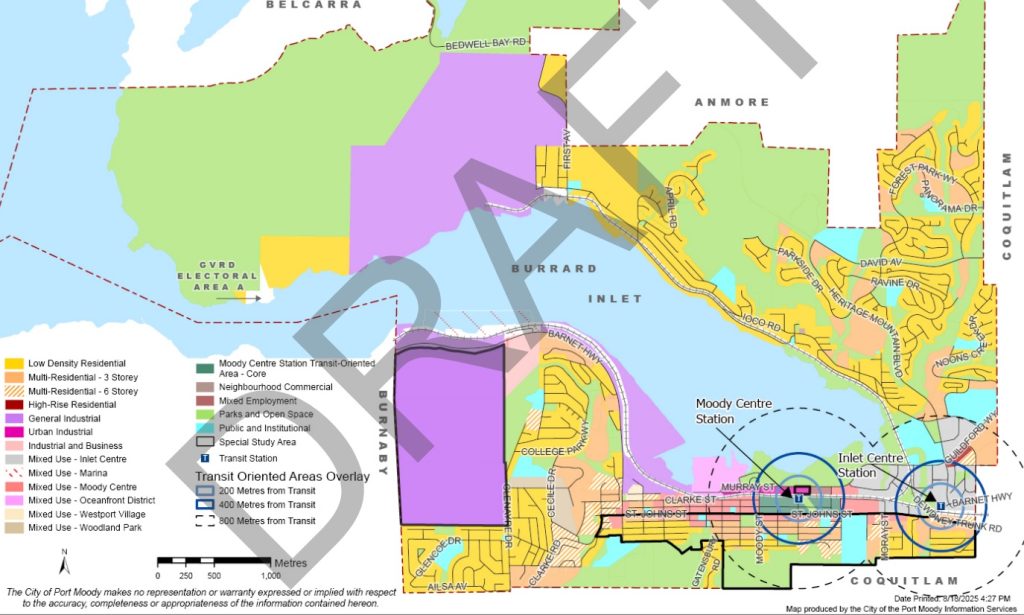
To meet those numbers, the plan designates transit-oriented development (TOD) areas around Moody Centre and Inlet Centre SkyTrain stations, identifies corridors for small-scale multi-unit housing, and integrates provincially mandated five and 20-year housing targets.
It also incorporates updates to the Zero Carbon Step Code, a strengthened climate-action lens, and new policies on urban forestry, stormwater management, and biodiversity protection.
Staff describe the document as the most technically detailed plan in the city’s history – one that links 22 existing municipal strategies, from parks and arts to child care and waste reduction, into a single framework.
Council discussion
Not all of council was convinced the OCP was representative of the community at large.
Notably, Coun. Haven Lurbiecki, who has consistently been opposed to the council’s decisions around development, said the plan charts the wrong course.
“This official community plan represents overbuilding without balance, density without infrastructure and change without community consent,” she said. “I believe it will overwhelm our small city and fundamentally change Port Moody from the community we love and call home.”
Lurbiecki accused the majority of ignoring public feedback gathered during the previous engagement surveys, stating the majority of residents do not support the level of height or density prescribed in the OCP.
Instead, she said the draft doubles down on luxury high-rise units that: “the market has already shown people don’t want and can’t afford.”
The majority of council countered that the OCP is a forward-looking, flexible framework – not a static document – and one shaped by both provincial legislation and extensive public engagement.
Coun. Callan Morrison said he was confident residents’ voices were reflected after years of surveys, town halls, and workshops.
“People have been asked to provide their thoughts so many times, and in so many different ways, that I truly believe that those that wanted to participate had the opportunity to do so,” he said.
While acknowledging public anxiety over rapid change, Morrison noted the province has imposed unprecedented housing requirements and transit-area density thresholds on municipalities.
He urged residents concerned about growth to “advocate passionately” to the province for infrastructure funding and support.
“Higher levels of government have not lived up to their responsibilities,” he said, citing crowded hospitals and delayed schools. “The provincial government has forced an unprecedented amount of density on our city without consultation.”
Coun. Samantha Agtarap called the draft “a milestone,” reflecting how much the city and its legislative landscape have changed since the last plan.
“A city is never finished. It is on a continuum of improvement, constantly evolving and changing, just like the OCP itself,” she said. “New opportunities will present themselves, and new approaches to addressing these issues and needs will be developed.”
She noted that the 2014 plan anticipated a 2021 population of 39,660 – but the 2024 figure was slightly below that, at 38,942 – illustrating that projections and plans inevitably shift.
Agtarap also pointed to the SkyTrain’s impact – with about 4,500 daily weekend boardings between Inlet Centre and Moody Centre stations – as proof the city has already changed dramatically.
The OCP, she said, “grounds those provincial requirements in our local context as best we can.”
Coun. Kyla Knowles said she’s heard both opposition and support from residents, including many who “absolutely do believe that density around our transit stations is the right thing to do.”
She rejected the idea that public engagement has collapsed, arguing that Port Moody does “a heck of a lot more” outreach than most municipalities.
Coun. Amy Lubik emphasized that beyond land use and tower height, the plan sets a moral and environmental foundation for future decisions: protecting the urban forest, fostering inclusive neighbourhoods, reducing emissions, and designing “healthy and equitable” public spaces.
Coun. Diana Dilworth praised staff for rewriting the OCP after provincial legislation forced a full restart in 2023, and described the document as, “an exceptional, dynamic, long-term vision for 25 years.”
She said the plan “integrates and interweaves” 22 other city strategies, from housing and environment to economic development and accessibility, and that it will be reviewed and updated regularly.
“This is not a plan for today. It is a plan for tomorrow,” Dilworth said.
Amendments
Several significant amendments were introduced during the lengthy three-hour discussion.
Council unanimously voted to remove properties on the southside of Dewdney Trunk Road between St. Johns Street and Viewmount Drive from a new special study area, and integrate them into the Inlet Centre transit oriented development area.
Several residents in the area had complained the designation would bog down development planning underway for several properties, noting these parcels were within 200 metres of Inlet Centre station and therefore entitled to build up to 20-storeys.
“This is going to give residents in that area more clarity and allow them to move forward with their plans,” Morrison said. “I do believe that we do need a neighborhood plan for that area. The province has made it very difficult to plan additional park space and amenities that are going to be needed.”
Council also voted to keep the site of the former Moody Elementary School designated as public and institutional, leaving the door open to another future school.
The Coquitlam School Board issued numerous concerns to council about the OCP’s plan to designate the land for future park use, stating the change could complicate their ability to plan for new schools on the site.
Lurbiecki introduced several amendments to lower tower height prescribed in several areas to align with provincial minimums set in Bill 47, including in Moody Centre (TOD) area and an area close to Inlet Centre station. These motions were all defeated without support from her fellow councillors.
She raised concerns that embedding heights allowances in the OCP above what is mandated in provincial legislation would lessen the city’s ability to leverage amenities if developers want to build taller. She also raised concerns about the potential impacts on affordability due to land speculation.
Staff, however, said aligning the OCP with the Moody Centre TOD framework would provide more clarity for applicants and would not stop the city from negotiating for more amenities, adding the city will be updating its inclusionary zoning policies by spring 2026.
Several councillors also remarked that it made more sense to have the OCP align with development on the ground already taking place.
Morrison noted that Moody Centre has been designated as a high-density transit hub and employment area since 2017.
“I’m not inclined to support something that gives a false narrative on our OCP. I’d want it to plan for that highest case number properly,” he said. “I like the ability to negotiate, and I think we’ve come up with a framework that is easy to understand, so I’m inclined to keep it realistic.”
Lahti agreed, stating the OCP should reflect the vision already approved for the area. “I don’t think that it would be proper to change it,” she said.
Another amendment, also introduced by Lurbecki, called for the special study area to be placed in the Oceanfront District with the aim of expanding Rocky Point Park.
She said while expanding the city’s biggest park is referenced in the language of the OCP, that goal is not reflected in any of the land use maps.
Adding a special study area would keep the current land use, but would allow for a neighbourhood planning process to occur, working with the community and the current landowner, according to Lurbiecki.
“This is our time to make changes about what we need to see, and we know that we want to see significant expansion of Rocky Point Park,” she said. “Now is the time for council to signal to the community that we’re serious about this.”
Other councillors, however, noted that a special study area had already been conducted, resulting in the current vision.
“I don’t see value in rehashing this,” Dilworth said, stating the council should be focusing on negotiations with the property owner to secure additional park space. “Revising it as a special study area is just going to take more years to actually get some action on that property.”
Dilworth added she’s seen some development plans for the site which include up to seven acres of parkland. “That’s bigger than Rocky Point Park is right now,” she said.
Staff added that the policies outlined in the OCP for Oceanfront District are fairly detailed, and are similar to what would be required in a special study area, including additional studies and concept and site plans.
Lahti said that while she didn’t support a special study area, she does want the OCP to reflect the community’s desire to have a large connected oceanfront park – not isolated pocket parks.
She noted recent studies have shown the need for more parkland in Moody Centre, and council needs to take measures to secure those larger spaces.
“There have been changes that have, in my mind, necessitated our need to articulate very clearly what it is we want to see in terms of park space there,” Lahti said.
While Lurbiecki’s motion was defeated 6-1, a separate motion calling for the OCP to articulate a desire to see a contiguous oceanfront park was passed unanimously.
Author