Port Moody council approves new OCP, charting path to double population by 2050
Port Moody council has approved the final draft of its new official community plan (OCP) bylaw, setting a long-range development vision which projects doubling the city’s population by 2050.
The marathon five-hour public hearing and subsequent council discussion on Feb. 3 exposed deep divisions over growth, density, and trust in the city’s planning process.
Mayor Meghan Lahti closed the discussion by acknowledging residents’ fears while defending the OCP as balanced growth.
Local news that matters to you
No one covers the Tri-Cities like we do. But we need your help to keep our community journalism sustainable.
“Change feels daunting,” Lahti said. “But when growth is managed responsibly, when it is done in a thoughtful way, it brings opportunities to the community, it also brings new resources and services. This document will help shape that future.”
Council passed the OCP by a 6–1 vote, replacing Port Moody’s 2014 OCP with a new 450-page document reshaping land use across the city, concentrating growth around SkyTrain stations, integrating climate policies into development decisions, and planning for a population target of more than 74,000.
Speakers at Tuesday night’s public hearing were roughly evenly split between support and opposition to the plan. Submitted written correspondence, on the other hand, was largely critical of the OCP in its current form.
Supporters frame it as a long-overdue plan to deal with regional growth pressures, and Port Moody’s responsibility to absorb new housing – particularly near rapid transit.
Resident John Grasty told council the city’s population has historically doubled roughly every 20 years and that decades of regional planning have made one solution clear: build dense town centres around transit hubs.
He argued what once counted as “moderate growth” no longer fits today’s housing reality and said staff and council had produced a workable plan despite provincial mandates and rising construction costs.
“The major issues facing Port Moody aren’t even under the purview of this council,” he said, pointing to hospitals, schools, infrastructure and housing funding as responsibilities of senior governments. “To those people who still don’t like what is going on with this OCP, please take it up with your MLA.”
That theme – that municipalities are being forced to manage growth without corresponding provincial investment – was echoed repeatedly among supporters.
Supporters also emphasized the economic rationale behind the plan, particularly mixed-use development on the waterfront and employment lands designed to broaden the tax base. They praised the OCP’s push for office space, creative industries, urban industrial uses and mixed-use towers as a way to generate jobs and municipal revenue.
Environmental policy emerged as another strong theme, with many residents highlighting strengthened protections for environmentally sensitive areas, urban forests and biodiversity corridors, tying growth directly to climate adaptation and ecosystem restoration.
Opponents, however, warned the plan represents development on a scale that would permanently destroy Port Moody’s character.
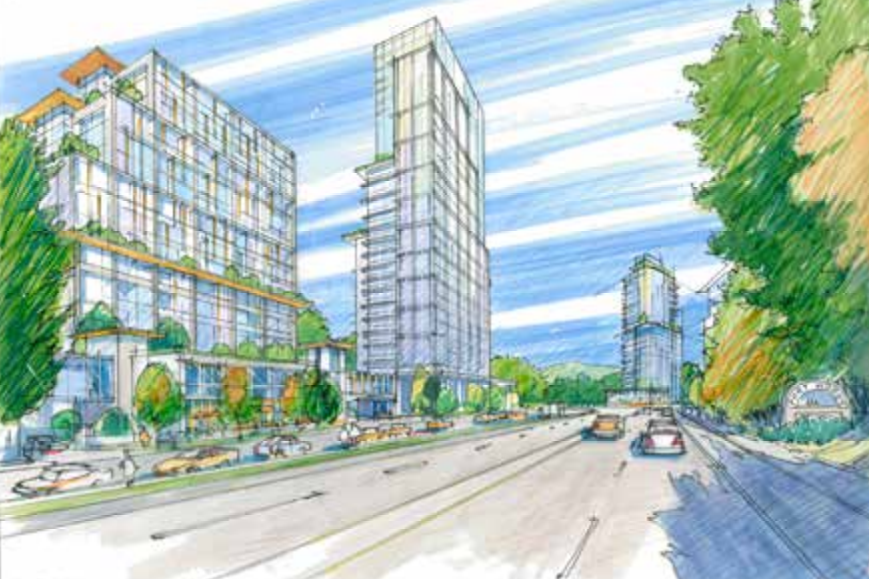
Many pointed to proposed highrise heights – up to roughly 39 storeys in parts of Moody Centre – and high population projections for a city long recognized for its nature, and small neighbourhood feel.
Several warned the plan would turn Port Moody into a “concrete jungle” copy of Metrotown or Brentwood Town Centre.
Traffic and infrastructure pressures were common themes among the opposition. Residents described St. Johns Street, Clarke Road and surrounding neighbourhoods as already gridlocked, with overflow traffic spilling into side streets, limited parking at parks and recreation facilities, and strained transit.
Concerns extended beyond roads. Speakers warned recreation programs are already oversubscribed, schools are near capacity, and access to family doctors is worsening – arguing the city is approving growth without guaranteed infrastructure expansion.
Affordability claims also drew skepticism.
Opponents pointed to highrise communities in Burnaby and Coquitlam where prices have continued rising despite tower construction, questioning whether additional density will deliver truly affordable housing or simply more investor-owned condos.
Several raised fears that unit sizes will remain too small for families, creating what one resident called “vertical dormitories.”
Process and trust issues emerged as perhaps the sharpest flashpoint.
Resident Mark Kunsley said after attending council meetings for a year, he saw a disconnect between community engagement and the land-use decisions embedded in the OCP – particularly the incorporation of the Moody Centre Transit-Oriented Development framework.
“I can’t see a clear line from the engagement input to the plan that’s in front of us,” Kunsley said, criticizing what he described as vague references to engagement quality rather than concrete data showing public support for the most consequential decisions.
He also questioned why the TOD framework was developed while broader OCP engagement was paused and embedded into the plan without separate public consultation.
“That’s not planning – that’s hoping the project problems will solve themselves later,” Kunsley said.
Several speakers accused the council of being overly aligned with development interests, referencing campaign donations and Coun. Diana Dilworth’s employment with Homebuilders Association Vancouver.
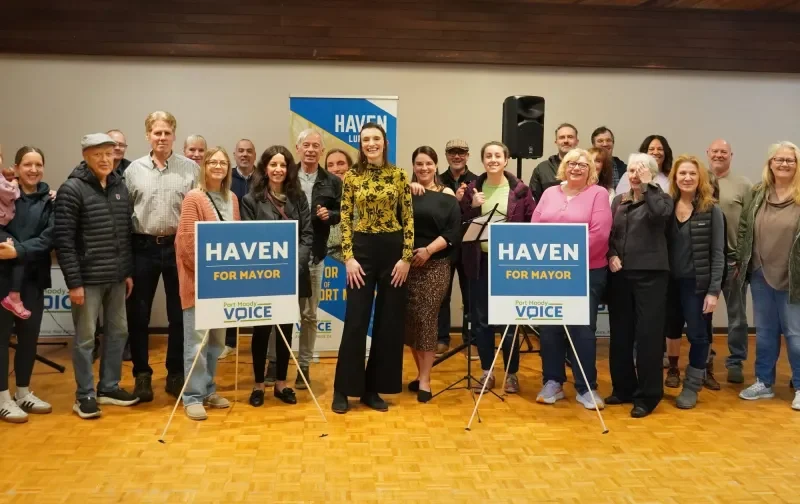
The opposition’s concerns were echoed by Coun. Haven Lurbiecki – the lone vote against the OCP.
Lurbiecki argued the most transformative planning decisions, particularly around tower heights in Moody Centre, advanced without meaningful public engagement while the OCP itself was put on hold.
She pointed to past city surveys where large majorities opposed tower heights currently being prescribed.
“What did we do as a council after being elected on promises of moderate growth and no wall of towers?” she said. “We approved a framework that went taller, we added even more towers, and we did that all without properly asking the public.”
Lurbiecki warned that Port Moody is now planning for more than two dozen towers between Moody Centre, the former Flavelle Mill site, St. Johns Street and Coronation Park.
“If there were an official definition of a wall of towers, Port Moody could submit an entry,” she said.
Supporters on council countered that density belongs near transit and that much of the opposition was focused on a relatively small area of the city.
Coun. Kyla Knowles said growth around SkyTrain stations is responsible.
“This is where density belongs – adjacent to SkyTrain in the middle of the city, surrounded by grocery stores, retail, office and amenities,” she said. “Sometimes people confuse being heard with getting what they want.”
Knowles also pushed back against what she described as misinformation around tower numbers. She emphasized that large park expansions – including waterfront space tied to redevelopment of the Flavelle lands – are already written into the OCP.
Coun. Samantha Agtarap framed the plan as far more than building heights, pointing to climate resilience, environmental protection, arts, culture and community wellbeing policies.
She also challenged the idea that family life requires single-family homes.
“My kids have known no other home than our 900 square foot condo,” Agtarap said. “It is possible – it requires a shift in mindset.”
Coun. Amy Lubik highlighted job creation, affordable rental units in the development pipeline, grocery store expansions, and partnerships aimed at healthcare and school advocacy.
“We’re not doing everything as fast as everyone would like,” she said, “but we are trying.”
Coun. Callan Morrison described the OCP as a living document that will be revisited every five years, shaped by evolving conditions and future councils.
Morrison also noted that provincial housing legislation has mandated significant density far beyond the small Moody Centre core that has dominated debate.
He acknowledged infrastructure concerns but echoed criticisms that the province was not delivering on its responsibilities.
“Time and time again, it has been proven that the province is reactive, not proactive,” Morrison said.
Coun. Diana Dilworth said while the city does need infrastructure upgrades to accommodate the growth, council was “not putting a cart before the horse.”
“You actually need to have growth and development that’s going to pay for the new water lines, the new sewer lines, the new garbage facilities, the new libraries,” she said. “The city doesn’t have a money tree out back. We need our stakeholders to help do that.”
The approved draft bylaw will next sent to Metro Vancouver for review, before the OCP is formally adopted in the spring of 2026.
[Correction: a previous version of this article stated council had “formally approved” the OCP. In fact, council approved third and final reading of the draft OCP bylaw.]
Author