All five Tri-Cities mayors back regional push to repeal B.C. housing laws
All five mayors in the Tri-Cities have added their signatures to a joint letter urging B.C. Premier David Eby to repeal major housing legislation introduced over the past two years.
The Nov. 16 letter, which was co-signed by 16 Metro Vancouver mayors, argued new mandates around small-scale multi-unit housing, housing target orders and transit-oriented areas have undermined local planning and failed to deliver the promised boost in housing supply.
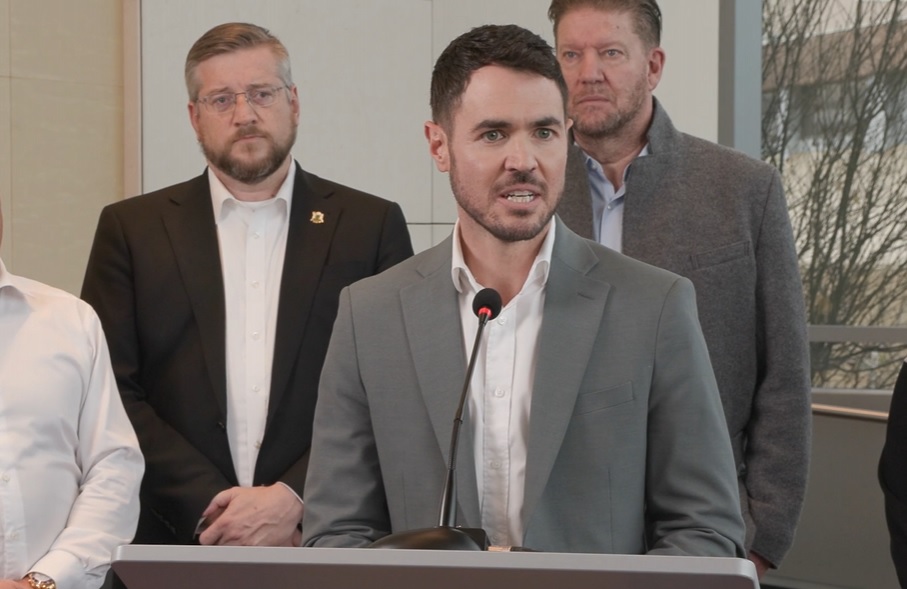
Numerous mayors, including Port Coquitlam Mayor Brad West and Anmore Mayor John McEwen, held a press conference on Dec. 11 coinciding with the public release of the letter.
Local news that matters to you
No one covers the Tri-Cities like we do. But we need your help to keep our community journalism sustainable.
While the province pointed to higher vacancy rates and lower rents, West railed against the legislation, which he said represents an overreach by the province into municipal decision-making.
“The province’s housing legislation has been one of the most ill-conceived, poorly thought-out policy initiatives that this province has ever suffered under,” he said. “Rather than unleashing more housing units like the province promised, it has unleashed chaos.”
The letter states the provincial legislation was developed with little consultation and fails to align with regional land-use plans or infrastructure capacity. It asks the province to roll back the legislation and begin a collaborative process to amend housing laws in a way that considers local challenges for each municipality.
The mayors say they support increasing housing supply and affordability, but argue those goals can only be achieved through cooperation between the province and municipalities, rather than centralized mandates imposed from Victoria.
Coquitlam Mayor Richard Stewart echoed those concerns in a statement provided to the Dispatch, arguing his city has a long history of delivering housing without provincial intervention.
“The City of Coquitlam has long been recognized as a regional housing leader, with a strong track record of approving new homes and supporting both regional and provincial housing goals,” Stewart said. “We have had a record of success for more than a decade without the need for provincial legislation or arbitrary targets.”
Stewart said the province’s approach fails to reflect the diverse conditions across Metro Vancouver, including differences in land use, infrastructure capacity and local planning contexts.
“A one-size-fits-all approach does not reflect the diverse land use patterns, infrastructure capacity and community contexts across Metro Vancouver, which is historically – and rightfully – the role of local government,” he said. “It also fails to consider factors outside of local government control like the economy, the real estate industry, and the timing of development.”
West similarly argued that provincially imposed housing target orders ignore local market realities and planning objectives. In Port Coquitlam, he said, strictly following the targets would result almost exclusively in one-bedroom condominium units, even as thousands of similar units sit empty across the region.
“This is what happens when decisions about communities and how they’re going to grow and develop aren’t made by duly elected mayors and councillors, but are made by bureaucrats in Victoria who couldn’t find these communities on a map,” he said.
The Port Coquitlam mayor also criticized what he described as a double standard, noting that while municipalities are subject to mandatory housing targets, the province has not set comparable benchmarks for its own responsibilities.
“They’ve established no targets for themselves – no targets for new classrooms, new schools, new hospital beds,” he said. “On their responsibilities, they’re failing, and continue to fail, and yet not satisfied with that, they’re going to come and tell every mayor and council how their city should be run.”
Stewart raised similar concerns, emphasizing that housing delivery depends on infrastructure that extends beyond municipal control.
“Housing does not exist in isolation,” he said. “It depends on municipalities being able to build roads, utilities, parks and playgrounds, as well as the infrastructure that falls under the responsibility of other orders of government like schools, transit and hospitals.”
He said municipalities are asking the province to pause and work collaboratively to ensure housing policies are realistic and properly funded.
“That is why we are asking the province to pause, listen and work collaboratively with local governments to ensure housing policies are realistic, achievable and accompanied by the infrastructure people need, supported by appropriate funding and investment from other government partners,” Stewart said.
Mayor John McEwen, who did not speak at the conference, later told the Dispatch that although Anmore is less affected by the changes due to its rural designation, he wanted to support other municipalities in the region.
“These changes are significant and come with substantial costs associated, which the province doesn’t seem to be offsetting to the municipalities,” he said.
He added that forcing Anmore to allow multiple units on all its residential properties would cause issues around parking and its septic infrastructure, which don’t have the capacity in place.
West also criticized the population growth under federal immigration policy, which he said has compounded pressure on municipalities, while senior levels of governments have failed to provide adequate funding for infrastructure and services.
He said municipalities are now left grappling with long-term impacts on infrastructure, health care and education systems.
“We are left dealing with the consequences of those decisions, and will be for probably decades,” West said. “You see these services cracking under the pressure all over the place.”
West framed the issue as a growing political risk for the province, urging the premier to reconsider the approach.
“The province and the premier . . . should be worried about voters,” he said. “People are seeing the consequences of it, and they’re having a reaction.”
B.C.’s premier and housing minister were unwavering in their responses to the letter.
Eby told CTV News that while the province is always willing to work with mayors to refine policy, “now is absolutely the wrong time to back off on housing.”
He claimed that B.C. is leading the country in rent declines, having seen close to a 10 percent reduction over the last two years.
Housing Minister Christine Boyle made similar statements, stating that Metro Vancouver is at a 30-year high in vacancy rates.
She also drew attention to the province’s $1 billion Growing Communities Fund, which was announced in 2024, as a way the province is helping local governments deal with costs.
“We know that what we are doing is making a difference – actions of the provincial government and actions of local governments – and we’re not going to go backwards,” Boyle said.
However, the group of mayors disputed that rent declines had anything to do with provincial policy, stating that their own work to increase supply is what is leading to price declines.
Port Moody Mayor Meghan Lahti, Coquitlam Mayor Richard Stewart, and Belcarra Mayor Jamie Ross were also signatories to the letter, though not present at the press conference.
Lahti declined to provide a statement to the Dispatch, while Ross did not respond by deadline.
Author