Council not convinced 8-storey development is right fit for landslide-prone slope
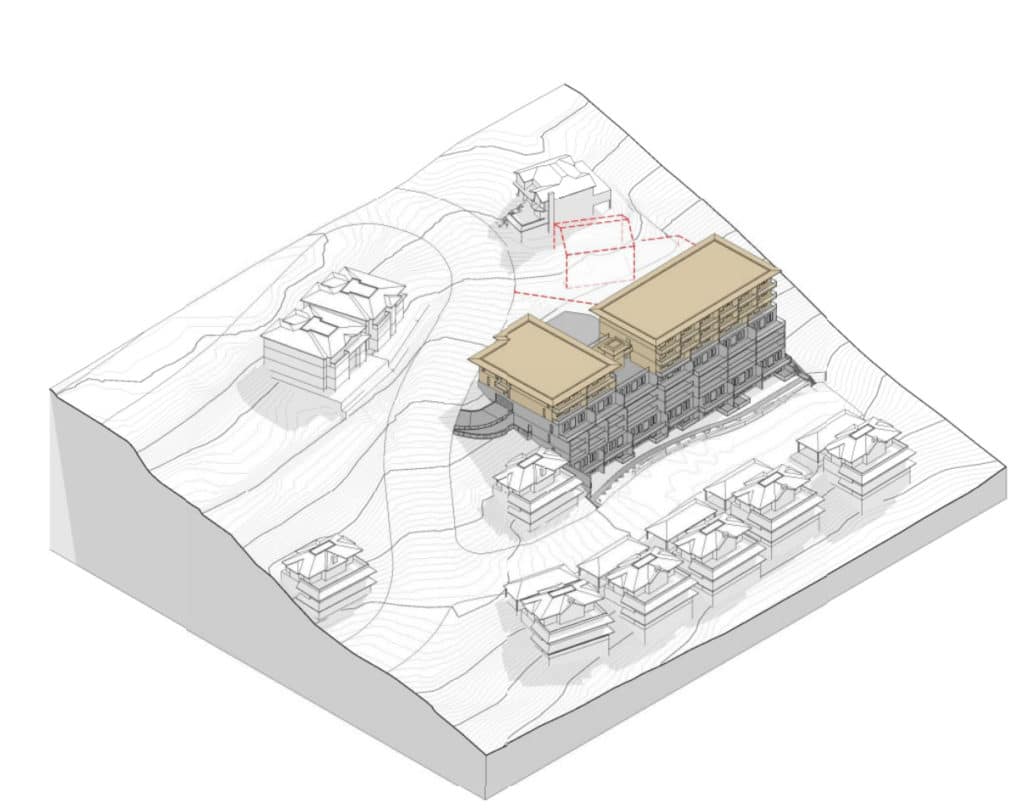
A developer contended that an eight-storey building could stabilize the steep, landslide-prone slope on the western edge of Port Moody. Council was not as convinced it was the right fit for the neighbourhood.
The vacant site was originally earmarked as the last section of a seven-phase development agreement made three decades ago.
A development permit was issued in 1992 for three-storey duplexes but nothing has been built since a 1994 landslide.
Local news that matters to you
No one covers the Tri-Cities like we do. But we need your help to keep our community journalism sustainable.
“In its current form, this is basically unstable,” said Thomas Grimwood, of Grimwood Architecture. “If that hill was to go down again, you’re looking at seven properties that would be impacted … This development would conveniently hold up the hillside.”
The 0.7-acre site is located at 38 Shoreline Circle south of Barnett Highway and is surrounded by duplexes and single-family homes.
The property’s elevation changes by nearly 60 feet from bottom of the property to the top – considered hazardous by the city.
The developer wants to remove the three to four-storey trees that have grown since the 1994 slides and build 68 market rental units.
Grimwood said the eight-storey building would not overwhelm its neighbours, as: “it’s largely buried into the hillside.”
The design includes a five-storey, 103-space concrete parkade, descending from a street level access point, to act as a retaining wall against the slope.
It would require a zoning change and an amendment to the Official Community Plan (OCP) to allow the eight-storey height requested.
In its pre-application review on Dec. 6, staff issued their concerns around the height and density being out of character with the neighbourhood, the lack of transit options, and geotechnical issues.
Further geotechnical investigations would be required if the project proceeds through the city’s development approval process, staff noted.
Council gave the application positive feedback for attempting to add more rental stock to the community, along with the majority of units being two or three bedrooms, but they were less keen on how the design fits within the existing neighbourhood.
Coun. Callan Morrison praised the applicant for proposing 64 percent of the units as family units, but did not think eight storeys was appropriate.
He said he might be in favour if it was “a couple storeys shorter.”
Coun. Diana Dilworth said council often allows OCP amendments to increase density, but this proposal would “dwarf” the smaller duplexes that surround the property.
“I have a real concern about that disparity,” Dilworth said.
Dilworth noted that the developer has a lot of experience building smaller townhouses and duplexes, and asked why they chose a design so “drastically non-conforming.”
Grimwood described the site’s footprint and geometry as “odd” and “awkward” due to the slope’s grade, making shorter designs difficult.
“The site actually benefits from the project being a little bit taller,” Grimwood said, adding that there has been “substantial” geotechnical work done on the site.
He said even a four-storey build cannot reconcile with the grade of the slope.
“A lot of the guidelines and regulations [were] laid out on the assumption that it’s a flat lot and a square site,” Grimwood said. “What we are trying to communicate is that this is really quite dramatic, and we really want to design the most successful project we can.”
He said they looked for precedents in the immediate neighbourhood and found a number of examples with similar building designs, “It’s just on a bigger scale, because of the size of the site.”
Coun. Amy Lubik said the design currently deviates from the city’s climate action plan, but she would consider the application if there was an affordable component offered with the rental units.
Coun. Haven Lurbiecki said she’s wary of the claim that a building would stabilize the slope better than the existing trees.
Lurbiecki said that she’s concerned about offering OCP amendments for larger projects in residential neighbourhoods that deviate from zoning definitions, adding it might increase more speculative applications.
“(Residents) don’t think this is going to be an anomaly,” Lurbiecki said. “I think that’s why we’re going to see things like this happening in places that they probably don’t belong.”
She said council needs to signal that OCP amendments should be rare, and made only for a good reason.
Mayor Meghan Lahti disagreed that the application was speculative, noting its design would be one of the only ways to build on the site because of the slope instability.
She did agree, however, with council and staff’s comments regarding the site’s impact on the neighbouring properties.
Author