Port Moody halts luxury seniors housing facility next to Kyle Park over affordability, density concerns
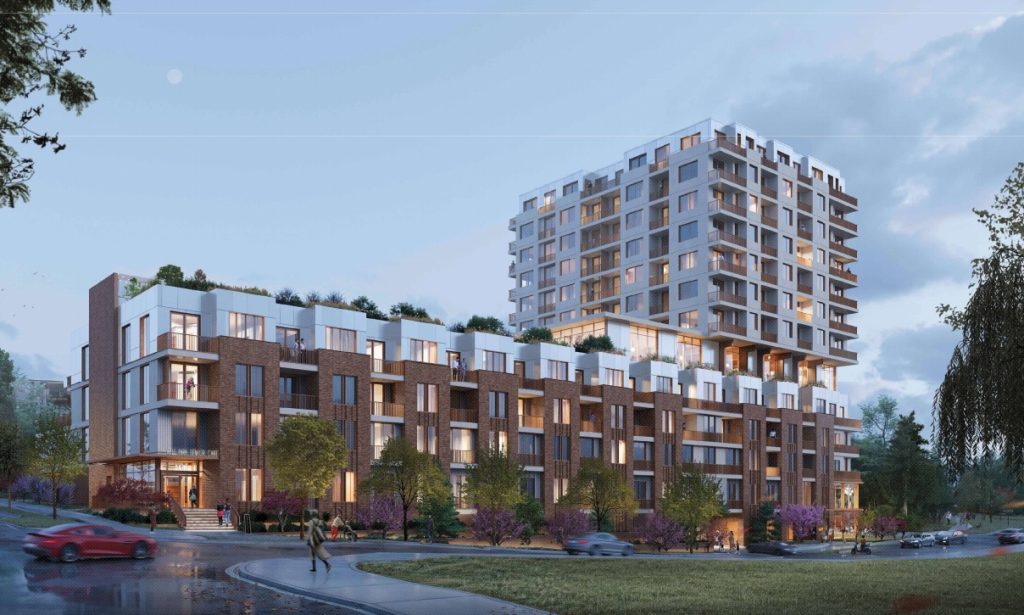
The plan to build a 12-storey private seniors housing facility beside Kyle Park has once again struggled to find enough support at city hall.
Council voted 4-1 against advancing the Kyle Park Senior Living project to a public hearing on Oct. 14, due to concerns over the affordability, location, and scale of the development.
“If we’re going to entertain allowing something that is over and above the massive entitlements already placed on that property, without anything really coming back to the city, I’m not sure that’s in the best interest of our residents,” Mayor Meghan Lahti said.
Local news that matters to you
No one covers the Tri-Cities like we do. But we need your help to keep our community journalism sustainable.
The rejection of second reading marks a major setback for Avenir Senior Living’s proposal, which has been in the works since 2021. Most councillors said the for-profit facility aimed at wealthy seniors still failed to address core community priorities, failed to meet council requested changes, and lacked tangible benefits.
The 12-storey project proposed for the 41,000-square foot site on the 2500-block of St. George St. would have delivered 183 seniors units, including 48 suites for memory and complex care and 135 rental units for independent and assisted living. It was set to feature a full floor of resident amenities, a rooftop patio, 74 parking spaces, and would have created 88 jobs.
Avenir also offered to dedicate 3,251 sq. ft. of land adjacent to Kyle Park, $670,000 in community amenity contributions, and $350,000 in density bonus fees.
Approval requires amending the city’s official community plan as the site is nestled amongst a low-density residential neighbourhood. The proposal also exceeded the eight-storey height and density allowable under the new provincial transit-oriented development rules.
Coun. Kyla Knowles – the only councillor to support advancing the project – said she believed the proposal was worth sending to a public hearing, where residents could weigh in directly.
“This has certainly been a long time coming,” she said, noting the developer had already made major changes at council’s request, including reducing height, relocating the tower on the site, and switching all units to rental.
Knowles stressed that the need for seniors housing is “undeniable” across the spectrum, including market-rate units, and that council should not pass on opportunities considering the ongoing financial struggles in the development industry.
“It’s a very poor development environment right now . . . if we can barely build market seniors housing right now, I don’t see how we’re going to be able to build affordable housing,” she said, adding council is already looking at other locations for affordable seniors housing. “There is a market for this. We need it.”
Knowles shared that she and Coun. Callan Morrison were approached by a group of seniors at a Kyle Centre luncheon who “pounded us on this issue for 20 to 30 minutes saying that they wanted this project, they need it, they want to age in place.”
But a majority of council said the project, as proposed, failed to deliver meaningful community benefits – particularly around affordability.
Coun. Amy Lubik said the application did not reflect council’s past direction and did little to address the needs of vulnerable seniors.
“This is very expensive seniors housing, and it doesn’t meet the needs of our most vulnerable,” Lubik said. ““This is very expensive seniors housing, and it doesn’t meet the needs of our most vulnerable,” she said. “The biggest argument for me is I haven’t seen any movement on that.”
Lubik also criticized the developer for failing to make changes council had previously requested. While she acknowledged the value of a memory-care component, Lubik argued: “it’s not an amenity if it’s a private entity.”
Coun. Haven Lurbiecki agreed, citing overwhelming public opposition – 73 percent of online engagement respondents opposed the project .
She also raised fundamental concerns about its scale and location next to single-family homes and city park, distance from rapid transit, and the price.
“These types of luxury developments, costing thousands and thousands of dollars per month, serve only the few that can afford them,” Lurbiecki said. “Far too many people, far too many seniors, are struggling right now to just survive month to month.”
Lurbiecki argued the development offers nothing close to the community benefit needed to justify its scale. She pointed to 2022 data from the Office of the Seniors Advocate B.C.: 45 percent of seniors live on less than minimum wage, 25 percent on under $21,000 a year, and low-income rates have nearly doubled since 2001.
She warned that approving a high-end project could worsen speculation in the neighbourhood, making future affordable developments even harder to deliver.
“How unfair and how unjust is that?” she said.
Coun. Samantha Agtarap said that while she didn’t disagree that Port Moody needs seniors housing for all income levels, she was not a fan of the development, also citing a lack of community benefits.
She emphasized, however, that municipalities need more support from the province in way of subsidies, and encouraged residents to appeal to higher levels of government.
“Any housing is fast becoming a luxury, regardless of whether that’s for higher income earners or low-income earners,” she said. “This province is not doing the job.”
Mayor Lahti said she was initially inclined to support a public hearing, but ultimately voted no, arguing the proposal ignored council’s clearest direction: to include an affordable component.
“We asked at the last meeting for them to incorporate some form of affordable, and what they did was change it from ownership units . . . and made it all rental so that they didn’t have to provide any,” she said.
While Lahti acknowledged it was not the developer’s responsibility to provide affordable care outside their niche business model, some in the community would welcome the project, and the neighbourhood was in transition; she said the density being requested was not an equal trade off.
“Do we need this kind of housing? Yeah, we do,” Lahti said. But if we send this to public hearing, it sends a message that we’re OK with everything about this. And I’m just not OK with a lot of this.”
With the motion defeated, the developer will need to go back to the drawing board if they want to proceed.
Author