‘You just have to keep rowing’: Belcarra marine biologist wins 4,800-kilometer race across Atlantic Ocean
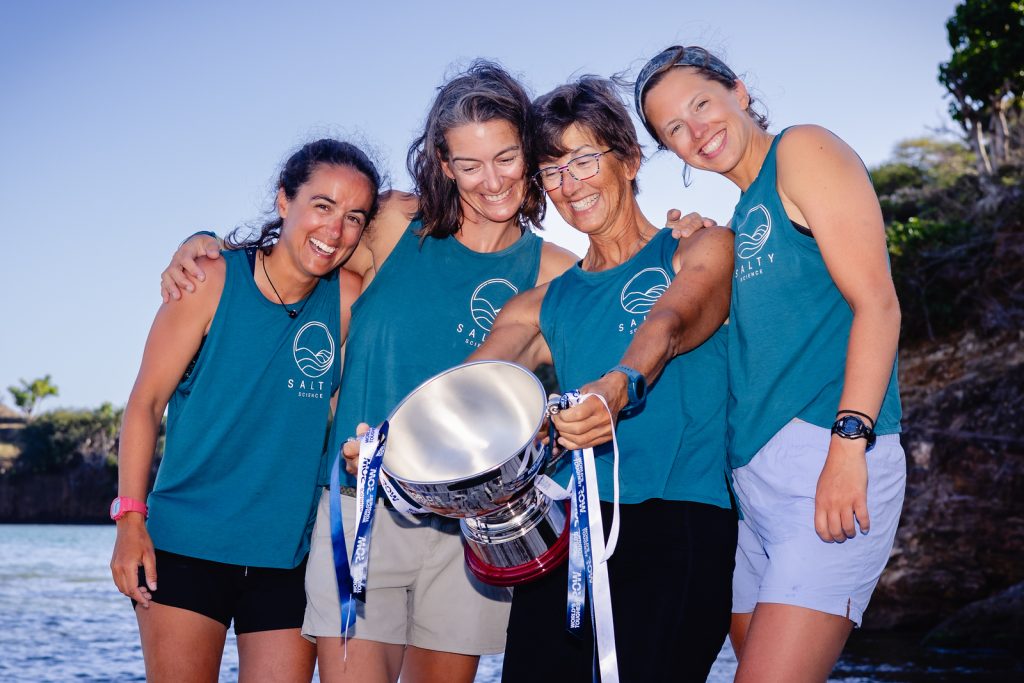
After more than 38 days in the vast expanse of the Atlantic Ocean, Belcarra’s own Isabelle Côté has just completed a feat of athleticism few in the world can lay claim to.
In her early 60s, the SFU marine biology professor rowed 12 hours a day through waves in excess of 25 feet amid broken equipment, sleep deprivation and body sores to complete a 4,800-kilometer rowing race.
“You just have to keep rowing. Nobody was gonna pluck you off the boat and save you,” Côté said. “You feel really, really small out there, and it feels like every day sort of stretches out.”
Local news that matters to you
No one covers the Tri-Cities like we do. But we need your help to keep our community journalism sustainable.
Côté and her three teammates, Lauren Shea, Chantale Bégin, Noelle Helder landed in the Caribbean island of Antigua on Jan. 20, after taking off from the Canary Islands off the coast of Africa on Dec. 13.
The race is called the World’s Toughest Row (WTR) for a reason, pitting teams against not only each other, but the sea, in a physical and phycological test of endurance.
Each rower typically burns more than 5,000 calories a day and will shed around eight kilograms during the journey, according to a WTR fact sheet. Each team will row more than 1.5 million strokes during the voyage, with nothing but a bucket to use as a washroom.
None of Côté’s team – all of whom are marine biologists – had any row experience prior to starting to train for the race three years ago.
And yet Team Salty Science did not just complete. They won.
Out of 38 total boats, the Canadian-American crew placed first out of more than a dozen women’s teams, and seventh overall. They were awarded the prestigious Murden Trophy.
“Winning the women’s class was never our goal,” Côté said. “We didn’t even think that was in the cards.”
She said their first priority was making it across the Atlantic safely. Second, was to do it having fun. Speed ranked last.
Their fifth teammate, the 28-foot rowboat named Emma, was the only one that had made the journey before. It would be her fourth crossing.
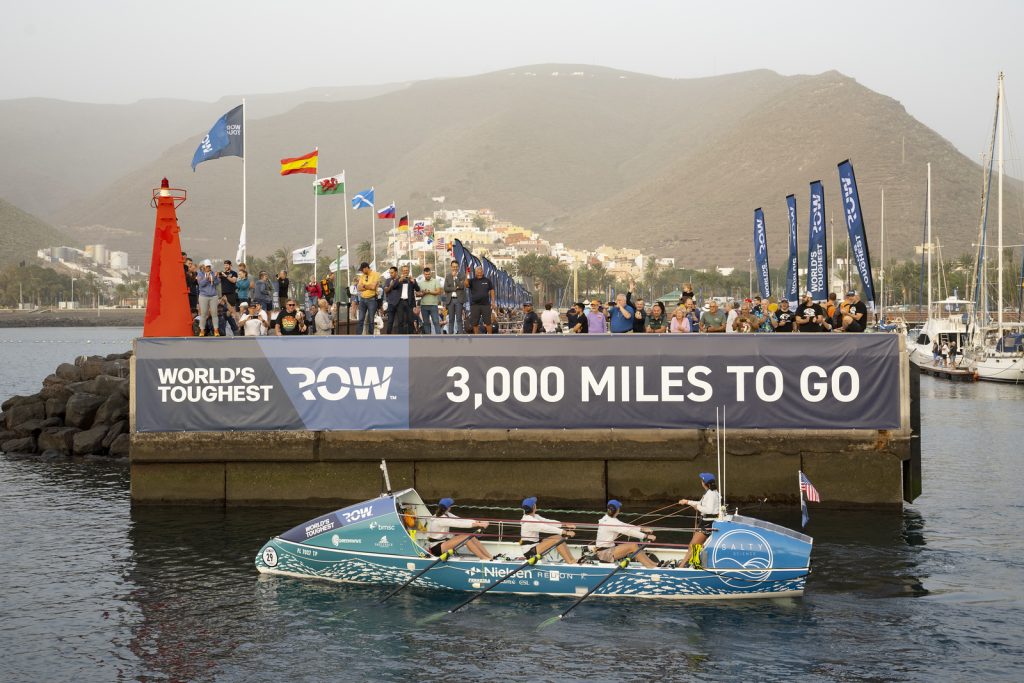
Each member of Team Salty Science is connected through three generations of academic mentorship: Côté was Bégin’s PhD supervisor, who was in turn a university professor for Shea and Helder.
Over three years, the team fundraised for not only the cost of the race – which required a boat, training and gear – but also for three marine conservation organizations.
In total, they brought more than $250,000 U.S. for the Shellback Expeditions, Greenwave, and the Bamfield Marine Science Center in Victoria B.C.
While all the team members were physically fit, they committed to a grueling training program over the last 18 months. A physical fitness coach and psychological coach volunteered their time to help the team prepare for the expedition.
The race’s regulations required them to log 120 hours rowing on Emma, which they completed over the course of three stretches in Florida.
Each member of Team Salty Science had to bring a specialty to the journey. Shea was the mechanical tinkerer, Bégin was in charge of navigation, Helder of nutrition, while Côté was the team’s medic.
Choppy start
The first few weeks of the race proved the most harrowing as they faced extreme weather conditions leaving both team and boat severely battered.
While training for the race in the Gulf of Mexico, they had only experienced waves that peaked at 18 inches, Côté said.
But a couple days into the race, Emma was rolling over waves more than 25 feet high.
“It was crazy. It was a blur to be honest, between being seasick and the big weather. . . . It was incredibly scary,” Côté said. “Nothing in our training really prepared us for those conditions, and everything broke.”
On day four, a large wave crashed into the side of the boat, pinning a metal oarlock at a 45 degree angle, rendering it unusable for the remainder of the race.
Next, their electric desalinator “basically drowned” after its compartment was flooded, Côté said, requiring each team member to manually pump water every day to eke out enough to survive.
This had to be done after their rowing shifts, which would rotate every two hours during the day, and every three hours during the night.
The extra energy spent pumping fresh water was cutting into the precious off-time needed to prep food, clean, navigate – and most crucially – sleep. Each team member would only usually get six hours of shut eye every 24 hours, according to Côté.
The rowing teams in the race are completely unsupported, Côté said, adding that since they row with the current, turning back is not an option.
As a last resort in extreme emergencies, crews can radio out an SOS in hopes a passing cargo ship will come to the rescue.
Fortunately, Shea eventually managed to rebuild the desalinator’s electrical command box to get it up and running.
And while the stormy conditions calmed, leading to some solid rowing days, it kept calming until the wind and current had completely died.
The resulting doldrum lasted around half a week, a period dubbed the “cement days” by the team.
Over one 24 period, they travelled only 20 nautical miles – nearly five times slower than their fastest day. Côté said at that rate it would take them more than two months to arrive.
“We basically did one nautical mile per hour, and that was really depressing,” she said. “It was like rowing in cement.”
(Almost) smooth sailing
The team’s spirit began to turn as the conditions and currents picked up again. Côté said after the first two weeks, they had “exhausted our fears.”
It helped that the marine biologists were treated to countless visits from wildlife alongside their boat.
They saw whales, marlins and were followed by a large pod of dolphins. Flying fish were constantly flopping into the boat.
Côté said when they tossed the fish back into the ocean, larger tuna fish would often catch them on the surface “with a mighty tail splash.”
She said every night they were escorted by a gang of tuna just beyond their oars, glowing a yellowish-green hue alongside the boat’s navigation light.
In the last stretch of the race, the team overtook another woman’s team for first place, and in the final few days, began gaining a substantial lead, Côté said.
She said just when the team thought they could start to relax, a stalking three-and-a-half-metre shark rammed their rudder and unhooked it from its autopilot, forcing them to steer manually.
“About 100 nautical miles or so from shore, we thought, ‘We’ve got this,’” Côté said. “It’s never over until it’s really over. You just can’t predict what’s going to happen.”
Landfall
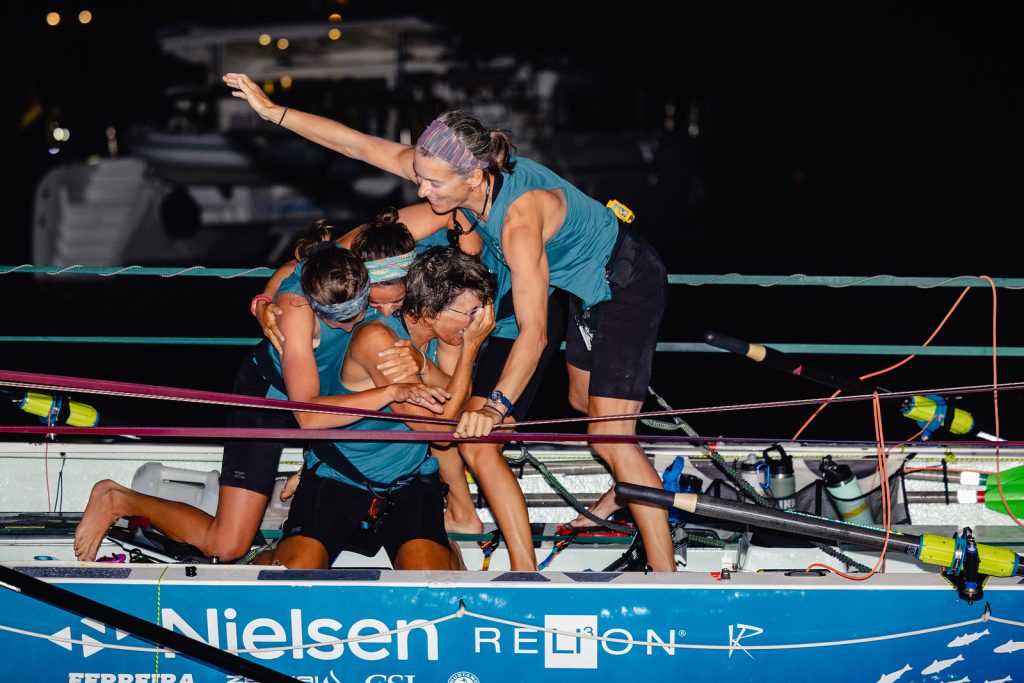
Team Salty Science arrived to English Harbour in Antigua late on Saturday, Jan. 20; the last of three teams to arrive that night. It had taken them 38 days, 18 hours and 56 minutes to reach their final destination.
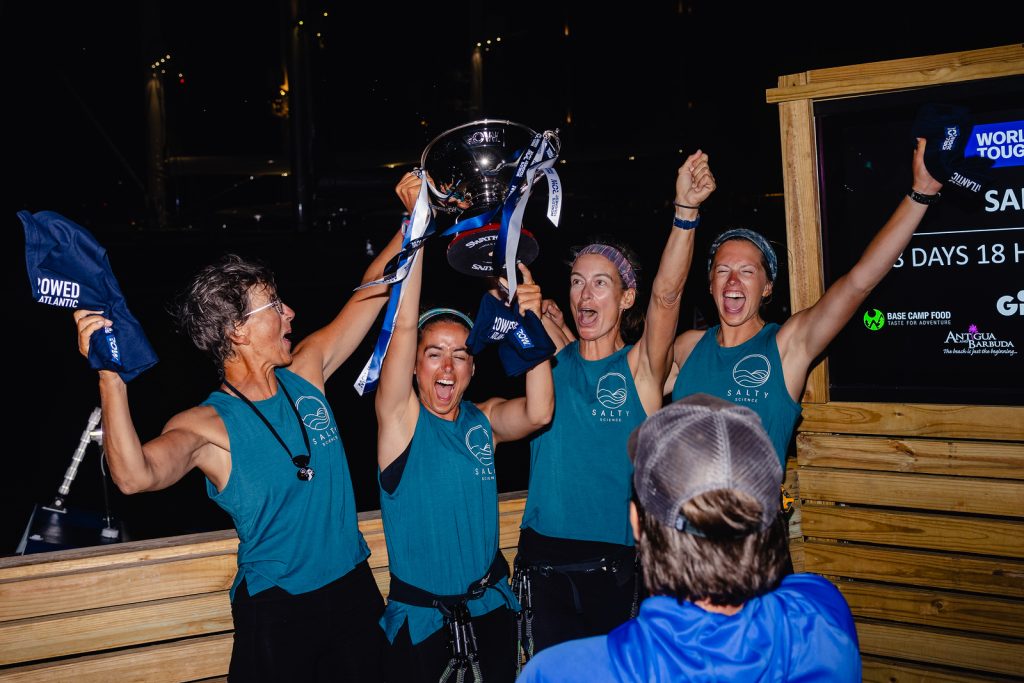
They were greeted by a cheering crowd which included their families, other teams, a huge spotlight, a trophy and the first non-hydrated meal in over a month.
“It was quite overwhelming. You don’t see anybody but your three teammates for 38 days, and all of a sudden there’s all these lights and cameras,” Côté said. “It was so loud, and it was crazy. But it was great.”
Côté said her two daughters stood on either side of her and carried her upright until she could sit down to eat.
She needed assistance walking for two days after making landfall, and her hands were stuck in the handle grip position. “I still can’t make a fist,” she said.
The SFU professor is recuperating another week in Antigua with her husband before flying back to Vancouver.
Together, the team achieved a stunning victory, celebrated Christmas and one birthday, and survived a sometimes-perilous trek across the Atlantic.
But of all the memories Côté takes home with her, she said the little things stick out the most.
She recalled Helder, who had organized the crew’s nutrition, had snuck hidden messages from friends and families into special meals for each team member every week.
“She had kept that a secret from us,” Côté said. “Those are the kinds of really nice team interactions are going to stay with me for a really long time.”
Author