Ioco terminal employees argue Imperial Oil’s mandatory drug and alcohol testing violates privacy rights
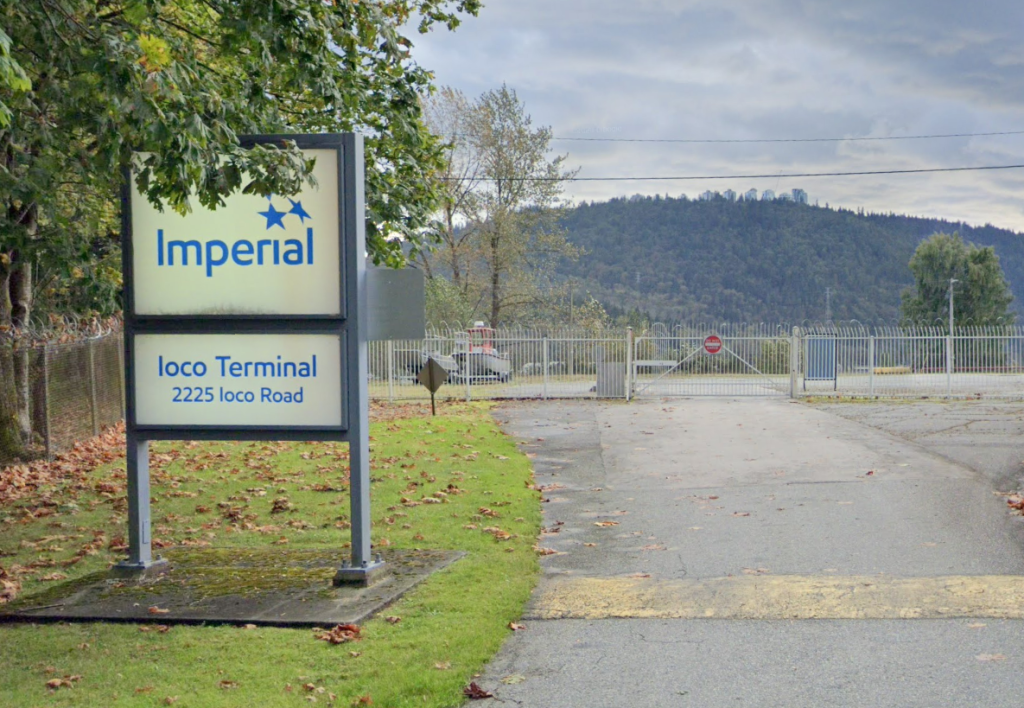
Unionized employees at Imperial Oil’s Ioco facility in Port Moody are in a fight with management over its mandatory drug and alcohol testing policy.
Unifor Local 601 filed a grievance against Imperial Oil on Jan. 24, 2022, arguing the periodic medical examinations were a breach of their employees’ privacy rights under the province’s Personal Information Protection Act (PIPA).
The union is seeking prospective remedies to quash future certification and recertification exams, damages dating back to shortly after the grievance was filed and the destruction of any company medical records attained through these exams.
Local news that matters to you
No one covers the Tri-Cities like we do. But we need your help to keep our community journalism sustainable.
Periodic testing currently applies to 14 employees working in “safety sensitive” positions at the terminal.
It requires these employees to take certification, and re-certification medical exams every two years, testing for alcohol and certain drugs (including cannabis), fitness and management assessments.
Historically, the policy has been a point of contention between the oil giant and the local union. It was first introduced by Imperial Oil in 1991, and the union filed a grievance later that year.
The dispute eventually led to arbitration in 1994, where the arbitration board ultimately sided with the corporation. A letter of understanding agreeing to the policy was signed between the union and company alongside a new collective agreement in 1995.
However, the union is arguing that since PIPA was passed by provincial legislators in 2003, new privacy rights pertaining to the reasonable collection, use and disclosure of personal information have become “semi-constitutional.”
The certification requirements these employees are forced to undergo, always under a company employed physician, are extensive.
A medical questionnaire inquires into their hospitalizations over the last five years, unfixed dental problems, regular medications, psychiatric diagnoses and treatments, tendency to fall asleep, and skin conditions.
They undergo a general-fitness assessment, a head-to-toe “physical system review,” a job-demands analysis, and have to consent to have their exam reports and lab result sent to Imperial Oil’s health department
The current arbitrator notes that the most recent 2020 fitness questionnaire has expanded this medical inquiry.
Company physicians are now performing blood tests for employees’ blood count, liver function and blood sugar, and have the ability to order further tests.
These tests are not just being used to detect substance abuse issues, according to the arbitrator, but overall fitness for work assessments.
“All of the information collected in the exam is disclosed to the employer, including all test results, and the union indicates it is unaware as to how the employer stores and uses the information.”
The arbitrator notes the degree of testing is beyond what the 1994 ruling awarded the company, adding the decision allowed for employees to choose their own physician. Imperial Oil asserts that no employee has every requested to do so.
October 2023 hearing
Imperial Oil sought to have the grievance dismissed, or significantly reduced in scope at an arbitration hearing on Oct. 23, 2023.
Its lawyers asserted the grievance had already been decided through the previous arbitration, had unreasonable and undue delays, and was against the public interest.
The letter of understanding has been incorporated into every collective agreement since 1995 which has confirmed the reasonableness of the practice, they argued.
The company maintains there has been no material changes to the certification processes, adding the union has been silent, showing “long-standing acquiescence” since the previous arbitration.
Unifor Local 601, however, responded that the parties cannot negotiate outside the scope of PIPA, or sanction an indefinite violation of privacy rights.
It asserted the previous arbitration was decided prior to the introduction of PIPA, and that subsequent case law has reached a consensus that without-cause medical inquiries are unreasonable, even for employees who perform safety-sensitive duties.
Lastly, the union argued the previous arbitration reached its conclusion on the basis of property rights analysis, and its ruling has received little support since.
Ultimately, the arbitrator dismissed Imperial Oil’s preliminary objections to the grievance.
They did not agree the union was attempting to relitigate an already decided matter, but apply developments in the law that previously did not exist.
Case law has generally recognized that medical testing at a workplace requires: “reasonable and probable grounds,” the arbitrator noted. “Random testing and periodic testing are generally viewed as an unacceptable encroachment of one’s privacy rights.”
Multiple subsequent cases were referenced by the arbitrator involving safety-sensitive positions at chemical and oil companies which confirmed these rights.
The also noted the arbitration board in 1994 prioritized the safety-sensitive nature of the workplace above other interests, while the case law since PIPA had recognized safety factors are “only the beginning” in determining invasive-medical testing.
“Employees covered by the 1994 Esso decision are on an island of their own in relation to the significant matter of periodic examinations, without having their situation assessed in the context of prevailing generally accepted rights under the PIPA; specifically, in relation to the matter of ‘reasonableness,’” the arbitrator said.
The arbitrator added that privacy rights at issue in the grievance are significant, and cannot be dismissed by mere silence or passage of time without complaint.
“Given the importance of the rights at issue, I am not comfortable in equating the union’s silence with agreement that has the effect of compromising those rights.”
The merits of the grievance are set to be decided at a future hearing.
Author