In Coquitlam, e-scooters are making some sidewalks less accessible for people with disabilities
City working with providers to keep sidewalks clear
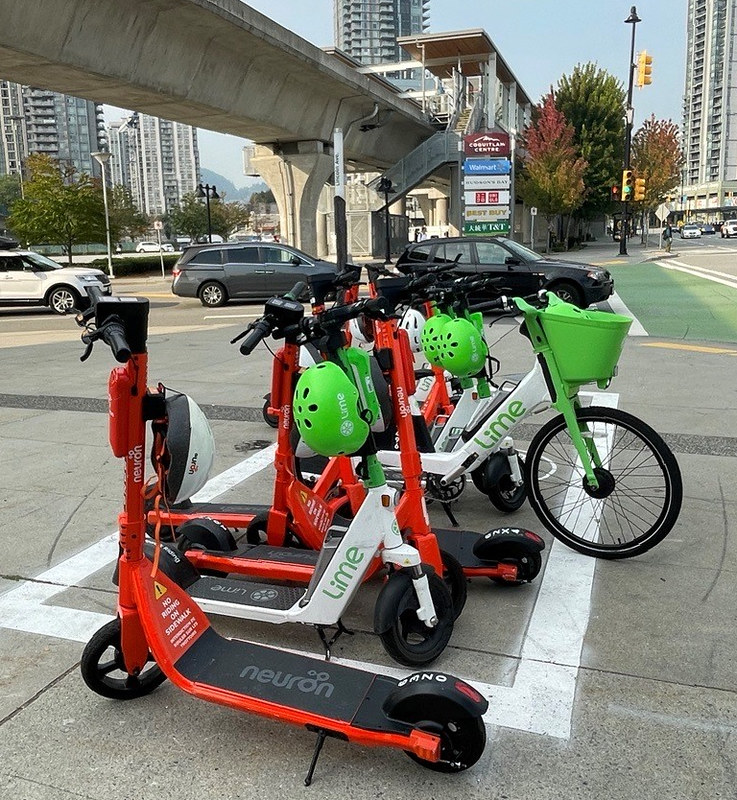
When Lelainia Lloyd comes across an e-scooter left on a sidewalk, it’s more than an inconvenience.
As a wheelchair user, a carelessly-parked scooter makes accessing basic services, such as the SkyTrain, much more challenging. She has to pivot off the sidewalk and onto the grass to navigate around it.
Lloyd moved back to Coquitlam in January of this year, to live in a building with several fully accessible suites. She noticed e-scooters were regularly scattered around the front door, making her own apartment hard to access — a problem that continued until she posted in her building’s Facebook group, explaining how it was an issue for her and other wheelchair users in the building.
Local news that matters to you
No one covers the Tri-Cities like we do. But we need your help to keep our community journalism sustainable.
“But everywhere I go, they’re just dumped all over the city,” Lloyd said. “And I’m lucky, because I have a power chair. If I had a manual chair, it would be that much harder.”
Lloyd also said she’s concerned about people driving e-scooters on sidewalks, and potentially hitting pedestrians as they pass them.
“It’s just so frustrating. And this is the stuff that disabled people have to deal with every day. Able-bodied people are not thinking about us at all. We’re invisible. And so when decisions like this are made, I don’t feel like they’ve given any thought to the impact on people in wheelchairs,” Lloyd said.
Coquitlam has been participating in the province’s e-scooter pilot project since 2023, to see if e-scooters should be authorized for permanent use in BC. This year, the pilot was extended until 2028. The goal is to increase zero-emission transportation options and reduce reliance on vehicles. And while Coquiltam prohibits users from driving or abandoning e-scooters on sidewalks, it’s still an issue that the city is working through.
Coun. Matt Djonlic, the chair of Coquitlam’s Accessibility and Inclusion Advisory Committee, says they are working with folks with lived experiences — such as people with mobility issues, visual impairments, and seniors — to try and make the city accessible for everyone.
He understands concerns about driving e-scooters on sidewalks or dumping them in inappropriate spots. “There is still a lot of work to do. Like I think a lot of things, where technology advancement seems to outpace the legislation.”
Coquitlam has two shared-service e-bike and e-scooter providers, Lime and Neuron, with contracts until the end of the year. They are responsible for the parking, maintenance, and removal and relocation of their devices. Coun. Djonlic said they are pushing them to forbid folks who dump devices on sidewalks from renting again.
To make sidewalks safer, Coun. Djonlic said they are advocating that the province enforce greater regulations on speed limits for e-bikes and e-scooters. Coquitlam is also investing in separated micro mobility lanes.
“These devices aren’t going anywhere. And there’s a lot of good that they provide. We want to see less traffic. We want to see people using micro-mobility,” Coun. Djonlic said.
Richard Marion, a spokesperson for Barrier Free Canada, an organization that advocates for accessibility, said that more guidance is needed from the province.
“Until the provincial government comes up with more clear guidelines for e-scooters, it’s going to be basically the Wild West of different rules and regulations on the various cities that are trying these pilot projects,” he said.
The province published a press release last year announcing a safety review over the next four years of the pilot. It will collect better health and safety data to address questions about the safe integration of e-scooters into cities.