‘State of chaos’: Coquitlam’s Grand Central engulfed in a war between two opposing strata councils
Inside the fight for control of one of Coquitlam’s largest strata corporations

This is the first article in a Tri-Cities Dispatch series on Grand Central’s governance crisis. Read part two here.
Just after midnight on Oct. 25, 2025, seven men clad in dark clothing and armed with pry bars entered the elevator of a Coquitlam highrise.
In two minutes flat, they ripped out new noticeboards installed by a recently elected strata council, tossing the debris into garbage bags.
Local news that matters to you
No one covers the Tri-Cities like we do. But we need your help to keep our community journalism sustainable.
Within an hour, all seven elevators across the Grand Central complex had been stripped bare, leaving behind tens of thousands of dollars in damage.
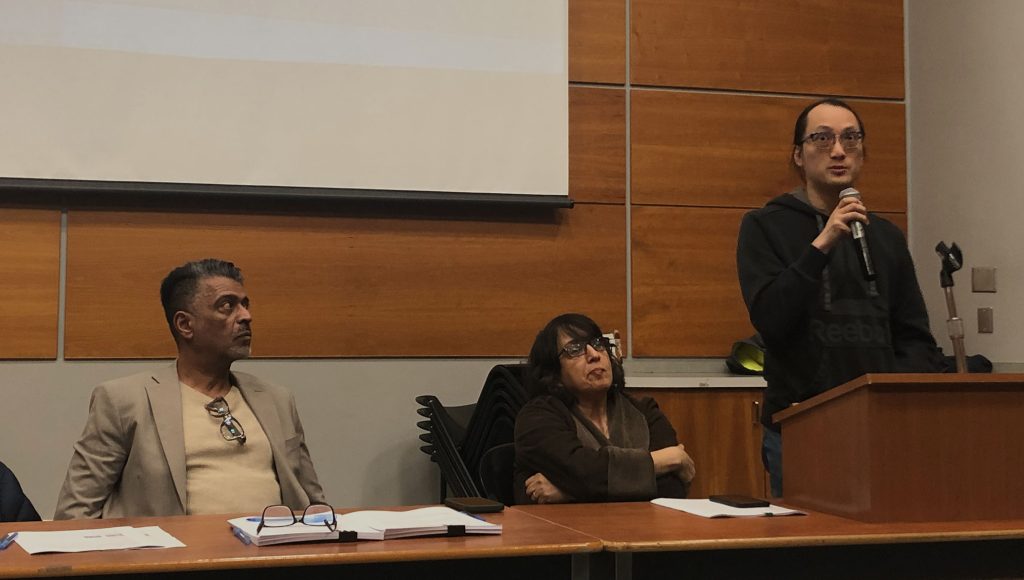
Security footage of the incident was later shared with roughly 60 owners at a Dec. 6 town hall-style meeting hosted by the new council at Douglas College.
While six of the men are unknown, the council told attendees the man holding the elevator door open was Hans Liu, a director of Prosprise Realty – the property management company hired by the recently ousted council.
Uneasy murmurs rippled through the room as the video played.
“This is our home,” said Suminder Mann, vice president of the new council, shouting over the noise. “This is not how a property management company acts.
“To me, it’s very clear there’s one party creating this confusion and destruction and mismanagement.”
For owners living in Grand Central – a massive mixed-use complex composed of three towers between 28 and 37 storeys immediately adjacent to Coquitlam Centre – the incident was just the latest episode in a bitter governance dispute that has fractured the 642-unit community.
Frustration with the former council had been building for years, amid what many owners describe as a pattern of costly litigation, dysfunctional administration, and retaliation against those who speak out.
In September, after more than a year of organizing — spearheaded largely by the strata’s commercial owners — a new council for both the strata and residential sections was elected at a special general meeting (SGM).
The former council declared that election “illegitimate” and refused to concede power.
Control of one of Coquitlam’s largest strata corporations is now the subject of an ongoing legal battle, with allegations of mismanagement, fraud, and defamation being leveled.
The result: two councils and two property management companies claim authority; conflicting narratives circulating through the complex; and owners left confused, angry, and desperate for a resolution.
From organizing to open conflict
Under B.C.’s Strata Property Act, councils are elected by owners to manage a building’s day-to-day affairs. In a mixed-use building there are three sections – commercial, residential and the strata – under the umbrella of the strata corporation. Each has a separate council, though the strata is often composed of a mix of the other section’s representatives as it is responsible for shared costs.
Councils are expected to act collectively and transparently, follow the bylaws, keep accurate records, and provide owners with access to key documents such as financial statements and contracts, while major decisions remain subject to owner oversight through SGMs and annual general meetings (AGM).
Owners at Grand Central say the reality has been very different.
For 15 months, Peyman Majidi, a long-time commercial owner and president of the new council, has been on a crusade to depose what he calls a “crazy dictatorship.”
“The owners in this strata are basically being held hostage by one person,” Majidi said. “I had to either choose between just selling or relocating my business, or fight back and open the owners’ eyes to what’s going on here.”
Supporters of the new council allege former president Hai Zhou dominated both the strata and residential councils for years through an unusually large proxy vote, allowing him to exercise outsized control over Grand Central’s governance.
They claim his leadership over the past five years has led to severe financial strain, maintenance deficiencies, depreciating real estate values, and a steady stream of litigation.
Zhou did not respond to the Dispatch’s repeated emails requesting comment on this series.
More than a dozen legal cases against the strata have made their way through in B.C.’s Supreme Court, Civil Resolution Tribunal and Human Rights Tribunal since Zhou gained control of the residential and strata sections in 2021. Internal strata emails obtained by the Dispatch indicate there are at least 10 active lawsuits open against the strata.
Shireen Nadim, long-time president of the commercial section, said Grand Central’s businesses have been forced to sue the strata continuously over what numerous courts rulings have described as “significantly unfair” treatment.
“When you’re living in a community with your neighbors, these things shouldn’t be happening,” Nadim said.
Tensions at Grand Central began to mount after the commercial owners started organizing a push to remove the council in late 2024.
Under the Strata Property Act (SPA), an SGM to remove a sitting council can be forced if at least 20 percent of owners sign a petition. Organizers say that threshold was reached by late spring, but the meeting was not called by the required deadline.
Instead, the council attempted to discredit the petition as “deceptive and deceitful,” claiming, without evidence, that proxy forms had been forged, according to allegations made in multiple court filings.
In June, Majidi and Nadim filed a petition in BC Supreme Court seeking an order to compel the council to hold the vote.
While that application was still before the court, supporters of the new council informed the judge that they planned to proceeded with an election of their own. The judge raised no objections and adjourned the case, commenting that an enforcement petition would be needed if the result was not recognized.
That SGM went ahead on Sept. 27, resulting in the removal of the former council from their seats. Two days later, an AGM was held and confirmed the results.
Both meetings, which were overseen by an independent third-party, were boycotted by Zhou and his fellow councillors.
Almost overnight, Grand Central became engulfed in an information war.
Owners began receiving contradictory notices and emails. Different property management companies asserted authority. Residents said they no longer knew who was in charge – or even where to send their monthly strata fees.
A “state of chaos”
In the preceding months, the escalating battle at Grand Central led to a shuffle of property managers.
AWM Alliance Real Estate Property Group, the company managing both the strata and residential sections since 2022, ended its service agreement on July 31. Prosprise and MNT Realty were brought on as replacements for the residential and strata sections, respectively.
MNT quit in less than two months.
On Sept. 28, the company gave notice to owners it was ending its contract, citing the level of polarization and uncertain authority going forward. Its last act before ending its services, however, was to affirm the legitimacy of the new council and to allow them access to the strata’s records.
“Any communications issued to owners outside of this council are to be considered unauthorized, illegal, and invalid,” MNT’s final notice said.
Prosprise, on the other hand, continued to follow the directions of the former council, refusing to recognize the election results while claiming to act as the new strata section manager.
On Sept. 29, two hours before the annual AGM, Prosprise sent out an email to owners trying to cancel the meeting, asserting MNT had “unlawfully” transferred meeting host controls to the new council.
Immediately after this meeting, Prosprise posted various notices around the complex attempting to schedule another AGM, alleging both September elections were “invalid.”
When the new council installed new lockable notice boards in Grand Central’s elevators on Oct. 15 to try to control the flow of information, they were dismantled in a stealthy midnight operation just 10 days later.
RCMP were called in relation to the incident, but chose not to open a criminal investigation.
“The initial investigation showed that the signs had been removed by contractors and there was some disagreement between various parties with respect to the scope of work,” an RCMP spokesperson said.
Prosprise and the former council have claimed the original elevator noticeboards were removed and destroyed illegally, and their actions were “legal and reasonable.”
Councillors say their ability to administer the building was repeatedly interfered with by the ousted council. Despite repeated demand letters, they have refused to turn over keys, access fobs, and laptops and passwords.
Mann said he tried to reach out to Grand Central’s security contractors to allow the new council full access to the complex, but was told the former council had preemptively warned numerous companies that the new council was not legitimate.
“You can imagine the extra work that that is creating for us,” he said. “Prosprise has been distributing information by accessing every single floor on every single building in the middle of the night.”
The dispute soon returned to court.
On Oct. 27 – two days after the elevator incident – a BC Supreme Court judge issued a temporary injunction barring every member of the former council from acting in any capacity as representatives of the strata corporation.
The order also prohibited Prosprise from acting as the strata corporation’s manager, though it was still permitted to act as the residential section’s agent as it was still under contract.
In her ruling, Justice Amy Francis described Grand Central as being in a “state of chaos.”
“At this point, it is completely unclear to the owners, to the competing councils, and to the court, who is properly in charge of this organization,” Francis said. “This is clearly a state that cannot continue.”
Prosprise was officially fired as the residential manager on Dec. 4.
The termination letter, sent by the new council’s lawyers, listed numerous “fundamental breaches” of the agency agreement, including refusing to take instructions from the new council despite the injunction, failing to disclose who it is taking direction from, ignoring correspondence, obstructing day-to-day operations, failure to provide basic maintenance and emergency services, attempting unauthorized withdrawals from owners’ bank accounts, and property damage.
The company, however, is refusing to recognize its dismissal.
Prosprise did not respond to the Dispatch’s repeated emails requesting comment on this series.
Another SGM ordered
The new council submitted a petition to enforce the results of the September SGM, and its supporters were eagerly awaiting the first court hearing before a judge on Nov. 26.
Their arguments, however, were never heard. Instead, the case was adjourned.
Zhou, using his sizable cohort of proxies, filed a parallel petition on Nov. 17 calling for a second SGM to remove the new council, effectively sidelining the case.
Justice Simon Coval, noting the large evidentiary record and court scheduling difficulties, said it would simplify issues if another election could settle the legitimacy question.
He reasoned the new enforcement petition could be rendered moot if another SGM could be held in a “valid” manner. An appeal of this decision has been filed.
That election, held on Dec. 19, would become the latest flashpoint in the conflict, one that owners say reflects a pattern of rule breaking and anti-democratic behavior on behalf of the former council.
[Editors note: Hai Zhou and Prosprise Realty issued a response five days past the deadline the Dispatch provided, which ignored most of the questions we asked. After review, we have decided to make several small wording tweaks, and add two sentences for clarity: a response from the RCMP regarding the elevator incident was added; a comment on the legality of the installation of the new elevator noticeboards was added.]
[Correction: The townhall organized by the September-elected council was held on Dec. 6, not Dec. 5 as initially stated.]
Author