BC Hydro cites weather, maintenance shutdown for continuing high water at Buntzen Lake
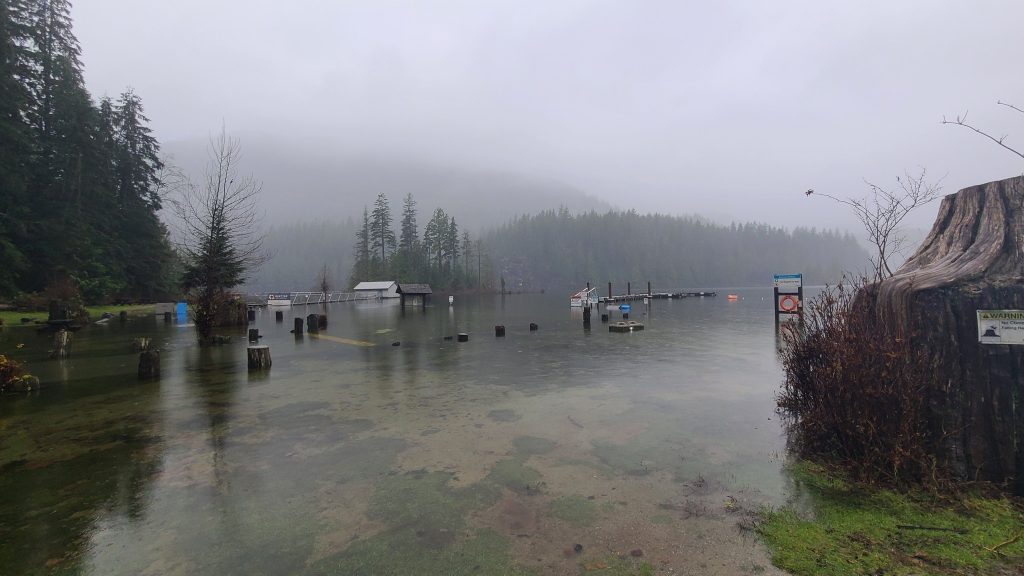
Persistent flooding at Buntzen Lake has stretched for more than a month, swallowing beaches and causing the closure of trails, docks and other amenities.
BC Hydro says the unusually high water is the result of heavy rainfall, warm temperatures, and ongoing capital work that has forced the utility to rely solely on its spillway to draw down the reservoir.
In a statement to the Tri-Cities Dispatch, the Crown corporation acknowledged community concerns and said the situation is linked to both system constraints and infrastructure upgrades are underway.
Local news that matters to you
No one covers the Tri-Cities like we do. But we need your help to keep our community journalism sustainable.
Generator offline
The generator at Buntzen Lake has been taken out of service for a major capital project, which means no water can currently be released through the powerhouse. Under normal conditions, operators balance flows by releasing water either through the generator or the spillway. With the generator shut down, outflow is restricted.
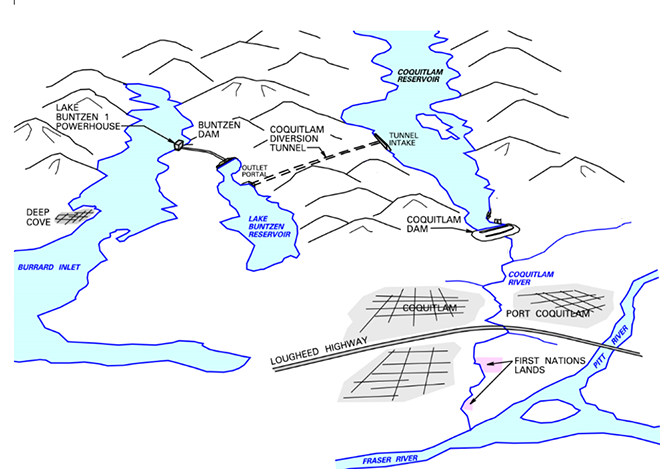
At the same time, BC Hydro has been diverting water into Buntzen from the Coquitlam Reservoir to manage upstream levels.
“Due to ongoing project work, the Buntzen Reservoir is flooding certain sections of shoreline and trails,” BC Hydro stated. “Normally, water is released through the generator or the spillway, but with the generator offline, it’s only released over the spillway, which can raise lake levels.”
High inflows, warm temperatures
While infrastructure is the main driver of the water-level imbalance, BC Hydro says this fall’s weather intensified the flooding.
“Current elevated water levels are primarily due to recent weather patterns, including heavy rainfall and warm temperatures, which have increased inflows to the reservoir,” the statement said, adding that at this time of year there is “no operational requirement” for the lake to be lower than its current elevation.
With more precipitation in the forecast, levels may remain high in the short term.
Closures extend through December 2025
Much of the lake’s shoreline infrastructure is now underwater. BC Hydro has closed the north and south beach docks, the boat launch, the floating bridge, the north beach connector trail, and the west Buntzen trail.
Those closures are expected to last until the end of December 2025, as the long list of rehabilitation projects continues.
Long-term upgrades to the Coquitlam-Buntzen system
BC Hydro’s website outlines a series of capital projects aimed at modernizing the 120-year-old Coquitlam-Buntzen water and power system.
The upgrades include:
- Lake Buntzen Unit Life Extension Project – extending the life of the powerhouse’s turbine and generator.
- Lake Buntzen Flood Discharge Capability Improvement Project – boosting the system’s ability to pass inflows and protect infrastructure.
- Generation Station Crew Dock & Accessibility Upgrades – replacing aging dock infrastructure for worker access.
- Turbine Inlet Valve Hydraulics Upgrade – shifting to a high-pressure hydraulic system to eliminate oil leakage and modernize operations.
One major component – the Coquitlam-Buntzen Diversion Tunnel upgrade – is already complete. Built in 1902 and expanded in 1909–1911, the 3.9-kilometre tunnel moves water from Coquitlam Reservoir into Buntzen Lake, both for electricity generation and to help regulate drinking-water levels for Metro Vancouver.
BC Hydro replaced the tunnel’s three flow-control gates, modernized seismic performance, and added new control equipment for remote monitoring. The system is now in service with temporary controls while crews commission full power and automation.
As part of related work, the utility is also building an experimental sockeye salmon hatchery with the Kwikwetlem First Nation, aiming to produce 25,000 smolts annually. Hatchery construction was completed in late 2024.
When will the lake recede?
BC Hydro says normalization will depend on a return to drier weather and the completion of ongoing generator work.
“We anticipate levels will normalize as inflows decrease and operations adjust,” BC Hydro said, noting the timeline is contingent on weather patterns through winter.
Until then, residents may continue to see flooded trails and infrastructure as century-old systems undergo overdue modernization.
Author