Tri-Cities drug deaths drop 21% in 2025, falling to half of deadliest peak in 2021
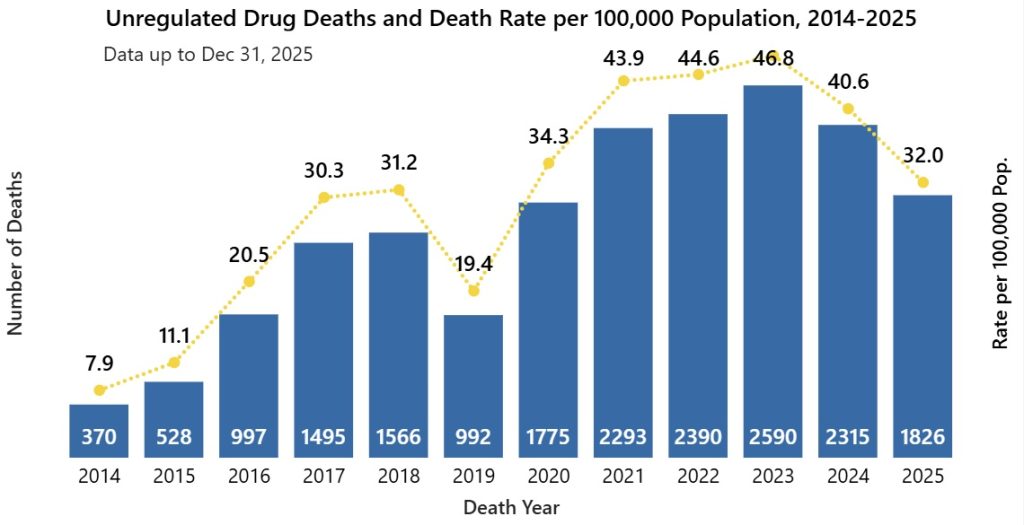
The Tri-Cities experienced a sharp decline in unregulated drug deaths in 2025, continuing a downward trend from the record highs seen earlier in the toxic drug crisis.
A total of 33 people died in Coquitlam, Port Coquitlam and Port Moody last year – a decline of approximately 21 percent from 2024, according to year-end data from the BC Coroners Service.
The number of deaths in the Tri-Cities has now fallen roughly 50 percent since 2021, the deadliest year on record locally, when 66 people lost their lives.
Local news that matters to you
No one covers the Tri-Cities like we do. But we need your help to keep our community journalism sustainable.
Most of the 2025 fatalities occurred in Coquitlam, which is listed as the township of injury for 23 of the deaths – three fewer than the year prior.
The local decline mirrors a near-identical drop across British Columbia. Provincewide, 1,826 people died from unregulated drug toxicity in 2025, down from 2,315 in 2024 – also a 21 percent decrease.
Emergency responders in Coquitlam and Port Coquitlam reported about a 40 percent decline in overdose calls by the third quarter of last year, though officials said at the time they could not fully explain the sudden decrease.
Since the toxic drug crisis was declared a public health emergency in 2016, 422 people have died in the Tri-Cities and 18,219 across B.C.
However, the province’s year-end summary shows the crisis remains severe.
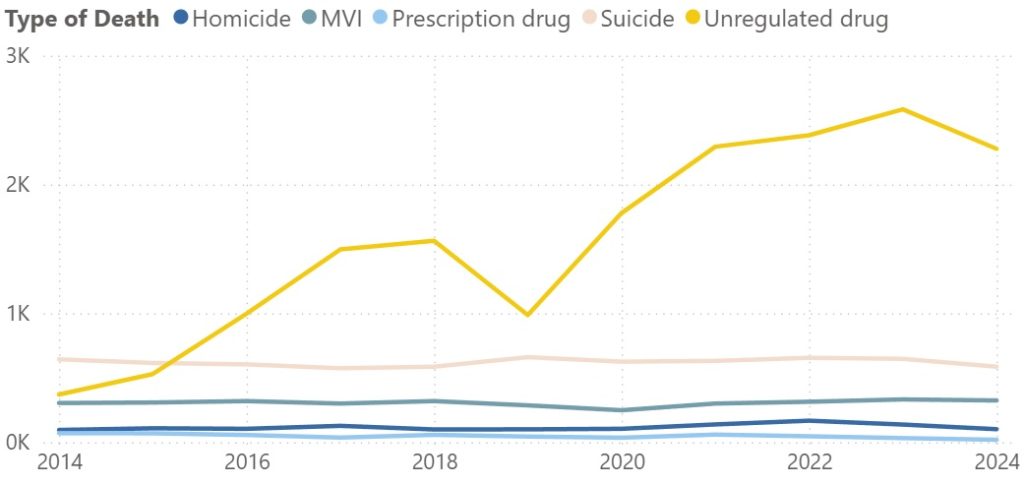
Unregulated drug-related deaths still account for the largest source of unnatural deaths in B.C. by a large margin, outpacing suicide, motor vehicle incidents, prescription drug deaths, and homicide combined.
Preliminary data indicates 136 suspected unregulated drug deaths occurred in November and 141 in December 2025 – averaging roughly 4.5 deaths per day during those two months. The figures remain subject to change as investigations conclude.
In 2025, 69 percent of those who died were between the ages of 30 and 59, and 77 percent were male.
While overall deaths declined, there was an increase among youth. Twenty-six people under 19 died of suspected drug toxicity in 2025, up from 21 the year before. That figure remains below youth totals recorded in 2021 (29), 2022 (34) and 2023 (28).
Geographically, the highest number of deaths occurred within the Fraser Health and Vancouver Coastal Health authorities, which recorded 533 and 484 deaths respectively – accounting for 56 percent of all fatalities in 2025. The highest death rates were recorded in Northern Health, at 48 deaths per 100,000 people, and Island Health, at 38 per 100,000.
Eighty percent of deaths occurred indoors, including 48 percent in private residences and 30 percent in other indoor locations such as supportive housing, SROs, shelters and hotels. Twenty percent occurred outdoors in places such as vehicles, streets and parks.
Smoking remained the most common mode of consumption, with 65 percent of fatalities showing evidence of smoking. Nasal insufflation accounted for 11 percent, injection for nine percent and oral consumption for four percent.
Toxicology results show fentanyl was detected in 69 percent of deaths, fluorofentanyl in 54 percent, cocaine in 53 percent and methamphetamine in 52 percent. Benzodiazepines such as bromazolam (31 percent) and desalkylgidazepam (27 percent) were also commonly present, while hydromorphone was detected in three percent of cases that underwent testing.
Author