Drained accounts, massive deficits, years of delayed repairs: Grand Central’s strata left on the financial brink
Former council left strata exposed after years of secrecy, owners claim
This is the third article in a Tri-Cities Dispatch series on Grand Central’s governance crisis. Read part one and part two here.
As Grand Central’s governance dispute dragged through the courts last fall, an urgent issue began to dawn on the newly elected strata council – they were nearly broke.
After gaining access to official records following the September election, councillors discovered a financial position so precarious that any event requiring significant emergency repairs could leave the strata completely exposed.
Local news that matters to you
No one covers the Tri-Cities like we do. But we need your help to keep our community journalism sustainable.
“If something happens to the building, there’s no money,” said Peyman Majidi, president of the new council. “That is really risky and scary.”
According to their records, the former council ran a massive deficit, failed to attend to crucial maintenance problems, drained the contingency fund, owed hundreds of thousands to contractors, and spent hundreds of thousands more on legal fees.
Even more concerning, the new council alleges, is that all previous spending cannot be accounted for. They have continually stressed to owners the need to hire a forensic accountant to decipher their books.
But without a legal resolution, the council says they are stuck in limbo. Bills need to be paid, expensive capital projects need to be approved, and the former council is still in control of the residential section’s accounts.
Financial shock
Residents of Grand Central had long had questions about the state of the strata’s coffers under the leadership of Hai Zhou, the former president.
After years of owners’ requests for record disclosures allegedly being ignored, the new council finally had access to the strata section’s finances.
“It was very shocking,” said Simon Ng, a member of the new council. “It was very disappointing.”
The strata corporation – which collects roughly $3 million annually in fees – had $4,315 in its operating account as of Oct. 31, 2025.
Current-year spending exceeded budgeted levels: the strata owes nearly $225,000 in unpaid invoices, and is facing a projected $265,000 operating deficit for 2025. When combined with deficits carried over from previous years, the combined deficit shortfall is over $650,000.
Internal emails obtained by the Dispatch show that the former property manager, AWM-Alliance Real Estate Property Group, was directed by the old council to conceal the deficit total from meeting minutes in an April 2025 email. AWM warned against this action, describing the situation as “troubling.”
“We highly recommend holding the annual general meeting (AGM) as soon as possible as the catch-up fees will be VERY substantial if held late,” the email stated.
Despite the warning, the AGM was not called for another four months.
According to allegations in court filings, the former council has called AGM months late for four consecutive years, allowing the council to approve budgets retroactively after much of the spending for the fiscal year had already occurred.
On top of faulty budgets, approximately $810,000 had been drawn from the contingency reserve fund (CRF) as loans, leaving a balance of just $375,000.
Under the Strata Property Act (SPA), borrowing from the CRF requires approval by a three-quarter vote of owners at a general meeting.
Commercial section president Shireen Nadim said no such vote ever occurred.
“They never got permission,” Nadim said. “People who don’t have any knowledge or experience are making decisions for a $250 million asset.”
Zhou did not respond to the Dispatch’s repeated emails requesting comment on this series.
Aging buildings, mounting costs
Concerns over the depletion of the strata’s CRF fund are compounded by the physical condition of the three-tower complex.
The CRF, which is a legally required rainy day reserve used to pay for major or unexpected repairs, lacks the capital needed for many needed maintenance projects, according to the new council.
Engineering reports commissioned from 2023 concluded that while Grand Central’s towers – built between 2009 and 2014 – remain structurally sound, many exterior components are reaching the end of their service life.
Inspectors documented cracking and water ingress in the parkade, and more serious deterioration at balconies, windows, sealants, and exterior wall transitions, where waterproofing systems are failing. Inside some units, engineers noted condensation, mould, and moisture staining, particularly near windows and exterior corners.
The reports warned that continued patch repairs would no longer be sufficient, recommending a coordinated program with preliminary cost estimates ranging from $5.1 million to $6.6 million.
Delaying comprehensive repairs, the reports cautioned, would likely result in higher long-term costs and additional interior damage.
Owners, however, claim strata fees have been stagnant for years.
A new owner, Ron Seida, said one of the attractions of buying in Grand Central were the building’s low strata fees. He said he now realizes the monthly costs were so low because no maintenance was being done.
When he first moved into a unit on the 32nd floor in mid-July, he initially thought the many holes covering the hallway ceiling were a positive sign that upkeep work was frequent.
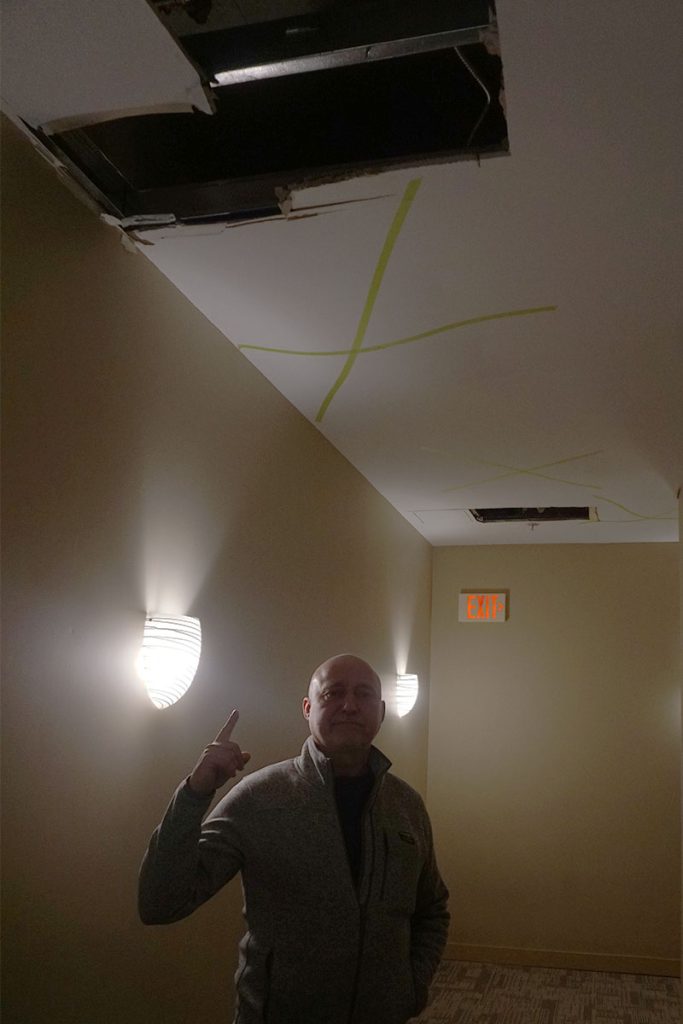
Neighbours soon informed him the holes were the two-year-old remnants of an unfinished pipe-repair job.
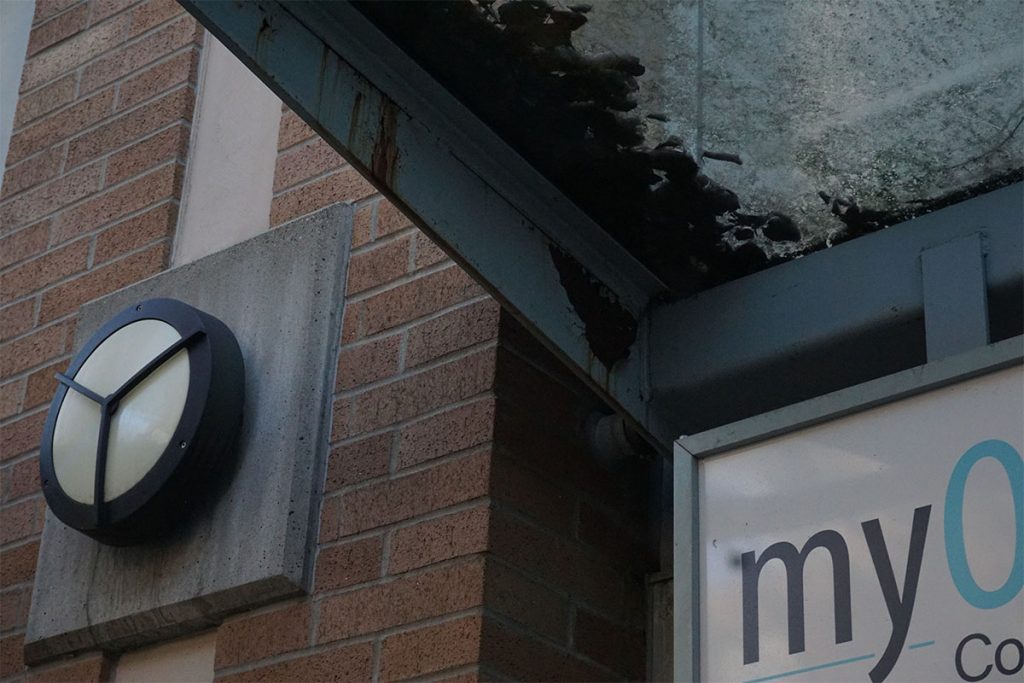
After living in Grand Central for six months, Seida said he is “appalled.” The carpets are filthy, air vents are stained with streaks of black dust, and rust and peeling paint cover the metal exteriors of the building.
“Things are literally falling apart. Honestly, if I had known how bad it was, I wouldn’t have bought the place. I would have run away,” he said. “I have myself to blame partly, but I’m just a consumer. I saw a good deal on a condo, and it was our dream home.”
Left: Seida pointing at the ceiling holes in the hallway on his floor in Grand Central 1. Patrick Penner photo
Numerous owners interviewed describe Grand Central’s elevators as being in a constant state of disrepair, frequently being out of service and often failing in pairs, leaving residents – especially seniors – with no options of getting home.
One resident, Padam Misri, said he was trapped in the elevator for two hours after it broke down, and had to rescued by firefighters.
“I have an 80-year-old wife who is terrified to even step in the elevator without me,” he said. “It has made our living here just impossible.”
Flooding is another frequent issue.
Grand Central’s copper pipes are riddled with pinhole leaks, which has led to pipes bursting and flooding multiple floors on numerous occasions, according to Ng.
“We have a lot of that, and we have to figure out long-term if the strata is going to have to replace them all,” he said.
In a legal ruling, the strata was found to be negligent regarding the maintenance of its pipes.
One owner, William Mok, was forced to file a dispute with the B.C.’s Civil Resolution Tribunal (CRT) after his unit flooded just two weeks after he purchased it, leading to months of lost rental income.
In late 2023, the tribunal found there had been years of inadequate maintenance on the building’s main drainpipe. The strata’s plumbing contractor terminated its maintenance agreement after invoices went unpaid, and there was a documented history of prior backups and warnings that more frequent cleanings were needed.
Omid Khosravi, secretary for the council elected in September and a real estate agent with nearly two decades of experience, said the Grand Central’s reputation has already affected property values.
Local real estate agents are required to look through strata minutes and inform clients about potential liabilities. Khosravi said that units in the complex are selling for significantly less than other comparable units in the area, despite property assessments being higher.
“All the realtors know about Grand Central,” he said. “They know how mismanaged this property is.”
Legal bills
With so much deferred maintenance, owners say much of the drain on the strata’s resources appear to be from legal bills.
More than 20 legal actions have been filed against the strata since 2021 – including at least 10 active suits – and the September-elected council estimate close to a million dollars have been wasted on unnecessary litigation.
After gaining control of the strata section, the new council was sent a $120,000 invoice from the strata’s former lawyer, requesting payment for unpaid debt incurred by former council in the leadup to the election.
Nadim said it is frustrating because the lawyer should be representing the interest of the strata, not just Zhou and his fellow councillors.
“Zhou paid out of the pocket of regular owners for his own interests,” Nadim said.
In fact, the former council has a history of dragging out lawsuits, causing legal bills to pile higher and higher.
One case, filed by commercial owners over an unsanctioned parking cage restricting customer parking, allegedly led to $350,000 in legal bills before a judge finally issued an injunction finding the strata acted in a “significantly unfair” manner.
In another suit, which has dragged on for years and is still for the courts, commercial owners claim they have been saddled with hundreds of thousands of dollars in improperly allocated expenses.
And the legal fees continue to mount.
Since owners filed a petition in the spring of 2025 calling for an SGM to remove the former council, the strata spent nearly $200,000 on lawyers. Since then, the new council has spent approximately $120,000 trying to enforce the validity of the recent election.
Internal emails obtained by the Dispatch show Zhou’s council, which still controls the residential section, has retained two legal firms. One was paid using money drawn from the CRF.
Seida said he feels like regular owners are being “held hostage” by Zhou and the courts.
“Zhou is burning up enormous amounts of time and enormous amounts of money,” Seida said. “It makes me so goddamn mad, because he’s spending my money.”
Unauthorized withdrawals, frozen accounts
Prosprise Realty, the residential section manager hired by Zhou’s council, was officially fired in December by the new council, who urged owners to redirect payments to the Pacific Quorum which was hired as their replacements.
Of the numerous alleged contract breaches Prosprise was terminated for, one was unauthorized withdrawals from owners bank accounts.
The new council said they have received repeated complaints from owners that Prosprise was still attempting to withdraw money even after being told to stop.
At a December town hall meeting, dozens of residents raised their hands when asked if they had experienced these unauthorized withdrawals. Several said they were forced to issue stop-payment orders at their banks.
On Nov. 21, the Royal Bank of Canada froze the residential trust account managed by Prosprise after being notified of the issues.
“We don’t know how they are handling our money,” Ng said. “We don’t know where our money is going.”
Prosprise did not respond to the Dispatch’s repeated emails requesting comment on this series.
Cost of uncertainty
Anxiety over the ongoing legal battle and financial state of Grand Central has taken a personal toll on many residents.
Ng said the stress has affected his sleep and his ability to work. He said even if the governance dispute is resolved in their favour, he fears the damage may have already been done.
“There’s going to be a long tail to this,” Ng said. “Fixing the records, fixing the finances, fixing the building – innocent owners are going to pay for it.”
Suminder Mann, vice-president of the September-elected council and a first time homeowner, said the experience has been “traumatic.” He said it has fundamentally changed how he views condo ownership, and he would never buy one again.
“How hard is it to buy anything here?” he said. “We worked our asses off, saved, and made huge compromises just to afford a place. Then you finally buy, and you’re being taken advantage of.”
Author