Port Moody edges forward on Moody Centre district energy system, but skepticism on council heats up
Port Moody council will keep advancing a plan for a district energy system for Moody Centre, even as doubts mounted over costs and risks.
On Sept. 16, council voted unanimously to approve staff’s recommendation to proceed with next steps on the sewer-heat-powered neighbourhood energy utility (NEU), setting aside $40,000 from the Climate Action Implementation Reserve to draft a service area bylaw, prepare connection guidelines for developers, and begin sounding out potential private sector partners.
But council’s prior enthusiasm has waned, with a majority of members expressing skepticism over the initial $21 million price tag, plus another $65 million to expand the network through 2050.
Local news that matters to you
No one covers the Tri-Cities like we do. But we need your help to keep our community journalism sustainable.
“I’m becoming less and less sure that this is the right path to take,” said Mayor Meghan Lahti. “We need to feel that we can pull the plug and not feel bad about it.”
A district energy system is a central plant that generates heating or cooling and distributes it through underground pipes to multiple buildings, replacing individual boilers or furnaces with a shared – often more efficient and low-carbon – network.
Council’s mood-shift follows a new preliminary design report which has tempered some of the previous expectations on what an NEU could provide.
A feasibility study released in March suggested a centralized sewer-heat recovery system could deliver heating to the Moody Centre transit-oriented development (TOD) area at 19 percent lower lifecycle cost than conventional building-by-building systems.
However, a new report projects savings closer to 10 to 14 percent over 25 years, with greenhouse-gas reductions roughly equal to the status quo, at least until the permanent plant is built around 2040.
Despite those diminishing returns, project consultant Gerard MacDonald of Reshape Strategies said council should consider NEUs as a “generational initiative . . . thinking on the 50 to 100-year-time horizon of your city.”
He said NEU are more resilient, easier to maintain and operate, enable implementation of new low-carbon technologies, and can scale easier than a building-by-building approach.
MacDonald pointed to Vancouver’s False Creek NEU – running since 2010 and now tripled in capacity – as proof the model can work.
He also noted growing interest from BC Hydro, which recently hosted a 100-person summit on district energy, suggesting Port Moody could secure senior-level funding if it positions itself now.
“All the solutions we’re looking at have near-zero carbon performance. Cost is one parameter for decision-making. . . . When you factor in other non-financial considerations, our conclusion was the neighbourhood pathway is the preferred pathway.”
How the system could potentially unfold
The design envisions three phases of rollout tied to development timelines.
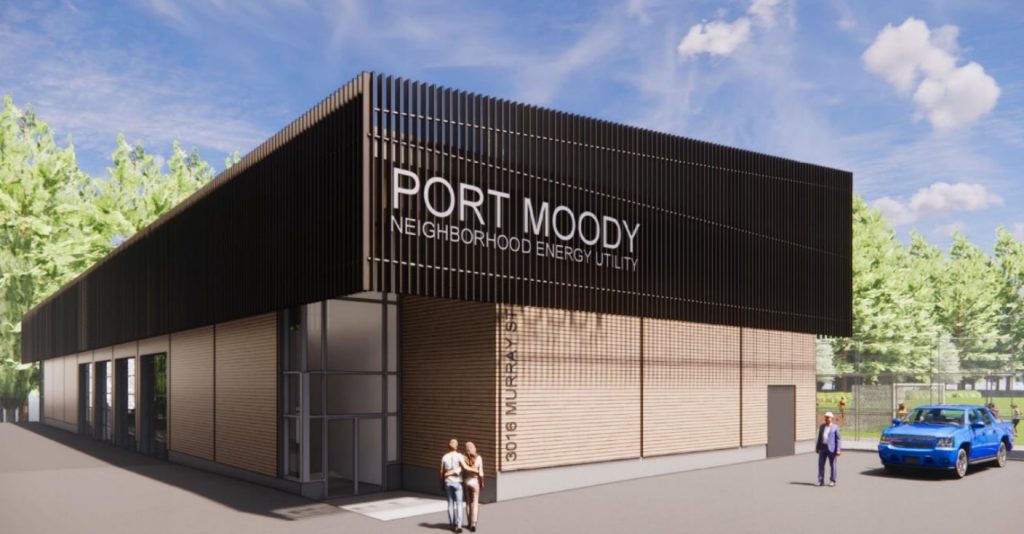
- Phase 1 (2025–2030): A temporary energy centre—essentially a shipping container housing electric and gas boilers—would be installed at 3016 Murray St. to serve three projects already proposed by Beedie Living, PCI Developments, and Anthem Properties. This would establish the “minimum viable network,” enabling those buildings to meet the top tier of B.C.’s zero-carbon step code.
- Phase 2 (2030–2040): More piping would be laid to connect additional parcels as development advances.
- Phase 3 (2040–2050): A permanent two-storey energy centre, also at 3016 Murray, would tie into Metro Vancouver’s sewer mains to recover heat and distribute it as hot water, covering about 70 per cent of the neighbourhood’s annual heating and domestic hot-water load.
Cooling would be left to individual buildings, following the path taken by Vancouver, Richmond, and North Vancouver when they first launched similar systems.
“It doesn’t stop you from adding cooling in the future,” MacDonald said. “But adding it now wasn’t going to give you much in terms of the public benefits you’re after.”
Ownership and financing still in flux
Staff are recommending a “100 percent municipal ownership with support” model, in which the city retains control of the assets and regulatory authority, but hires a private partner under a design-build-finance-operate-maintain arrangement.
This would allow Port Moody to leverage private capital and expertise, while keeping strategic decisions like mandatory connections within council’s authority.
MacDonald noted Richmond’s approach—creating a government business enterprise to own the system while private partners finance and operate it—as a possible model.
“They maintain the underlying ownership of the asset, but they have the private partner bring the capital, bring the debt, bring the equity. Under this arrangement, it doesn’t impact the city’s borrowing capacity.”
Council support laced with skepticism
While no councillor opposed advancing the work, many voiced deep reservations.
Coun. Kyla Knowles said new projections for emission reductions and cost savings may not be worth the risk to the city.
Like the mayor, she cautioned against advancing the project due to sunken costs. She added that while the province has raised the amount of debt municipalities can take on without needing to hold a referendum, “it shouldn’t be a free-for-all.”
“I’m really going to be looking for a return on investment here for the city. If the city is proposing to become a utility here, it has to be worth it,” Knowles said. “The downsides might be that there is an impact to affordability.”
Coun. Haven Lurbiecki tied her concerns to broader unease over Port Moody’s development vision, arguing that creating an NEU for Moody Centre essentially ties the city to success of the high-density developments planned for the neighbourhood.
“I personally do not agree with the (development) vision that this is leading us to, and I think many, many, many, many residents in our community don’t either,” she said. “This is a huge, huge undertaking for a relatively small city. I think we really need to be careful.”
Mayor Lahti said she supported building the business case but worried about exposure if assumptions proved wrong.
“I think we need to do a little bit more digging around what other systems are out there.”
Coun. Callan Morrison worried about tying up scarce city resources trying to be a leader on climate change.
“Sometimes being cutting edge and trying to lead for climate change is great . . . but there can be a point where the risk factor to be a leader can become very large,” he said. “Especially when we’re going to be potentially borrowing for other very important projects and a lot of capital projects in the future.”’
Other councillors were more optimistic.
Coun. Diana Dilworth said that while it was a greater level of risk than the city would usually undertake, she stressed that the costs would be shared by developers and potential energy partners.
She said her biggest concern was around timing, noting how volatile the development industry currently is, with projects frequently being behind schedule and over budget.
“I would hate to think of the worst-case scenario: having buildings built but they don’t have heat, or we have a new heating system in place with no buildings to heat,” Dilworth said. “At the end of the day, there has to be a positive return on investment.”
However, she also noted that Port Moody would not be “reinventing the wheel” as many municipalities have successfully implemented NEUs in different models.
Coun. Samantha Agtarap agreed, pointing out there were 250 NEU systems across Canada, several of which are right in the Lower Mainland.
“We’re not the first, we’re not piloting some new technology. That helps me feel a little bit more comfortable with the level of risk we’re taking,” she said.
Coun. Amy Lubik emphasized energy security in a changing climate, and also noted the project could help decarbonize older buildings in the area.
MacDonald acknowledged council’s hesitation, stating the long-term benefits of a built-out network are hard to see when the project is boiled down to the initial three developments.
“It’s questionable if the lemons are worth the squeeze. There’s a lot of complexity, a lot of risk, but there’s not a lot of GHG benefits,”
However, he pointed out that Denmark and Sweden heat 90 percent of its buildings through district energy, and they started implementing these systems 50 years ago.
“We’re a generation who just inherited all our infrastructure. Building cities, it’s a new thing we’re not used to,” MacDonald said. “When we look at a decarbonized future where everything’s electrified, this thermal grid is the thing that makes a balance with the electricity network.”
Staff will return this fall with a completed business case, including utility-rate modeling, capital structures, and cost-allocation options.
Other immediate steps include consulting with developers on technical requirements, issuing a request for expressions of interest to test market appetite, and preparing bylaws to mandate connections for all new developments within Moody Centre.
Author