Metro Vancouver report warns of widening affordability gap, funding shortfalls that Port Moody councillors describe as ‘crisis level’
Metro Vancouver’s new Affordable Housing Gap Analysis paints a stark picture of a region falling dramatically behind on housing for low- and moderate-income residents.
After planners presented the report to Port Moody council on Feb. 17, several councillors described the issue as having reached a “crisis level.”
“It’s actually really quite depressing to think about the massive shortfall, because as much as we want to see affordable housing, we’re kind of limited in what we can do as a municipality,” said Mayor Meghan Lahti. “We’re working really hard here in Port Moody to try and create the opportunities, but it’s sad to see such a need not being met.”
Local news that matters to you
No one covers the Tri-Cities like we do. But we need your help to keep our community journalism sustainable.
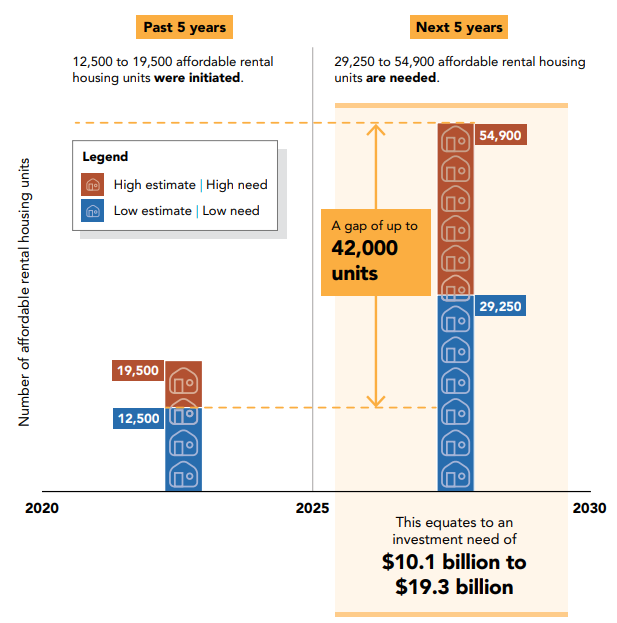
The regional study estimates between 29,250 and 54,500 affordable rental homes are needed over the next five years, while only 12,500 to 19,500 units were initiated across the region in the previous five-year period, leaving a gap that continues to widen.
To bridge that shortfall, Metro Vancouver calculates $10.1 billion to $19.3 billion in combined government investment would be required — yet federal and provincial capital contributions over the last five years totalled $1.2 billion.
The analysis is part of Metro Vancouver’s broader Housing 2050 initiative focused on regional housing coordination and advocacy.
Marina Jozipovic, senior planner on Metro Vancouver’s housing policy and planning team, said the goal was to provide a better sense of affordable rental need and delivery to create a long-term roadmap for greater collaboration.
“We all know that we need more affordable housing, but actually estimating the level of affordability needed is a challenge,” Jozipovic said. “We sought to go beyond a general number – to really dive into what number of affordable rental units we need by rent level, by bedroom count, and how much is actually being delivered.”
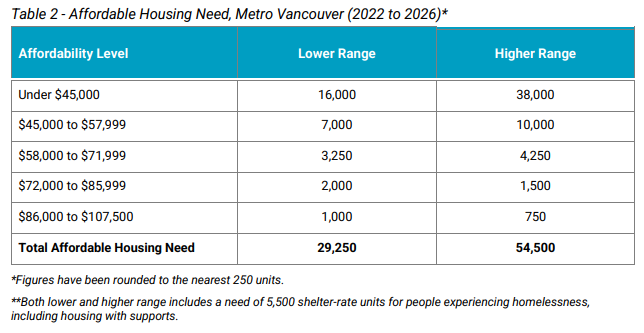
The analysis breaks affordable housing demand down by income level, showing the crisis is most severe for residents earning under $45,000 a year.
Households in that bracket account for between 16,000 and 38,000 units of unmet need – representing the vast majority of the region’s affordable housing shortfall.
Coun. Haven Lurbiecki said the problem is regional, but visible in Port Moody.
“So much of that affordable housing that does get built is likely just slightly below market – not deeply affordable,” she said. “We’re at a critical deficit in affordability for those who need it most. When you look at the average incomes and housing costs in this region, the math is not mathing.”
While Metro Vancouver highlighted the role local governments play through tools like parking reductions, fee waivers, density bonuses and inclusionary zoning, the analysis is blunt about where the biggest gap lies: senior government funding.
Over the past five years, provincial and federal governments contributed about $59,000 to $92,000 per affordable unit – a fraction of the roughly $346,000 to $354,000 per unit needed to make deeply affordable housing financially viable long-term
“We’ve got a massive, massive shortfall in federal and provincial investment,” Lahti said.
The report shows municipal government actions can reduce project costs by tens — sometimes hundreds — of thousands of dollars per unit through land contributions, parking reductions and waived fees. In some hypothetical scenarios, municipal tools were shown to offset more than $120,000 per unit in costs.
Across Metro Vancouver, the most commonly used tools included fee reductions (64 percent of projects), additional density (51 percent), land contributions (41 per cent), and parking reductions (30 percent).
But planners cautioned these measures, while essential, are not enough to close a gap of this magnitude without major federal and provincial contributions.
Coun. Kyla Knowles echoed that sentiment.
“If you look at the . . . ways that cities can help, it all involves giving something,” Knowles said. “We are trying to create those conditions for affordable housing, but in the current construction and housing market, it’s really difficult.”
Knowles added that unlike other Metro Vancouver municipalities, Port Moody does not have much land to give when compared to provincial land holdings. “It’s night and day,” she said.
Jozipovic emphasized the crisis didn’t emerge overnight, and that the shortfall reflects decades of under-investment in non-market housing, even as population growth and housing costs accelerated across the region.
Despite recent increases in affordable housing programs, the analysis concludes current delivery trends will simply maintain – not close – the existing gap over the next five years.
One of Metro Vancouver’s next steps will be working to better quantify municipal contributions – which are currently poorly tracked across the region – to strengthen advocacy for senior government funding.
Without major funding shifts, the region risks rising homelessness, increased out-migration, suppressed household formation, and growing reliance on social services – outcomes already being felt.
Coun. Amy Lubik said while the numbers are difficult to confront, they provide crucial clarity.
“It is kind of depressing the way some of these things are shaking out, but I think it is helpful to have this information and to understand we are going to need to be pushing,” she said.
Author