Coquitlam council disapprovingly approves new housing legislation
After going round and round on Monday, Coquitlam council decided they had no choice but to play the circle game.
Despite deeply-held misgivings about provincial housing legislation that establishes density in concentric circles around transit stations, city council approved the new Transit Oriented Areas.
The key question for some councillors was whether or not they needed to approve the bylaw at all.
Local news that matters to you
No one covers the Tri-Cities like we do. But we need your help to keep our community journalism sustainable.
“Let the province take the heat for it. I don’t want to take the heat for making a decision that I don’t believe in,” said Coun. Craig Hodge.
The land in question must be designated as Transit Oriented Areas by June 30. Failure to adopt the bylaw could mean the province approving the new rules on behalf of the municipality, according to city staff.
While he criticized the legislation as undemocratic, Coun. Dennis Marsden emphasized the utility of moving forward.
“I don’t think we need to waste any more staff time in pissing matches with the province,” he said.
“Our work is going to be around making sense of the circles,” said Coun. Matt Djonlic.
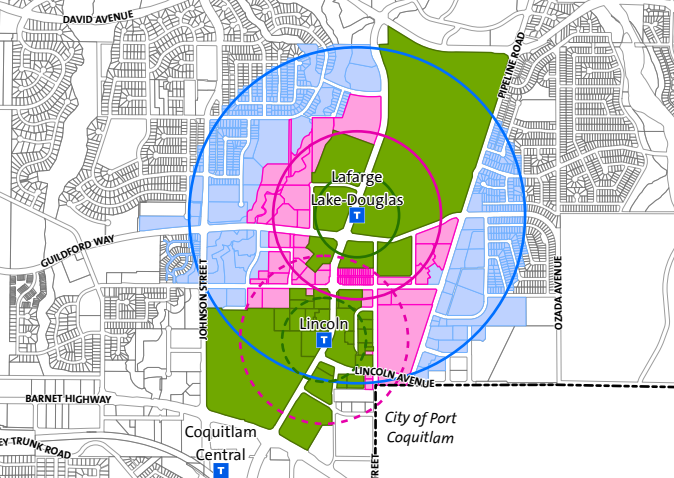
There are eight TOA circles that are either inside Coquitlam or spill over the municipal border from Port Moody, Burnaby, and New Westminster. The closer a property is to transit, the higher the density. Maximum building heights range from 20 storeys for properties within 200 metres of a SkyTrain to eight storeys for properties on the outskirts of the circle.
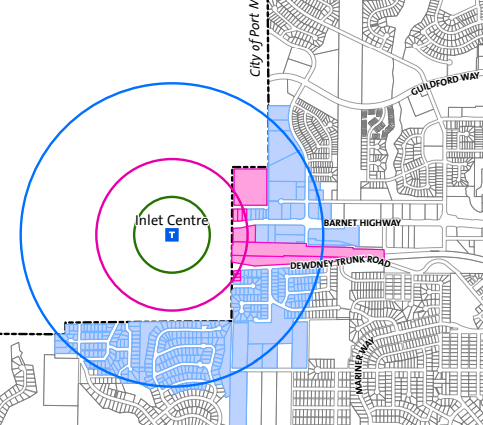
However, there are spots within those circles that lack the sewer, roads, and other infrastructure needed for a big development, Djonlic said. It will be council’s job to “pour cold water on land speculators” seeking to build high-density towers in those spots, he added.
Coun. Steve Kim zeroed in on the area at Barnet and Lougheed previously earmarked, “to keep small businesses in our city.”
“Where are we going to go from here?” Kim asked, noting the need for a discussion with the province about capacity at schools and hospitals.
Besides being “misguided,” the legislation will disrupt the city’s strategy of charging developers density bonus fees to pay for growth, according to Coun. Brent Asmundson.
“It is going to increase the costs to our taxpayers. Development will no longer pay for development,” he said.
Coquitlam will have access to Amenity Cost Charges, a new tool included in recent housing legislation, according to a message from the Ministry of Housing to the Dispatch.
“The Ministry has made it clear to Coquitlam that there are no impediments to them to continue to approve housing projects and fund amenities,” according to the ministry.
Coquitlam is projected to be paid approximately $300 million in density bonus contributions from projects throughout the city.
“The future of this program and how growth related amenities can be funded without significant impacts on taxpayer’s remains uncertain,” stated a city staff report.
The province’s strategy will fail to help the people who need it most, according to Asmundson.
“I also think that this government has been duped by UDI [Urban Development Institute], development industries and other, to thinking that if we reduce fees and charges by local government, that housing prices will go down.”
While he’s been identified and sometimes criticized as being pro-development, Mayor Richard Stewart noted he was about to approve a bylaw with: “less density than what we wanted.”
Stewart has repeatedly warned of unintended consequences springing from the legislation.
The elimination of parking requirements in TOA developments could mean “parking wars,” he predicted. The TOAs will also include parcels that might be close to a SkyTrain station as the crow flies, but not as a human walks.
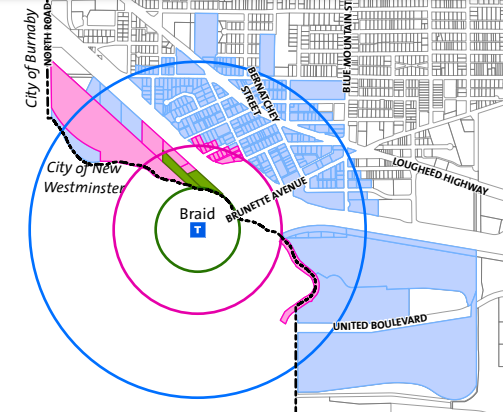
For example, a property on Gauthier Avenue might be close to Braid Station but getting there would likely be a 15-20 minute walk that crosses a highway.
“The resolution has been moved, begrudgingly, may the record show,” Stewart said.
Author