Coquitlam council settles on 3.37% property tax hike in 7-1 vote
Including property taxes and utility fees, Coquitlam residents are set to pay an average of $4.558 in 2026 – a bump of $137 from this year.
“I wish it was lower,” Coun. Craig Hodge acknowledged. “I wish there were more things that we could do. But not this year.”
The city is facing significant financial pressure, said Hodge, noting the $3.1 million RCMP contract inched up about seven percent, “without adding new officers.”
Local news that matters to you
No one covers the Tri-Cities like we do. But we need your help to keep our community journalism sustainable.
As acting mayor, Hodge opened the discussion with a speech that delved into other pressures affecting the city including rising utility levies from Metro Vancouver and construction inflation.
However, the speech emphasized the importance of city services.
“As our city grows, so do expectations for roads, parks, utilities, community centres and cultural services. And during these uncertain times, residents rely on these services more than ever,” Hodge said. “Ignoring maintenance only increases costs and creates potentially devastating service interruptions to residents later.”
Construction costs have been hopping up between five and 18 percent each year, said Coun. Brent Asmundson.
“A city is really a big construction department for roads, pipes, facilities,” he said, noting that Coquitlam’s tax increase is coming in under the inflation rate of 4.9 percent.
While council was largely in agreement on the budget, the inclusion of a $3.2 million development stabilization reserve was a sticking point for Coun. Dennis Marsden.
“I’m sorry, the transparency on that doesn’t meet my expectations,” Marsden said.
While the fund has been in place for years, Marsden said the decision to augment the reserve was something he couldn’t approve.
Marsden cast the lone vote against the budget, explaining residents could be facing a 1.9 percent tax increase without that fund.
As the money comes into the city from new growth, the city holds onto some of that cash to pay for associated infrastructure, Hodge responded.
“The stabilization fund is a way of taking the money that’s coming in today from new people coming into these growing neighbourhoods, knowing that in a couple of years those services are going to come at a huge cost,” he said.
In the future, council may need to look at new revenue streams, said Coun. Steve Kim.
The question of “What can we stop doing?” was the focus of council’s budget talks, according to Coun. Matt Djonlic.
The city looked to cut consultant reports when possible and to consider eliminating vacant management positions, Djonlic said.
Coun. Teri Towner described hearing from residents who want more of everything from pickleball to bike lanes, as well as from residents who want the city to deliver a zero percent tax increase.
“We’re living in very uncertain, challenging, complex times,” she said. “We want Coquitlam to stay as livable as possible.”
By taking a long-term view and ensuring: “every project is aligned with the long-term community needs,” council is attempting to protect future generations from an unnecessary financial burden, Coun. Trish Mandewo said.
The next council may have to examine the city’s capital program and making some difficult decisions, according to Coun. Robert Mazzarolo.
Tax increases in the next several years are pegged at around seven percent, he noted.
“I’m of the opinion that that is not sustainable for any household in our city,” Mazzarolo said.
Utility breakdown
A single-family is set to pay about $1,655 for water, sewer, and solid waste – about $42 more than 2025. The biggest increase is a $25 bump in sewer costs from $636 to $661.
Property taxes are set to account for 45 percent of Coquitlam’s revenue in 2026, with fees, rates and service charges adding up to another 32 percent.
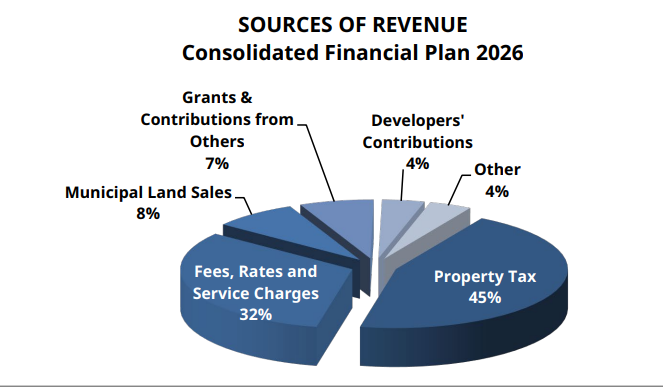
The City’s total budget for 2026, including both operating and capital activities, is $880 million. That includes $401 million for the General Fund Operating Plan, $101 million for the Utility Funds (Water and Sewer and Drainage) and $378 million for the Capital Fund.
The budget passed 7-1 with Coun. Dennis Marsden opposed. Mayor Richard Stewart was absent due to illness.
Author