Coquitlam begrudgingly rezones 22,000 properties
Small things are coming to Coquitlam.
Voting over their own objections, Coquitlam city council moved to rezone 22,000 properties for small-scale development in a unanimous vote Monday.
The provincially-mandated change allows for four units on most single-family lots in Coquitlam, with six units on properties near transit.
Local news that matters to you
No one covers the Tri-Cities like we do. But we need your help to keep our community journalism sustainable.
The zoning is: “the least efficient way to densify a community,” Mayor Richard Stewart said Monday.
Coquitlam has largely concentrated density around the SkyTrain. However, by making land assemblies more challenging, the new zoning essentially undercuts the city’s focus, Stewart explained.
“One size fits all usually doesn’t.”
The provincial legislation has also effectively “de-incentivized” townhouse development, Coun. Robert Mazzarolo added, emphasizing the need for family-friendly housing.
Noting the importance of trees, particularly during the summer, Coun. Teri Towner asked if the city had any recourse to deal with the likely loss of tree canopy that would likely accompany a spate of development.
The small-scale housing would make maintaining or adding to tree canopy a challenge, replied Lanny Englund, the city’s general manager of parks, recreation, culture and facilities. Staff are set to explore policy options, which could include more trees on city land, Englund added.
Coun. Steve Kim asked about a “perfect storm” of neighbourhood residents simultaneously deciding to add units to their property.
Given that public hearings are not permitted and the city doesn’t have control over timing, there could be extra pressure on Coquitlam staff in terms of managing construction and traffic impacts.
However, chief administrative officer Raul Allueva noted that there are limitations, particularly in terms of connecting to city infrastructure.
“It will be the responsibility of each land owner/developer to undertake a review of civil services . . . and in some cases to pay for necessary upgrades beyond their required frontage and service improvements,” stated a city staff report.
Coquitlam previously requested a one-year extension to implement the zoning change, largely over concerns about meeting possible infrastructure demands.
“Most of the city wasn’t designed for even that modest increase in density,” said Andrew Merrill, the city’s general manager of planning and development at the time. “Particularly in parts of older Coquitlam. Some of the pipes in the ground in those areas of southwest [Coquitlam] are 50, 60, 70 years old.”
The new zoning allows for lots smaller than 3,014 square feet to have three dwelling units.
Owners of lots larger than 3,014 sq. ft. can add four units or as many as six if the lot is within 400 metres of a bus stop. There are no parking requirements.
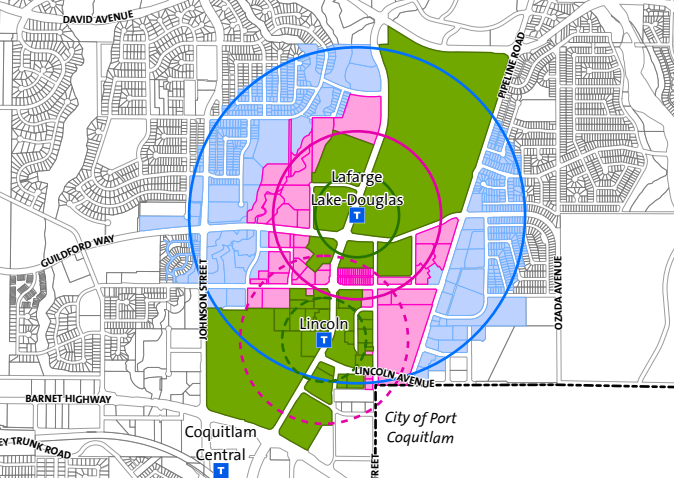
Properties within 800 metres of a SkyTrain station are Transit-Oriented Areas and not included in the new zoning.
There are eight TOA circles that are either inside Coquitlam or spill over the municipal border from Port Moody, Burnaby, and New Westminster. The closer a property is to transit, the higher the density. Maximum building heights range from 20 storeys for properties within 200 metres of a SkyTrain to eight storeys for properties on the outskirts of the circle.
“Everyone here is opposed to this but we all voted to allow it to pass because it’s required by the province,” Stewart concluded on Monday.
Author