Port Moody earmarks $23.7 million for project spending in 2024, leaving several reserves with deficits
Port Moody intends to spend $23.7 million on capital projects next year, leaving several of its infrastructure-related reserves with significant deficits.
The provisional five-year financial plan was approved by council on Dec. 5, which has $78.8 million in projects planned from 2024 to 2028.
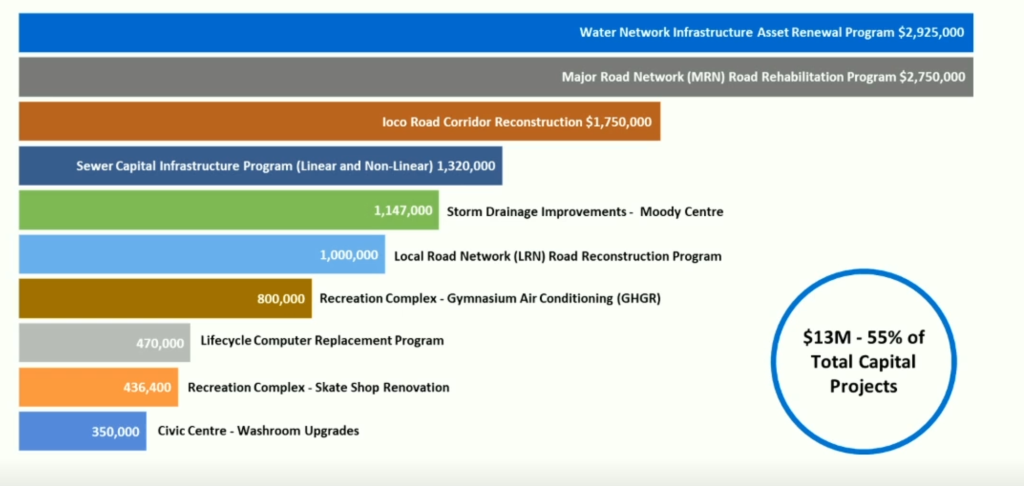
Following the same trend as last year’s capital budget, infrastructure and utility replacement and renewal projects represent six of the top 10 biggest ticket items in the plan.
Local news that matters to you
No one covers the Tri-Cities like we do. But we need your help to keep our community journalism sustainable.
Next year’s capital costs represent an 18 percent increase in spending from 2023, but spending will decrease around 48 percent by 2025.
Projects relating to the city’s water, sewer and drainage infrastructure account for $5.4 million in project costs; while rehabilitation and reconstruction of road networks account for $5.5 million.
By department: utilities represent 35 percent of the total project spending in 2024, engineering and operations account for 24 percent, and community services account for 29 percent.
Other large projects in the city’s top 10 list include $1.6 million in upgrades to Port Moody’s civic facilities.
The public will be allowed to provide input on the budget and capital plan prior to final approval in May 2024.
Deficits
Capital projects in Port Moody are funded through a mix of reserve spending and external sources such as development levies.
Without building up reserves — which are required to be balanced at the end of five-year cycles — the city would need to take on debt to finance projects.
While staff have found a way to keep all their reserves out of red ink by 2028, they said budgets are being challenged by inflationary impacts.
Tyson Ganske, deputy finance officer with the city, said staff are trying to deliver a wider variety of projects in the midst of increased construction costs, supply chain issues, and stricter regulations related to environmental assessments and stakeholder consultation.
Substantial deficits are being created in the city’s asset reserve, major road network reserve, and sewer and water capital reserves.
In 2024, a total of $7.1 million is set to be drawn out of the Port Moody’s asset reserve, which is used to replace city infrastructure, leaving a deficit of $3.2 million.
The financial plan forecasts $28.8 million being drawn from the reserve over the next five years, with deficits projected to continue in 2025 ($3.7 million), 2026 ($3.1 million), and 2027 ($1.3 million) before being balanced by 2028.
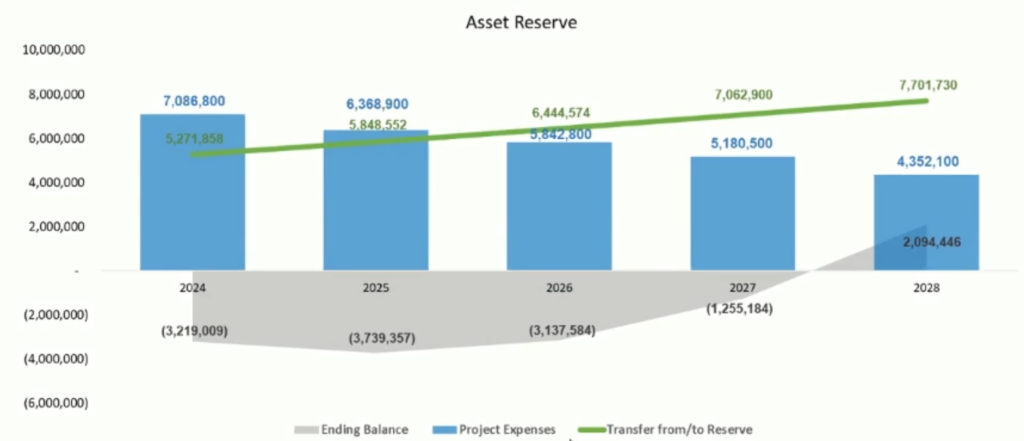
To address the deficits, the city is increasing taxation through its asset levy, which is slated to bump up one percent annually until 2028.
One-time transfers to the reserve totalling $2.5 million are also slated for 2024, but staff said this practice is not sustainable.
“Generally, in the long term, this is not a sustainable practice, we need to work on living within our means and make sure that our service needs are in line with our ability to pay,” Ganske said.
He added the annual 1 percent increase to the asset levy is “insufficient” to maintain the city’s inventory, and staff said more funding will be needed.
Other expensive projects in 2024 are causing a $2 million deficit in the major road network reserve, a $3 million deficit in the sewer capital reserve, and a $4.9 million deficit in the water capital reserve — all of which won’t be balanced until 2028.
The city’s new initiative reserve, which takes on strategic projects at council’s direction, is forecasted for an opening deficit of $875,000.
Ganske said the reserve will be oversubscribed until 2027, and prior years of overspending has led to a financial burden on today’s taxpayers.
Coun. Kyla Knowles raised concern over how the reserve was being used, stating residents have referred to it as council’s “slush fund.”
She said several 2024 projects being financed from the reserve could be funded from other sources, citing the holiday lighting program and dog management strategy as examples.
“The new initiatives reserve was never intended to be a catch all for all new projects for an unspecified period of time,” Knowles said. “The purpose was to provide a trial run source of funding for a new service or program.”
She introduced a motion to direct staff to review funding for all 17 projects slated for 2024 ahead of budget deliberations in February. It passed unanimously.
Climate action funding
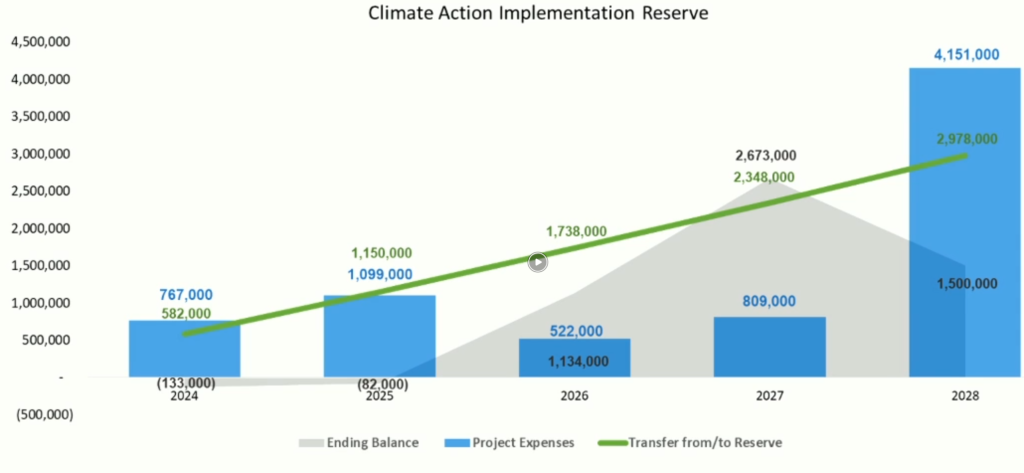
The city’s climate action implementation reserve is also forecasted to run a $130,000 deficit in 2024, which would continue until 2025.
To have civic facilities and equipment achieve carbon neutrality the city may need to spend $11.7 million by 2040, and several major projects are slated for 2028.
The city is trying to build up the reserve through annual one percent tax increases until 2028, but council made inquiries with staff regarding deferring those increases to 2025.
Ganske said the deferral would reduce the reserve by $2.6 million over the five-year plan, and could delay the installment of a heat recovery system for the recreation centre’s ice plant.
A total of $4.1 million is slated to be drawn out of the reserve in 2028, and Ganske said deferring the tax increase would leave it with a $1.2 million deficit.
Author