Port Moody’s residents would rather see services cut than face tax hike, says budget survey

More than half of Port Moody residents would rather cut services than see increased property taxes, according to the 2025 budget consultation.
Mayor Meghan Lahti said the survey results reflect the stressful economic conditions residents are living under, and vowed to look for additional ways to reduce the proposed 8.52 percent tax increase.
“This is indeed a different reflection than what we have seen in the past,” Lahti said. “We need to make some changes.”
Local news that matters to you
No one covers the Tri-Cities like we do. But we need your help to keep our community journalism sustainable.
The past two budget cycles, the city has approved significant property tax increases following two years of COVID-19 austerity budgets.
Port Moody residents saw a a 6.6 percent increase in 2024, and a 9.29 percent increase in 2023.
This year’s budget survey appears to show that tolerance for tax hikes is thinning, as satisfaction rates with services, budget direction, and subsidies are all ticking downward.
Coun. Diana Dilworth said many of the survey comments had a “frustrated” tone, and council needs to try and find a balance between essential and quality of life services.
“Our community is pretty split,” she said. “We also have to recognize unintended or unknown consequences of decisions that we’re going to be making later.”
Feedback from the survey was collected from Oct. 28 to Nov. 17. The city received 260 responses, down 36 percent from a record-high participation rate last year.
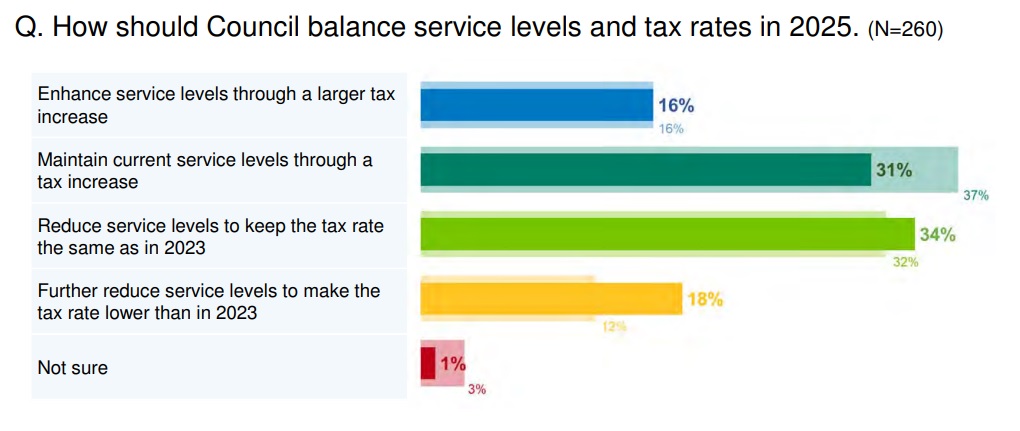
A total of 52 percent of respondents were not in favour of any tax increase in 2025.
The survey showed 34 percent preferred reducing services levels to keep the tax level on par with 2024, while 18 percent were in favour of even further cuts to lower the tax rate. This is a two percent and six percent increase, respectively.
The percentage of support for the city’s current level of services also fell by six points.
Meanwhile, the number of respondents in favour of increasing, or keeping, 2024’s level of subsidies for city programs fell by 10 percent. Support for cuts or complete removal of these subsidies rose by 11 percent.
While 65 percent of respondents said they received good and excellent value for services in relation to their taxes and utility fees, this figure has also fallen by two points overall.
The percentage of people stating they receive very poor value rose 7 percent.
Themes staff gleaned from the survey comments included a desire to see projects delayed or reduced in scope (44 mentions); prioritizing livability related to traffic, transportation, infrastructure and recreation (21 mentions); using development as way to finance amenities and infrastructure (13 mentions); and more focus on core services, while backing away from non jurisdictional issues (six mentions).
Lahti concurred with some comments related to non-jurisdictional issues, stating the city was spending money on issues downloaded by senior levels of government.
“Things like affordable housing, homelessness – those issues are not municipal issues,” Lahti said. “They’re not supposed to be funded by municipalities, although we do fund them, I think we would have a hard time stepping away from that to every degree.”
However, the mayor disagreed with comments suggesting that climate spending counted as non-jurisdictional, stressing that mitigating the negative effects of climate change included protecting city assets.
Coun. Kyla Knowles said the drop in support for maintaining or increasing current services levels is significant.
She said much of the tax increase is outside their control, and related to labour-negotiated staffing costs and inflation.
“It’s not as if this council is spending a ton of money,” Knowles said. “I’m looking around at our neighboring communities, and they’re all looking at massive increases as well.”
Nevertheless, Knowles said it might be time to make some “drastic cuts.”
“The nice-to-haves have got to go,” she said. “Let’s focus on our core services, and our core needs.”
Coun. Callan Morrison agreed, stating the decreased support for added taxation is not something council can ignore.
He said council should try reducing some programs for a year to test the reaction from the public, adding council can always add them back in.
Coun. Amy Lubik, on the other hand, said council should be careful about what it considers core service, stating that residents’ may be interpreting these survey questions differently than council.
She noted that affordable housing was one of the biggest issues in the 2022 municipal election.
“That’s something that people want every level of government doing what they can on,” Lubik said. “That’s a really big part of the cost of living for folks.”
Picking up on Lubik’s point, Coun. Haven Lurbiecki said council needs to differentiate between services funded through taxation versus other sources.
She noted that Port Moody’s affordable housing reserve is funded through development, while Port Moody discontinued its emergency weather shelter for homeless people this year.
Lurbiecki also pointed out that much of Port Moody’s budget woes relate to funding cuts made during COVID.
“I just want to caution that if we’re going to go into this now, hacking away at services and things like that, we have to be very careful we don’t just put ourselves in the exact same situation,” she said.
Coun. Samantha Agtarap also seemed weary about making cuts, stating that council should not treat the 260 survey responses as “statistically significant.”
“I just want to caution everybody that short-term thinking sometimes leads to immediate reductions in costs, but it also can potentially push those costs out further on to future residents,” she said.
Author