Port Moody approves rezoning for Beedie Living’s three-tower, 1,000 condo project in Moody Centre
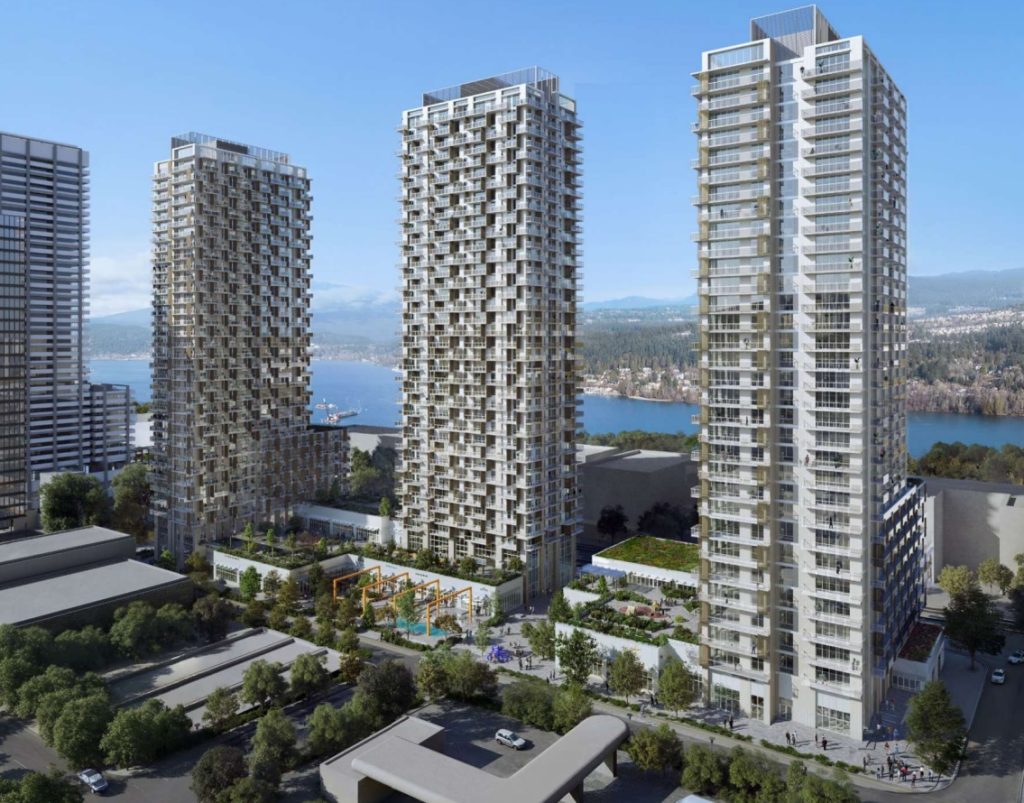
Port Moody has approved a major rezoning that clears the way for Beedie Living’s three-tower transit-oriented development (TOD) in Moody Centre.
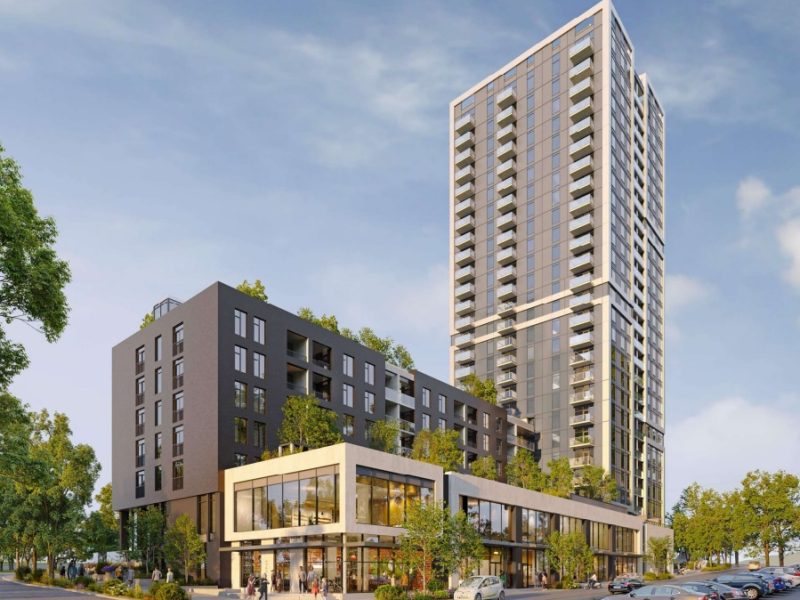
Council voted 5-1 on Nov. 25 to adopt OCP and zoning amendments enabling more than 1,000 market condos, and a separate eight-storey women’s transitional housing building with up to 60 units.
“I’m really excited about the vibrancy that is going to be brought to that neighborhood,” said Coun. Diana Dilworth. “We’re going to liven up Moody Center in a way that our residents have been asking for for literally decades.”
Local news that matters to you
No one covers the Tri-Cities like we do. But we need your help to keep our community journalism sustainable.
The decision clears the way for development permit review early in the new year, with staff confirming Beedie has already submitted its application. According to the development report, the company plans to begin construction in 2027, with the first tower completed in 2031 or 2032.
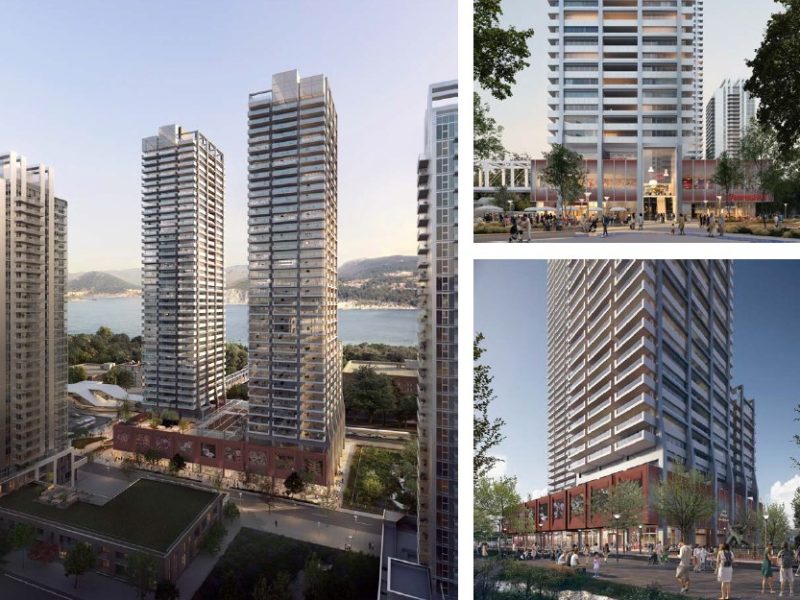
Now approved, the plan allows for the development of 32, 34 and 38-storey towers atop commercial podiums, at least 6,300 square metres of commercial space, about 1,875 sq. m of indoor amenity space, 2,388 bicycle parking stalls, and a large public plaza known as the Living Room at Electronic Avenue and Spring Street.
The combined project also includes an estimated 520 to 555 jobs at build-out and a $28-million package of financial contributions, plus $2.4 million for public art.
The second site one block west, will house the BC Housing-owned facility, and must be completed before occupancy of the towers takes place.
‘Too high, too dense’
Coun. Haven Lurbiecki was the lone vote in opposition. The councillor – who has repeatedly opposed the scale of the project – said the rezoning entrenches a flawed vision “most people don’t support.”
She said the project was enabled by council’s Moody Centre TOD Framework, which she described as the “infamous 14-tower framework,” and argued that plan was never meaningfully vetted through public engagement.
“I think it’s too high, too dense, and the reason that’s a problem is because the type of housing it’s delivering is the wrong type of housing,” Lurbiecki said, adding the proposal largely produces “small, expensive condos” instead of the affordable, diverse unit types she believes the community needs.
She also criticized the loss of industrial land on the main site, noting the plan “does not meet our jobs-to-population target rate in our downtown core – not even close, with less than half.”
But a new concern raised by Lurbiecki Monday was the possibility of land banking – that Beedie could secure valuable zoning entitlements but delay construction for years.
“We’ve heard over and over again that in this market we should plan for things not to be built,” she said. “Why are we seeing adoption for rezoning right now? . . . What can we do to protect the city and ensure that once we’ve committed to building something, it actually gets built?”
Staff told council that while construction timelines are ultimately market-driven and not enforceable by the city, Beedie appears motivated to proceed. A development permit is already under review, they said, and the company’s stated schedule requires rezoning adoption now to secure development and building permits in early 2026.
However, staff confirmed there is no legislation requiring a developer to build within any defined window once zoning is granted. A development permit would be valid for two years; if no work starts within that period, the permit lapses and the proponent must reapply.
Lurbiecki said she remained worried the city could see “land sitting for years and years and years,” citing stalled projects elsewhere in the city.
Staff said the city’s strongest mechanism to encourage timely construction is to “hold the course” and maintain permitting certainty so applicants can pursue financing and prepare for aggressive construction schedules.
Should delays occur later, staff said they continue to monitor projects post-approval and can bring proponents back to council should major issues arise.
Supportive councillors highlight non-market housing, jobs and amenities
Other councillors strongly rejected the notion the project was delivering only market strata units.
Coun. Diana Dilworth highlighted the application’s inclusion of a housing complex for women and children fleeing violence – a facility secured through a housing agreement and required before the towers can be occupied.
“That’s affordable, non-market housing,” she said, adding that she sees the project delivering what residents have asked for: larger homes, childcare, jobs and new public spaces. She also noted the developer’s contributions to the city.
Dilworth also took a more positive interpretation of the jobs employment space within the project, stating that far more jobs would be provided than what the largely vacant properties currently on the site provide.
She also said the financial contributions being made through density bonuses, amenity contributions, levies and public art contributions were: “not something to look our noses down on.”
“It’s a real shame . . . if everything goes right with this application we’re going to have homes ready in five years, and we need those homes quicker,” she added, arguing the city should focus on cutting red tape and giving applicants the certainty they need to proceed.
Coun. Amy Lubik emphasized the project’s larger-than-usual unit sizes, noting they exceed the city’s family-friendly housing policy and are closer to the dimensions of Suter Brook and Newport Village – homes built decades earlier.
She also highlighted the planned childcare centre, a significant expansion of tree canopy from 2 percent to more than 20 percent, and the environmental health benefits of reducing the urban heat island effect.
“When we talk about affordable housing, we have to remember that that comes with partnerships,” Lubik said. “Through partnerships with the public and private sector, we can see more things like this happen.”
Coun. Samantha Agtarap added that many of the existing buildings on the site were underused, and in most cases are not used as office or industrial space at all.
“This is a much-needed reinvigoration of that area,” she said.
Coun. Kyla Knowles called the project “exactly the type” of development she hoped to see when elected, citing the childcare space, commercial space, jobs and non-market housing.
“I think we are lucky to have a partner in Beedie,” Knowles said. “I’m excited about the reinvigoration of that space, which is currently not really providing our city with anything, if the truth be told.”
Author