Coquitlam re-opens the door on transit hub highrises; councillor bashes province for ‘back door’ tax hike
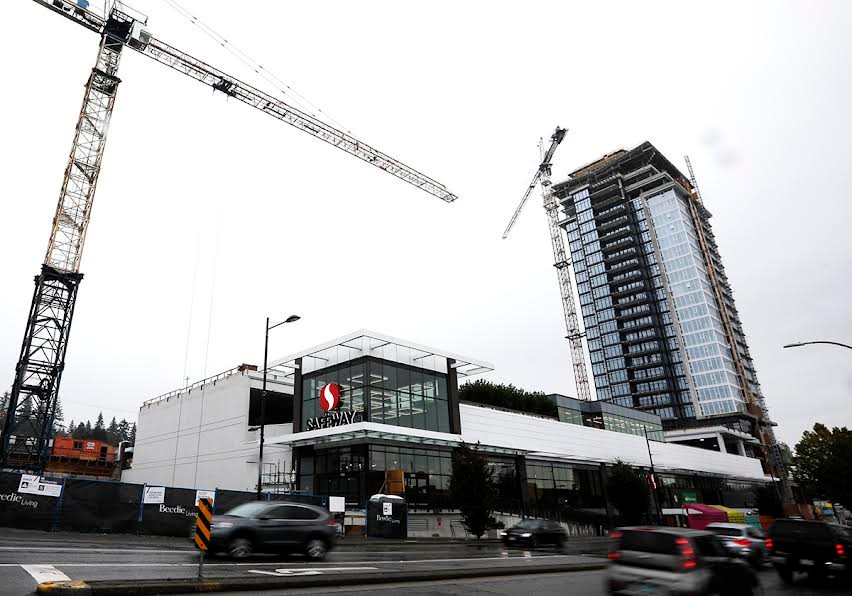
After hitting pause on housing applications near transit hubs, Coquitlam is ready to press play.
Coquitlam unanimously approved the reversal on Monday, following an announcement from the province that local governments could continue to charge developers density bonus fees.
While the impasse between the province and the municipality remains, Coun. Dennis Marsden praised the provincial government for at least partially coming to their senses.
Local news that matters to you
No one covers the Tri-Cities like we do. But we need your help to keep our community journalism sustainable.
“That’s what good leaders do. When they screw up they recognize it and they make changes,” he said.
Council froze housing applications around transit hubs in February following provincial legislation that created uncertainty around Community Amenity Contributions.
Generally, developers pay CACs to the city for projects that are bigger or denser than the city envisioned. Coquitlam relies on that money to pay for rec centres, infrastructure upgrades and for childcare and affordable housing funds.

But while the density bonus tool is back in their toolbox, council roundly criticized the province’s new housing legislation as counterproductive, bureaucratic, and fundamentally flawed.
Attempting to create cheaper housing by lowering costs for developers is akin to trickle-down economics, said Coun. Brent Asmundson.
“It’s a pipe dream,” Asmundson said Monday. “The market will dictate the price in housing, not the reduction in fees.”
Asmundson added that he anticipated, “a long-term mess.”
In the short-term, Coquitlam has seen uncertainty in the housing market, according to the city’s planning manager Andrew Merrill.
“Several developers are slowing down or pausing projects as they re-contemplate [new provincial housing legislation],” Merrill told council.
Mayor Richard Stewart has repeatedly warned of unintended consequences connected to B.C.’s new rules on housing.
“The legislation was intended to speed up the development of housing, not to give windfall profits to developers at the expense of municipal infrastructure programs,” he said.
However, Stewart said he anticipated less housing being built in Coquitlam in 2024 than in 2023, when the city recorded 4,500 housing starts.
Lowering costs for developers will result in shifting the tax burden, warned Coun. Robert Mazzarolo.
As the city densifies around transit hubs, those neighbourhoods will require more services and sturdier infrastructure. If developers don’t foot the bill, residents will essentially be asked to subsidize development.
“They are raising your taxes through the back door,” Mazzarolo said.
Coun. Steve Kim expressed disappointment that the province is: “cutting red tape by adding red tape.”
The province has been difficult to deal with, according to Coquitlam city manager Raul Allueva.
“Frankly, they’re not interested in an answer that I consider reasonable,” he said. “We have let them know this is the biggest land value transfer to the development community that I’ve ever seen, and they’re just not interested in a conversation about it.”
The city currently has 13 projects near transit hubs awaiting first reading from council. Those projects add up to an estimated $160 million in Community Amenity Charges.
Projects that have already been granted third reading but haven’t yet received a development permit add up to $135 million in CACs.
The city currently has $14 million in its Affordable Housing Reserve Fund with projects at various stages of approval expected to contribute another $13 million.
The city is considering $21.8 million in grants that would result in 675 non-market units.
Municipalities are set to switch over to a new provincial framework around development and cost charges by mid-2025.
Author