‘Walling’ effect along St. Johns Street prompts investigation into podium heights
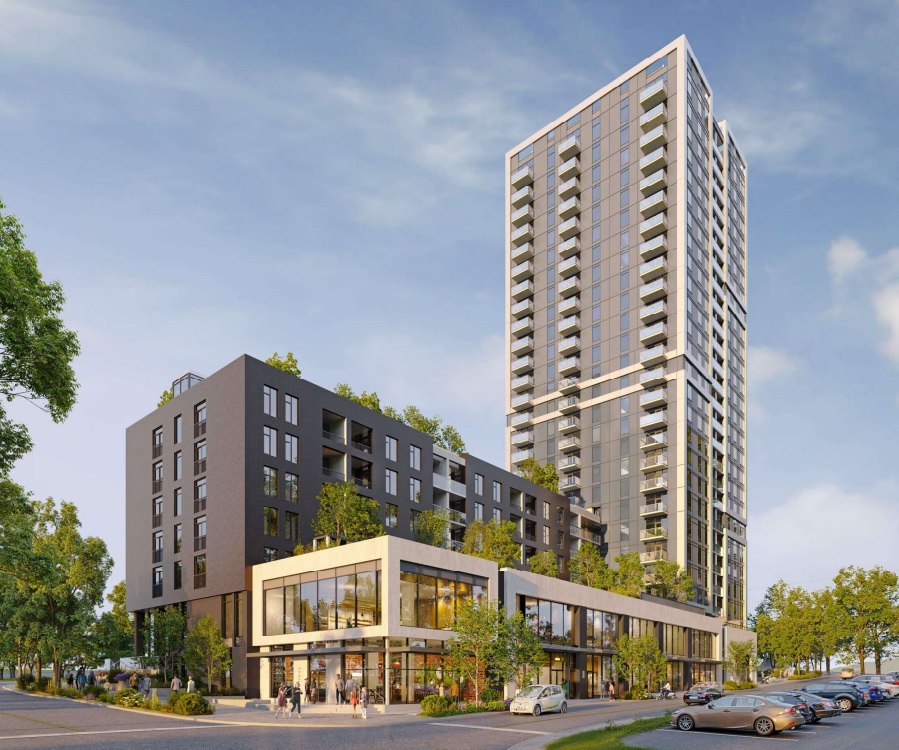
Port Moody council has directed staff to explore a policy on podium heights, in an attempt to reign in any potential “walling” effect along the St. Johns Street corridor.
The motion, brought forward by Coun. Callan Morrison and passed unanimously on Feb. 10, asks staff to report back on how tall podiums – the low-rise buildings that often form the base of towers – should be, and what community objectives they should deliver.
“Members of this council have said many times that they do not want a wall effect,” Morrison said. “Let’s protect the view corridors that were so important to us when creating the transit oriented development (TOD) framework, and that are so important to our residents.”
Local news that matters to you
No one covers the Tri-Cities like we do. But we need your help to keep our community journalism sustainable.
The request stems from concerns that while Port Moody’s planning framework allows podiums between three and six storeys in much of the TOD area, there is little guidance explaining when taller podiums are appropriate or what benefits they should provide, according to the motion.
Morrison said the issue has taken on new urgency as provincial housing legislation has imposed minimum densities on a vast area surrounding transit hubs – changes largely outside municipal control.
St. Johns Street, he noted, is just under three kilometres long, with roughly 2.3 kilometres now falling within the provincially mandated density circles created by Bill 47.
“That’s a lot,” Morrison said.
While podiums can bring positives like retail and office space, daycares, rooftop greenery and public amenities, Morrison warned that continuous six-storey podiums could also create long “walling effects” along the corridor, blocking view corridors and intensifying massing.
“A low podium with a tower set back from the street is, in my opinion, far more appealing visually than a tower built into a six-storey building that stretches down half a city block,” he said.
Morrison argued that without clear criteria, developers are incentivized to push podiums to the six-storey maximum – often filling them with residential units instead of employment space or community amenities.
“Let’s figure out what flexibilities in heights are reasonable when developments actually deliver what our community needs –jobs, daycare, affordable housing and family-sized units.”
Coun. Haven Lurbiecki, although she ultimately supported the motion, said a new policy should have been embedded in the new official community plan (OCP), which passed third reading last week.
Lurbiecki said the real issue wasn’t a lack of policy – but a council unwilling to reject developments that failed to meet community objectives.
She said council has already approved major developments without properly updating many of policies regarding growth, podiums, traffic and affordable housing, claiming this has frustrated and confused residents.
“The time to have done this work has already passed,” she said. “A policy is words on paper unless it’s implemented and unless it’s a requirement.”
Lurbiecki moved to defer any podium policy work until other major housing initiatives were completed, including the amenity cost charge (ACC) bylaw, development cost charge (DCC) update, and affordable housing bylaw.
Her motion was narrowly defeated, with Couns. Morrison, Amy Lubik, Kyla Knowles, and Diana Dilworth opposed.
Mayor Meghan Lahti said she shared some of Lurbiecki’s concerns, noting that the newly approved OCP already calls for podiums in transit-oriented development areas, and changes could have been addressed during the OCP process.
“We already have a policy,” she said. “We’re just saying ‘develop another policy’ without really giving staff direction.”
While Lahti ultimately supported the referral, she also questioned whether it should take priority given the volume of major housing work already underway.
Knowles said she had no issue with Morrison wanting clearer parameters, but stressed the need for council to better prioritize staff workloads.
“This is pretty far down the list of my personal priorities,” she said. “I think we need to, as a wholesome exercise as a council, look at the list of projects and decide how we want to prioritize things.”
Lubik recalled earlier council discussions about podium heights leading up to the OCP’s passage and said clearer guidance would help signal expectations to developers.
“When we say three to six storeys, we don’t necessarily mean six storeys every time,” she said. “This policy will provide some help and something concrete to point to when applications come forward.”
Meanwhile, Samantha Agtarap noted that a recent development proposal featuring a six-storey podium attached to a tower was the first of its kind the council had seen.
“All of the other applications in Moody Centre, as far as I can recall, have had three-storey podiums at most,” she said, adding she would look to staff for guidance on how the new work fits into overall priorities.
With the motion approved, staff will investigate a podium height policy – including feasibility, resources, timelines and alignment with the city’s strategic priorities.
For Morrison, the goal is to regain some local influence over how Port Moody’s main corridor evolves amid provincially imposed density.
“Now is the time to set the guidelines for what we want to see,” he said.
Author