Port Moody ramps up rhetoric against ‘under-taxed’ provincial and federal lands, voting for study on lost revenue from port terminal and other sites
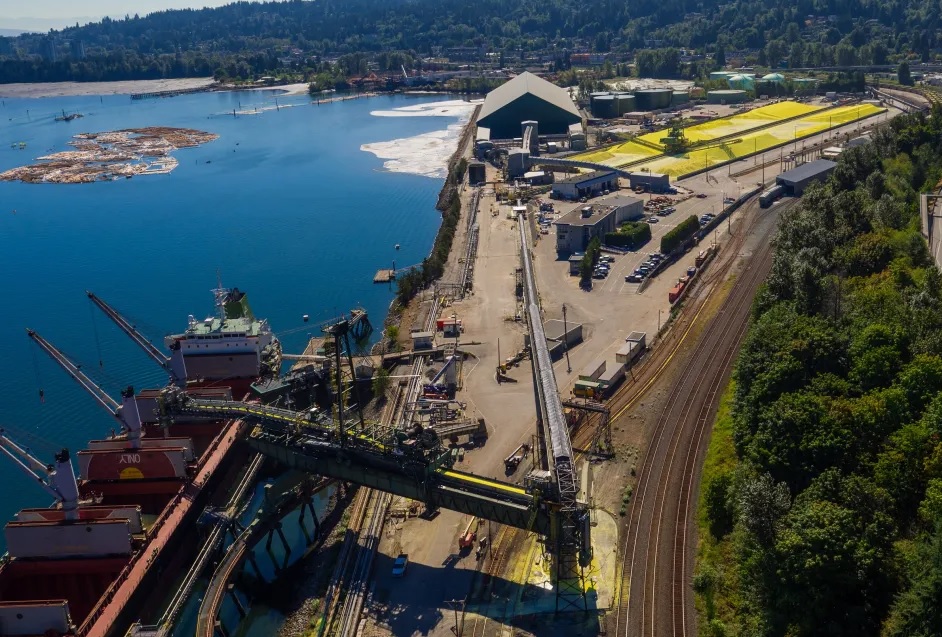
Port Moody council has directed staff to investigate how much tax revenue the city is losing because of provincially and federally imposed tax caps – and to identify every property in the city that isn’t being taxed at its “highest and best use.”
The motion, introduced by Coun. Samantha Agtarap on Nov. 18, includes conducting a sweeping analysis of “under-taxed parcels,” as well as a symbolic invoice to be sent to senior levels of government for owed taxes from the Pacific Coast Terminal.
While Agtarap acknowledged the motion was largely “performative,” she said the general public needs to be aware the city is losing out on potential revenue due to legislation out of its control.
Local news that matters to you
No one covers the Tri-Cities like we do. But we need your help to keep our community journalism sustainable.
“We should all be really upset about the inequity that this levies on us,” Agtarap said. “I recognize the ports are an important part of our Canadian economy, but our taxpayers should not be responsible for subsidizing this sector through reduced property taxes. All Canadian and B.C. residents should be sharing equitably – both in benefit and in burden.”
Port Moody is one of 10 B.C. municipalities that host port facilities, and part of an emerging consortium of port municipalities seeking changes to the Port Property Tax Act, which has capped major-industry rates since 2003.
Agtarap’s memo states the provincial legislation capping major-industry port tax rates has “created a persistent and increasing gap between actual taxes levied and what could have been collected without the cap.”
It adds that the Port Competitiveness Grant intended to offset those losses has fallen behind real-world tax growth because it is tied to CPI rather than property values.
The goal of the study is to quantify how much of Port Moody’s limited land base is constrained by legislation – whether through port tax caps, pipeline and rail classifications, or BC Assessment’s practice of shifting some privately owned future development sites into recreational class when used temporarily as dog parks or gardens.
She argued that when nearly a quarter of the city’s land cannot be taxed at full potential, residents end up subsidizing federal and provincial policy choices.
“The rate cap has created inequities between communities,” Agtarap said. “To be clear, this is not about reducing port competitiveness through increasing their taxation. It’s about sharing the tax burden.”
Port Moody council has been struggling to stabilize rising tax rates as its growth has put increasing demand on its services. Over the last three decades, the city’s industrial tax base has dwindled, leaving residential owners footing an increased share of the bill.
For the last three years, the city has submitted resolutions to the Union of BC Municipalities, lobbying for a more equitable redistribution of gaming revenue with little success.
One clause of Agtarap’s motion – specifically intended as a jab against the province – requested a casino licence; however, the clause was struck by a 4-2 vote.
Pushback on the performative
Coun. Haven Lurbiecki delivered the strongest pushback, warning that symbolic gestures risk harming relationships with senior governments and distracting from local decisions that also affect tax revenue.
“When I hear the word performative, and using staff time and resources to do something, I immediately think: why?” she said. “We love sending angry letters and pointing fingers at other levels of government . . . I don’t think it’s going to result in what we are hoping for.”
Lurbiecki was the only councillor to oppose the clause directing staff to prepare an invoice to senior governments.
She also challenged colleagues to reflect on local decisions affecting the tax base – particularly the loss of industrial and business lands due to rezoning for high-density housing within the Moody Centre transit oriented area.
“I don’t think this is the best look for city council,” she said. “Our frustration seems to be superseding our thought process.”
Coun. Callan Morrison argued the symbolism might help force a conversation that advocacy efforts at UBCM have failed to advance.
“We try to ask for these things . . . but for some reason we never seem to get that extra attention and help,” he said. “So I think this will bring a little bit of attention.”
He reiterated concerns about equitable sharing of online gaming and cannabis revenue – neither of which municipalities without a casino currently receive.
Coun. Amy Lubik said Port Moody must explore every tool to diversify municipal revenue.
She said the growing number of temporarily repurposed private parcels – such as the two dog-park sites – illustrate the financial pressures the city faces when land-use decisions outside its control alter tax classifications.
“We all love dog parks, but deferred revenue is also something that’s challenging to absorb.”
Coun. Kyla Knowles rejected the suggestion that council is failing to pursue new revenue streams.
“I completely reject that assertion,” she said. “We are doing a lot to generate revenues . . . and doing a lot to protect our industrial lands.”
Knowles was supportive of motion, describing it as “political,” not performative.
Mayor Meghan Lahti said while she understood the concerns around tone, Port Moody has exhausted polite channels to address inequitable gaming and port taxation structures.
“I think that we do need to be pushing that envelope and poking the bear a bit, because we are not getting anywhere on this very important issue,” she said. “It’s time to take a louder stance and bring some real awareness to the community.”
Lahti said the city must mobilize public understanding of how legislated caps shift tax burdens onto local homeowners and businesses.
Staff will now determine whether the analysis requires a project proposal or a detailed report, and will evaluate feasibility, timelines, resources, and legislative considerations.
Author