Port Moody council endorses long-term plan to build modern library system
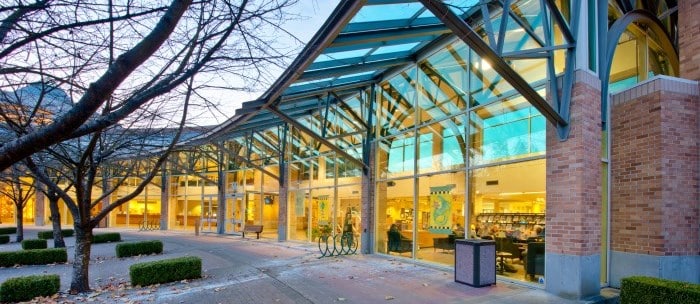
After more than two decades of advocacy, plans for a modern public library system in Port Moody have entered a new chapter.
On Oct. 28, city council unanimously endorsed the Port Moody Public Library’s Facility Master Plan and Functional Program Reports; documents that lay out a detailed 25-year blueprint for expanding the city’s library system to match its growing population and evolving community needs.
“This is about a vision,” said Daphne Herberts, chair of the library board. “One shaped by years of planning, community engagement and strategic foresight – a new central library that will serve as the anchor of a long-term, three-tier system that will not only serve our community through 2050, but shape it.”
Local news that matters to you
No one covers the Tri-Cities like we do. But we need your help to keep our community journalism sustainable.
The decision formally integrates the library project into the city’s civic facilities roadmap, clearing the way for next-phase planning and cost assessment. It envisions a modern three-tier system of library facilities that would serve Port Moody through to 2050.
The plan includes a new 49,000 sq. ft. central library on the old fire hall site at Ioco Road and Murray Street, targeted for completion around 2030; a 20,000 sq. ft. community branch in Moody Centre, between the SkyTrain station and Kyle Centre, to follow once the city surpasses 60,000 residents; and smaller “express” service points (500–2,000 sq. ft.) in neighbourhood hubs such as College Park or Heritage Mountain, offering holds, pickup, returns and self-service lending.
The three-tier model is designed around accessibility and flexibility – ensuring all residents live within 2.5 kilometres of library services, and expanding to roughly 62,500 sq. ft. of library space city-wide by 2050.
It sets an aspirational target of 1 sq. ft. of library space per resident, a benchmark common to mid-sized Canadian cities but far beyond Port Moody’s current 0.32 sq. ft. ratio. That’s nearly five times today’s footprint.
“This isn’t just about space – it’s about untapped community potential,” Herberts said.
From study to strategy
The need for expansion was first identified in 2004, when consultants confirmed the city’s 12,500 sq. ft. library was operating with less than half the space required for its population.
A replacement was included in Port Moody’s 2008 capital plan, and a joint expansion committee of council and library board members was struck. But by 2010, the project was shelved due to other capital priorities, notably the new fire hall.
Director of library services, Marc Saunders, told council the issue has only intensified.
The current library is one of the smallest libraries serving populations of 35,000 to 89,000. Yet despite its size, the branch sees one of the highest per-square-metre visitation rates among peer libraries.
“Our current library bursts with potential but lacks the space to fully serve our community. Residents consistently tell us that they want more flexible, gathering spaces, meeting rooms, quiet study spots, and areas for social connection through board games and shared activities,” Saunders said. “They love that we offer what we offer, but dream of what we could become.”
The library’s new Functional Program Reports add specificity, outlining detailed space allocations, adjacency requirements, and equipment lists to guide architects when design work begins.
Through consultations between 2023 and 2024, which included surveys and workshops with nearly 950 residents, the board identified three priorities: digital inclusion, safe and welcoming spaces, and the library as a community hub.
The proposed central facility would feature maker spaces, computer labs, teen and seniors’ areas, and multiple bookable rooms – amenities the current library lacks.
The plan also calls for sustainability and potential co-location opportunities with civic, cultural, or housing partners, reflecting city policies on complete neighbourhoods and transit-oriented development
Port Moody’s old fire hall site at Ioco Road and Murray Street is identified as the preferred location for the central library in the master plan.
The site was first identified in a 2006 site selection process, and was ranked highest for its visibility, centrality, and potential for co-location with other civic amenities.
It could accommodate the full 49,000 sq. ft. footprint, underground parking for approximately 125 vehicles, and future expansion. Its proximity to Inlet Centre Station and major bus routes aligns with the city’s transit-oriented development goals, according to the report.
Saunders said the site “represents more than just a convenient location. It’s the perfect foundation for our community’s library dreams.”
He said while the board is flexible about other locations, they want to ensure that whatever choice the city lands on prioritizes library services and is community focused.
Alternative sites, such as the Public Works Yard and Pioneer Park, were seen as less advantageous; the former for its industrial setting and rail adjacency, the latter to preserve green space.
Herberts said the library board is also pursuing charitable status, allowing it to accept and run charitable campaigns, and increase community engagement through targeted marketing and strategic board recruitment.
“This isn’t just about raising funds, it’s about deepening community ownership that ensures our library becomes the vibrant, responsive institution Port Moody deserves,” she said. “Every resident has a role in bringing this vision to life.”
The board hopes that by formalizing the project within the city’s Civic Facilities Roadmap, council can begin to explore funding options ranging from provincial and federal infrastructure grants to developer amenity contributions.
Council comments
Council members were unanimous in recognizing how long the city has waited for a new library, and how needed it is as the city grows.
Mayor Meghan Lahti described it as a “come-to-Jesus” moment.
“I think this is the time for us to really be focusing on the library and I’m really looking forward to having those discussions going forward and seeing . . . how we can make that work,” she said. “It’s time for us to really get our plans in place and to really stake out that strategic future so that when it’s time, we’re ready.”
Coun. Samantha Agtarap called the presentation “a milestone two decades in the making.” She commended the library board and staff for their “vision and endurance,” saying their detailed reports give council the clarity it needs to finally move forward.
“I’m excited about this project,” she said. “We are growing, all communities are growing, and this is our opportunity to plan for those future needs.”
Coun. Diana Dilworth, who was on council when the current library opened, recalled the optimism that surrounded the ribbon-cutting 19 years ago, and how quickly reality set in.
“We thought, look at this amazing library. And then we realized how . . . it outgrew its space quite early on,” she said. “I’m optimistic that after two decades, we can start a ball rolling, not only because we need to, but because our residents want us to.”
Coun. Haven Lurbiecki emphasized the role of libraries as “some of the last free spaces” left in the community where people can come together. She added the challenge now is not about proving the need, but finding the means to make it happen.
“We absolutely know we need a bigger library,” she said. “That’s the what – the how is still to be determined.”
Coun. Amly Lubik described the library as “the people’s living room,” noting that the library plays an outsized role in bridging equity divides, welcoming newcomers, and allowing residents to learn for free and connect with others.
“As our Port Moody family grows, we need a bigger living room,” she said. “I think this is such an important piece of the work that we’re doing as we grow as a community.”
Coun. Callan Morrison pointed out the growing regional demand, stating that as Port Moody and Coquitlam densify, pressure on Port Moody’s facilities will only increase.
“This is really a regional thing that needs to be provided over the short term – hopefully not too long – to be able to keep up with the need,” he said.
However, Morrison also said that while he appreciated a preferred location has been identified, engagement needs to take place with the public.
Coun. Kyla Knowles agreed, and while she said she liked using the old firehall site, she said that using city lands will be “tricky” and the cost of construction is extremely high.
Knowles also praised the library board seeking charitable status, stating it opens up opportunities
“Beyond that, the data doesn’t lie,” she said. “I think it’s clear to everyone here, based on the comments that I’ve heard, that we agree a new library has to come”
Author