Salmon hatcheries to track thousands of salmon as part of UBC research project on survival rates
The goal of the project is to understand how many of the hatchery salmon survive

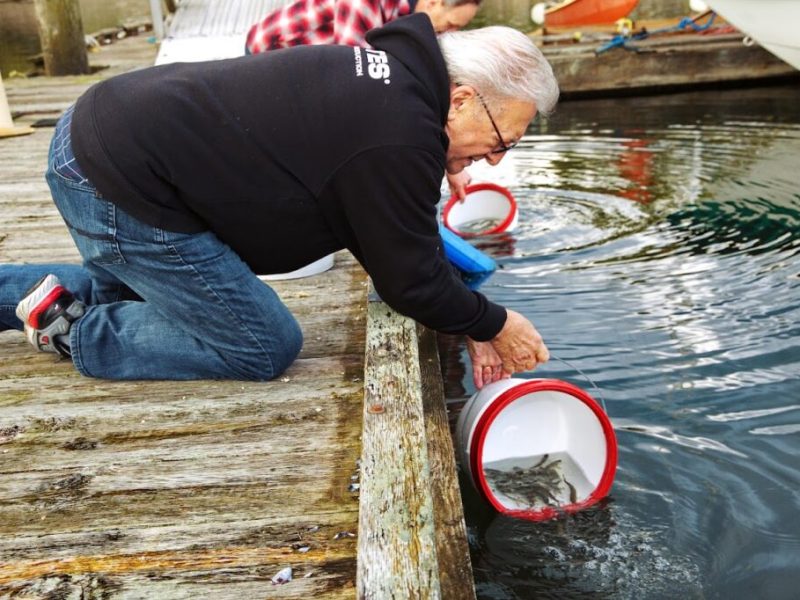
When Noons Creek Hatchery releases 6,000 coho salmon in the next couple of weeks, one third of them will be swimming with tracking devices called PIT (passive integrated transponder) tags under their skin.
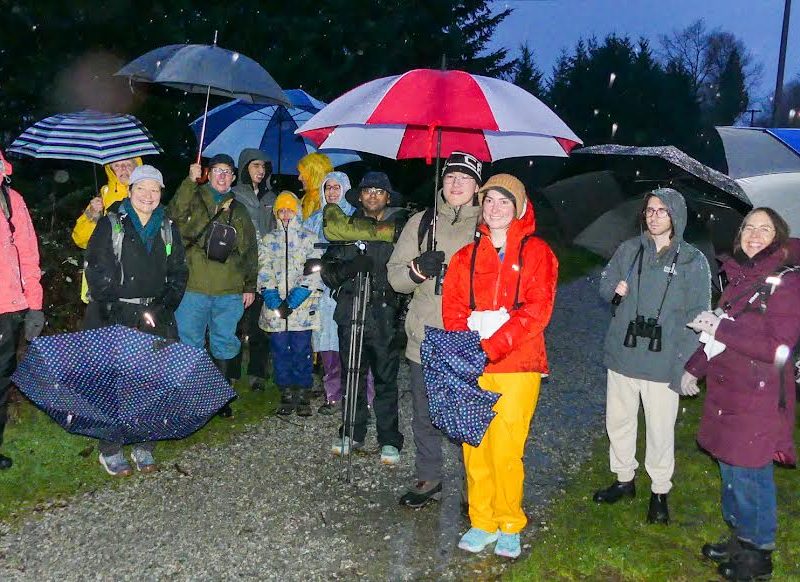
Last week, volunteers from both Noons Creek and Mossom Creek hatcheries, as well as Department of Fisheries and Oceans workers, got together to tag the cohort of salmon hatched in the fall of 2023.
“It’s almost kind of like a factory thing,” said Steve Townsend of PIT tagging, a volunteer with Noons Creek hatchery, “There’s five or six different jobs on each table.”
Local news that matters to you
No one covers the Tri-Cities like we do. But we need your help to keep our community journalism sustainable.
Each person had a job, from catching the fish with a net, anesthetizing, inserting PIT tags, measuring, weighing, checking the tag to ensure it works, and recording each salmon’s information. Townsend said it took less than 30 seconds per fish, and once they’re back in the water they recover in another 30 seconds.
The purpose? To get a better sense of survival rates of fish once they leave the hatcheries. Both Mossom and Noons Creeks Hatcheries are working with the Pacific Salmon Ecology and Conservation Laboratory on this project.
“We use this to answer lots of different questions in fisheries conservation, and this particular question is, ‘What’s the survival rate of these hatchery fish?’ said Scott Hinch, a UBC professor in applied conservation science and the principal investigator of the lab.
“Because when you release fish from a hatchery – or from the wild — unless you’re marking individuals, you don’t really know what your survival rates are.”
He said just because a fish doesn’t return to the same hatchery doesn’t necessarily mean it didn’t survive. It might have gone to another stream or never left the stream in the first place.
PIT tags are about the size of a large grain of rice and suitable for the juvenile salmon like this cohort at Noons Hatchery. They’re also “passive,” Hinch said, meaning they don’t have a battery and don’t transmit a radio signal until they pass through an electric field or electric current, which will cause it to emit a one time, 11-digit alphanumeric code.
“So when you put them inside a fish, you can identify that particular individual fish when it transmits its signal,” said Hinch. “They are now a really important tool for tracking the fate and movement of juvenile salmon.”
The lab has installed PIT tag readers at the mouths of both Noons Creek and Mossom Creek, so when the fish swims through it, “we know that fish is there somewhere in the creek.”
Salmon conservation
Understanding survival rates can help community hatcheries like Noons and Mossom answer questions about how to best handle fish or best release locations.
Having this information all helps with the broader goal of salmon conservation. Currently, Fisheries and Ocean Canada is going through a hatchery modernization program, with Hinch serving as part of the advisory panel. He said they’re trying to get the DFO to figure out the best science-based practices, hatchery by hatchery.
This is important for the broader environment. Salmon (while also having important cultural and economic values) are one of the only ways that marine nutrients get into fresh water systems and re-fertilize watersheds.
“Ecologically, you can’t understate how important they are,” Hinch said.