Port Moody prepares to enact overhaul of tree protection bylaw
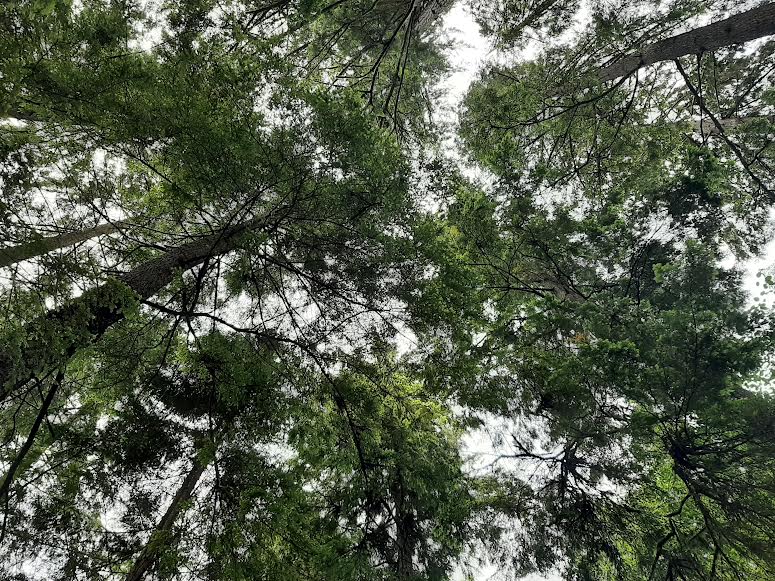
Port Moody is preparing to adopt a sweeping update to its tree protection bylaw, replacing the current legislation with a new set of rules aimed at preserving and expanding the city’s urban forest.
Council reviewed the proposed bylaw for the first time on Tuesday. The bylaw was presented by staff and consultants following three years of public engagement.
It marks a significant shift in how the city will regulate tree removals and incentivizes preservation.
Local news that matters to you
No one covers the Tri-Cities like we do. But we need your help to keep our community journalism sustainable.
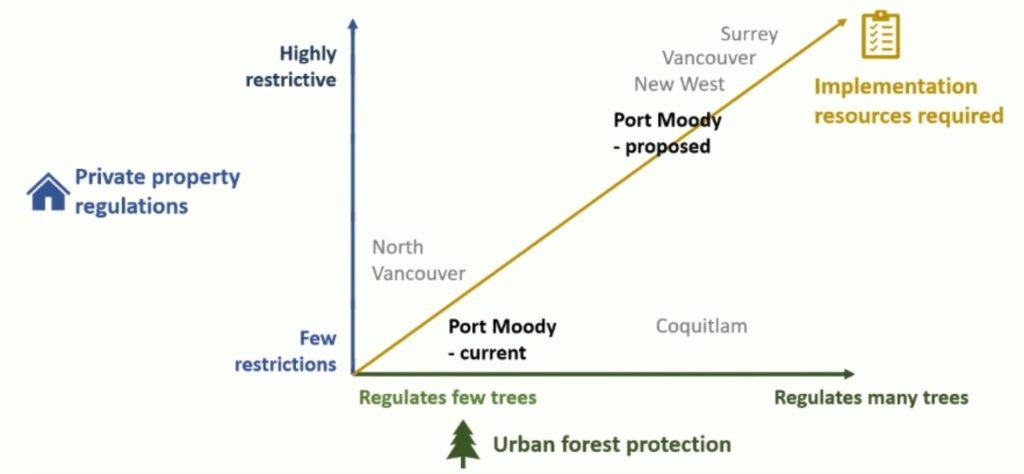
“With the proposed updates, Port Moody would be moving . . . towards much more regulation in terms of the proportion of your urban forest, and the number of restrictions,” said Camille Lefrançois, environmental planner with Diamond Head Consulting.
Port Moody currently has some of the best tree canopy coverage in Metro Vancouver, but it needs to triple tree replanting over the next 30 years to maintain that coverage, according to its Urban Forest Management Strategy.
Doing nothing would result in the loss of 124 acres of shaded area by 2050.
The revised bylaw is one of the key branches to support the city’s strategy, which was officially approved in September 2023.
One of the most significant changes is the shift in how replacement-tree requirements are calculated. Instead of the current two-to-one replacement ratio, the number of required plantings will now depend on the canopy size the trees reach at maturity.
In some instances, the ratio grows as high as four-to-one. This approach encourages property owners and developers to choose species that provide more environmental benefits over time, according to staff.
The new rules would apply not only to development sites and environmentally sensitive areas, but also to existing single-family homes, rental units, and strata properties.
This change means that most property owners in Port Moody will now need a permit to remove trees exceeding 30 centimetres in diameter, or 10 centimetres for certain slow-growing native species like Pacific dogwood and Arbutus.
If space on-site is limited, property owners can pay cash in lieu, allowing the city to plant trees elsewhere.
Mayor Meghan Lahti successfully introduced an amendment to cap the number of replacement trees required on properties which already have significant coverage.
Currently, the replacement ratio is capped on properties with 45 percent canopy coverage, but Lahti raised fairness concerns over properties shy of that threshold.
She said the city needs to have flexibility when assessing properties, as forcing replanting on already well-shaded lots could diminish the intention of the bylaw, as well as the health of the new trees.
“I don’t think we need to limit it to a percentage,” she said. “I think we need to look at the tree stand itself and determine if it’s the right place to plant trees.”
The bylaw also establishes a formal registry for landmark and legacy trees – those considered significant due to their size, age, cultural importance, or ecological value.
A new nomination and evaluation process will allow members of the public or city staff to recommend trees for protection, which would be inducted into the registry on an annual basis.
Once added, these trees cannot be removed or altered without council approval.
Coun. Amy Lubik praised the introduction of the registry, but raised concern over the length of time to register the significant trees with the city.
“That’s a long time to wait when we have a lot of developments potentially proposed for areas where we didn’t anticipate there to be density before,” she said.
Lubik successfully introduced an amendment to have staff expedite the registry process.
She said the city should try to streamline the process, at least for the first year, to build up its inventory of legacy trees.
Developers will face stricter requirements, including the obligation to prioritize tree retention by modifying site layouts when feasible.
They will also need to provide detailed arborist reports and post refundable security deposits to ensure retained trees are not damaged during construction. Landmark and legacy trees on construction sites, for instance, will require a deposit of $2,000 each.
Definitions of development would also be expanded under the bylaw to include applications for demolition, building permits, temporary use permits, and heritage alteration permits
The bylaw further introduces new financial incentives for existing homeowners, including lower permit fees and reduced security deposits. Removal permits will cost $75, and deposits for replacement trees are being cut in half – from $740 to $370.
Hazardous tree removals will not require a permit fee, though a certified arborist must still confirm the risk. The city will also require new reports if there is a concern that removal could adversely affect surrounding ecosystems or infrastructure.
Lahti said she appreciated the change in fee structure, as residents have frequently complained about permits being too expensive.
Alongside new protections, the City is also updating its enforcement approach. The list of fineable offences has been expanded, and a new $100 fine will be issued to anyone who fails to post a tree removal permit at the site before removal takes place.
Several councillors also raised concerns over the limited fines the city is able to impose for infractions, the highest being at $1,000 per tree under provincial laws.
Coun. Callan Morrison suggested large builders would likely eat the relatively small penalties as a cost of doing business.
He said council should be advocating to the province for higher fines as disincentive rule breakers, especially considering how the value of property has grown in B.C.
Lefrançois, noted that in some instances, multiple fines could be applied, and in severe cases, the city could also take rule breakers to provincial court for long-form prosecutions – a specific process for serious bylaw violations.
Morrison also introduced an amendment to seek clarification from the province over tree planting, tree retention and minimum tree canopy requirements under new provincial housing legislation.
He said the province needs to establish if the city’s tree requirements measure in relation to the province’s density mandates.
“Our priority is to protect trees as well as provide responsible development and growth within these areas that they’ve designated upon us,” he said. “If we’re not able to do it all, what are we doing?”
Coun. Haven Lurbiecki said tree retention is going to be very difficult if council continues to approve extremely tall, large and dense developments.
“We can have all the bylaws in the world,” she said. “At the end of the day, the type of development that council is willing to approve will dictate what tree retention can occur.”
If approved, the new bylaw would come into effect immediately. A legal review is currently underway, and the city will also prepare amendments to its fees and ticketing bylaws to reflect the changes.
The city anticipates a surge in permit requests and public inquiries, and additional arborist and administrative resources have already been budgeted to support implementation. Staff will monitor workloads and report back on any potential long-term staffing needs.
Author