Local breweries face uncertainty amid U.S.-Canada trade war
Some are sourcing cans from Asia and hops from Australia, New Zealand
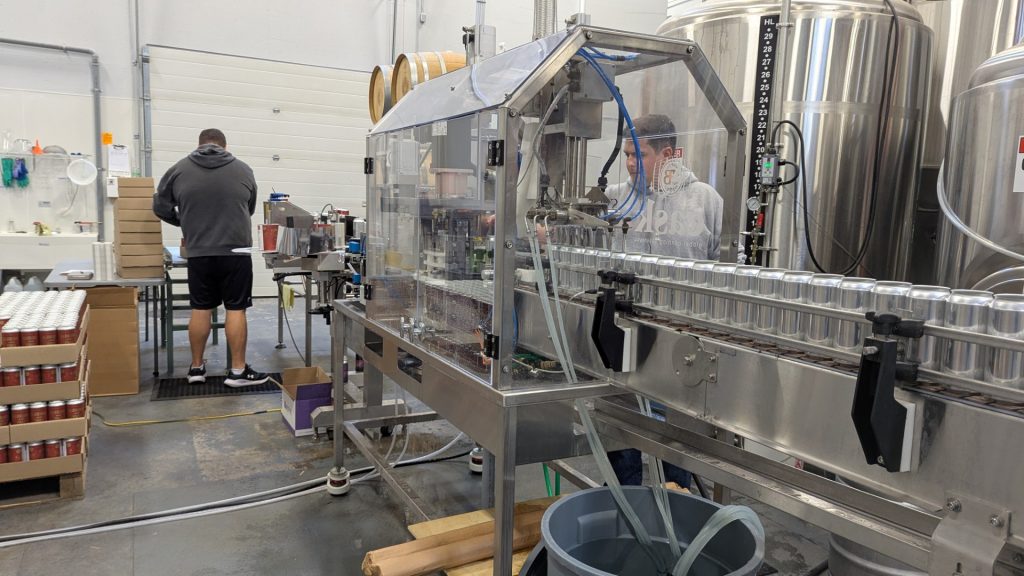
Aluminum cans and hops have become a source of uncertainty for local brewers.
Aluminum has already been slapped with U.S. and Canadian retaliatory tariffs, and Canada has included hops on its list of items slated to be hit with retaliatory tariffs if the U.S goes ahead with its promised April 2 tariff threats.
“People are figuring it out in real time,” said Ken Beattie, the executive director of the BC Craft Brewers Guild.
Local news that matters to you
No one covers the Tri-Cities like we do. But we need your help to keep our community journalism sustainable.
On March 12, the U.S. imposed 25 percent tariffs on all Canadian steel and aluminum products, to which the Canadian government followed with 25 percent retaliatory tariffs on $3 billion worth of products including steel and aluminum. This includes the aluminum beer cans.
The aluminum brewers are purchasing could be hit with a double tariff that could account for a 50 percent increase in price, said Beattie.
“Everyone’s scrambling now, because they’re looking for alternatives to avoid that,” he said.
COVID impacts
This comes at a time when the craft beer industry has yet to recover from the pandemic.
Post-COVID inflation, Russia’s invasion of Ukraine affecting grain crops, and an aluminum shortage have all driven up costs, said Beattie. From 2020 to 2023, costs went up by 32 percent on average, he added.
But because craft beer is made from high priced ingredients (and brewers don’t have economies of scale like big companies) it’s already at a high price point, meaning they haven’t been able to increase their prices to reflect the higher costs.
“The margin on cans is so tight that any increase really, really hurts it,” said Michael Kirkland, the head brewer at Port Coquitlam’s Northpaw Brew Co.
Aluminum can suppliers who once used American manufacturers are looking to pivot elsewhere. Phil Smith, the co-owner of Tinhouse Brewing, another brewery in PoCo, said their supplier has switched from using a U.S-based manufacturer to companies based in Malaysia and China.
Hops might go up too
The majority of hops that Canadian brewers use are imported from the U.S. If the U.S. imposes tariffs on Canada on April 2, hops are on the list of items set to be slapped with a 25 percent retaliatory tariff.
While Hops Connect, a Vancouver-based hops supplier, has been stockpiling the plant since it learned about the tariffs, Beattie said it’s hard to know when their supply might run out.
“The challenge is the unpredictability and the chaos of this whole situation, because we honestly don’t know what will happen virtually hour to hour with the [U.S.] president. He changes his mind a lot,” said Beattie.
Kirkland of Northpaw Brew said that they’re feeling nervous about buying American hops given that it “could dry up.”
“But we were also looking to switch away from buying anything American, for the same reason everyone else is,” Kirkland said.
They have recently started using hops from New Zealand and Australia for their IPA.
B.C.’s response to tarrifs
On March 10, B.C. directed the BC Liquor Distribution Branch (LDB) to remove all American beer, wine, spirits and refreshment beverages from BC Liquor Store shelves, in response to U.S. threats.
Beattie said this would have big impacts for alcoholic products like wine, but “virtually no effect” for craft beer, since there’s not a big market for American craft beer.
He also added that a few large beer brands remain on shelves — despite having foreign ownership — because they are produced in B.C.
“Local for us is independently owned and operated B.C. breweries, where the money all stays in Canada, stays in B.C.,” Beattie said.
But Smith of Tinhouse Brewing noted that since the LDB has taken U.S. products off their shelves, “they seem to want to put more B.C. product on the shelf.” Tinhouse Brewing is applying to see if they can get a couple of their beers permanently listed in B.C. liquor stores.

Advocating for reduced markups
For the past year, Beattie has been advocating for the LDB to lower the markup on B.C. beer, which he says isn’t fair to small breweries.
Every litre of beer brewed in B.C. is taxed at different tiers depending on how much beer a company makes. The lowest tier is 15,000 hectolitres at 40 cents a litre, the highest is 350,000 hectolitres at $1.08 a litre.
Beattie said they are asking the provincial government to bring the lowest tier down to 2,000 hectolitres and to 10 cents a litre, which he said could save small breweries tens of thousands of dollars per year.
The majority of brewers he represents don’t meet the bottom end requirements, brewing far less than 15,000 hectolitres per year, yet they still pay as if they do.
“The costs have gotten too high, and their margin has shrunk,” he said.
Large companies that brew well above the top tier don’t pay more. “As they grow, they don’t get charged any more tax because they’ve maxed out.”
In a media backgrounder sent to The Dispatch, the LDB stated that this tax is: “an essential source of government revenue” that contributed just over $1 billion to the government in 2023 and 2024.
Buy Canadian
Meanwhile, both Smith and Kirkland are making Canadian inspired beer.
Last week, Tinhouse released a beer called the Glorious and Free IPA, made with100 percent Canadian ingredients (the recipe comes from an Ottawa based brewery), and are donating proceeds from every beer sold to the Gord Downie & Chanie Wenjack Fund.
Northpaw also has a distinctly Canadian pilsner in the works.
“And I know a lot of local breweries are doing similar kind of things” said Kirkland. “Wanting to definitely show that we’re Canadian.”
Related Articles
Tickets selling fast for Search for the Perfect Pint event in Port Moody
Event held at Port Moody City Hall on May 5